

Vol. 14. Núm. 28.
Páginas 1629-1642 (Marzo 2025)

Actualización
Monocitos, macrófagos y células dendríticas en homeostasis y patología

Monocytes, macrophages, and dendritic cells in homeostasis and pathology

Á. Domínguez-SotoaÁ.L. CorbíaA. MirandabcR. Sánchez MartínbM. Álvarez-MonbcdeJ. Monserrat Sanzbce
Doi : https://10.1016/j.med.2025.03.010
Opciones
Resumen

Los monocitos, los macrófagos y las células dendríticas son células inmunitarias que desempeñan funciones esenciales en la defensa del cuerpo contra patógenos, siendo caracterizadas en común como células presentadoras de antígeno profesionales (APC). Adicionalmente, los macrófagos inician la inflamación, destruyen patógenos y son los encargados del mantenimiento de la homeostasis tisular, adaptándose dinámicamente a diversas señales del microambiente. Por otro lado, las células dendríticas representan el nexo de unión entre la inmunidad innata y la inmunidad adaptativa.

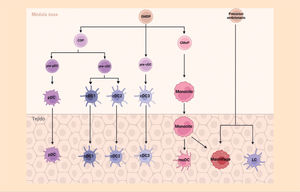
En esta breve revisión se estudiarán los monocitos, los macrófagos y las células dendríticas pertenecientes al sistema inmunitario, atendiendo a su origen y homeostasis, su nomenclatura y clasificación, su fisiología y los mecanismos por los cuales ejercen sus funciones, así como su contribución a la patogénesis de diversas enfermedades.

Los avances en la caracterización básica de los monocitos, macrófagos y células dendríticas han permitido su mejor comprensión como actores principales en la inmunidad y en la progresión de patologías inflamatorias, el cáncer, la obesidad, la fibrosis o las enfermedades autoinmunes. Las estrategias para modificar su polarización o modular su actividad ofrecen nuevas oportunidades terapéuticas para el tratamiento de estas patologías.

Palabras clave
Monocitos
Macrófagos
Células dendríticas
Inmunoterapia
Abstract

Monocytes, macrophages, and dendritic cells are immune cells that play essential roles in the body's defense against pathogens. They are commonly characterized as professional antigen-presenting cells (APCs). Additionally, macrophages initiate inflammation, destroy pathogens, and are responsible for maintaining tissue homeostasis, adapting dynamically to various signals from the microenvironment. On the other hand, dendritic cells represent the nexus between innate and adaptive immunity.

In this brief review, monocytes, macrophages, and dendritic cells belonging to the immune system will be studied in regard to their origin and homeostasis, nomenclature and classification, physiology, mechanisms by which they perform their functions, and their contribution to the pathogenesis of various diseases.

Advances in the basic characterization of monocytes, macrophages, and dendritic cells have allowed for understanding them better as major factors in immunity and the progression of inflammatory diseases, cancer, obesity, fibrosis, or autoimmune diseases. Strategies to modify their polarization or modulate their activity offer new therapeutic opportunities for the treatment of these diseases.

Keywords
Monocytes
Macrophages
Dendritic cells
Immunotherapy

Identifíquese

¿Aún no es suscriptor de la revista?
Comprar el acceso al artículo

Comprando el artículo el pdf del mismo podrá ser descargado

Teléfono para incidencias

De lunes a viernes de 9h a 18h (GMT+1) excepto los meses de julio y agosto que será de 9 a 15h
Llamadas desde España 932 415 960
Llamadas desde fuera de España +34 932 415 960
Bibliografía
[1]
N. Pishesha
202504020510360278
, T.J. Harmand, H.L. Ploegh.
A guide to antigen processing and presentation.
Nat Rev Immunol. 2022 22:12 [Internet]., (2022), 22 pp. 751-764
[2]
A.G. Doyle, G. Herbein, L.J. Montaner, A.J. Minty, D. Caput, P. Ferrara, et al.
Interleukin-13 alters the activation state of murine macrophages in vitro: comparison with interleukin-4 and interferon-gamma.
Eur J Immunol [Internet]., (1994), 24 pp. 1441-1445
[3]
M.H. Sieweke, J.E. Allen.
Beyond stem cells: self-renewal of differentiated macrophages.
Science [Internet]., (2013), 342
[4]
C. Blériot, S. Chakarov, F. Ginhoux.
Determinants of Resident Tissue Macrophage Identity and Function.
Immunity [Internet]., (2020), 52 pp. 957-970
[5]
M. Guilliams, G.R. Thierry, J. Bonnardel, M. Bajenoff.
Establishment and Maintenance of the Macrophage Niche.
Immunity [Internet]., (2020), 52 pp. 434-451
[6]
D.M. Mosser
202504020510360279
, J.P. Edwards.
Exploring the full spectrum of macrophage activation.
Nat Rev Immunol [Internet]., (2008), 8 pp. 958-969
[7]
J.L. Schultze.
Reprogramming of macrophages--new opportunities for therapeutic targeting.
Curr Opin Pharmacol [Internet]., (2016), 26 pp. 10-15
[8]
J. Hettinger, D.M. Richards, J. Hansson, M.M. Barra, A.C. Joschko, J. Krijgsveld, et al.
Origin of monocytes and macrophages in a committed progenitor.
Nat Immunol [Internet]., (2013), 14 pp. 821-830
[9]
S. Yona, K.W. Kim, Y. Wolf, A. Mildner, D. Varol, M. Breker, et al.
Fate mapping reveals origins and dynamics of monocytes and tissue macrophages under homeostasis.
Immunity [Internet]., (2013), 38 pp. 79-91
[10]
P. Italiani
2025040205103602710
, D. Boraschi.
From monocytes to M1/M2 macrophages: Phenotypical vs. functional differentiation.
Front Immunol [Internet]., (2014), 5
[11]
S. He, W. Song, S. Cui, J. Li, Y. Jiang, X. Chen, et al.
Modulation of miR-146b by N6-methyladenosine modification remodels tumor-associated macrophages and enhances anti-PD-1 therapy in colorectal cancer.
Cellular oncology (Dordrecht, Netherlands) [Internet]., (2023), 46 pp. 1731-1746
[12]
S. Wallner, C. Schröder, E. Leitão, T. Berulava, C. Haak, D. Beißer, et al.
Epigenetic dynamics of monocyte-to-macrophage differentiation.
Epigenetics Chromatin [Internet]., (2016), 9
[13]
L. Ziegler-Heitbrock.
The CD14+ CD16+ blood monocytes: their role in infection and inflammation.
J Leukoc Biol [Internet]., (2007), 81 pp. 584-592
[14]
C. Jakubzick, E.L. Gautier, S.L. Gibbings, D.K. Sojka, A. Schlitzer, T.E. Johnson, et al.
Minimal differentiation of classical monocytes as they survey steady-state tissues and transport antigen to lymph nodes.
Immunity [Internet]., (2013), 39 pp. 599-610
[15]
C. Dong, G. Zhao, M. Zhong, Y. Yue, L. Wu, S. Xiong.
RNA sequencing and transcriptomal analysis of human monocyte to macrophage differentiation.
Gene [Internet]., (2013), 519 pp. 279-287
[16]
F.O. Martínez, A. Sica, A. Mantovani, M. Locati.
Macrophage activation and polarization.
Front Biosci [Internet]., (2008), 13 pp. 453-461
[17]
T. Lawrence, G. Natoli.
Transcriptional regulation of macrophage polarization: enabling diversity with identity.
Nat Rev Immunol 2011 [Internet]., (2011), 11 pp. 750-761
[18]
S.K. Biswas, A. Mantovani.
Orchestration of metabolism by macrophages.
Cell Metab [Internet]., (2012), 15 pp. 432-437
[19]
F. Ginhoux, S. Jung.
Monocytes and macrophages: developmental pathways and tissue homeostasis.
Nat Rev Immunol [Internet]., (2014), 14 pp. 392-404
[20]
M. Locati
2025040205103602711
, G. Curtale, A. Mantovani.
Diversity, mechanisms, and significance of macrophage plasticity.
Annu Rev Pathol [Internet]., (2020), 15 pp. 123-147
[21]
M.G. Netea, L.A.B. Joosten, E. Latz, K.H.G. Mills, G. Natoli, H.G. Stunnenberg, et al.
Trained immunity: a program of innate immune memory in health and disease.
Science [Internet]., (2016), 352 pp. aaf1098
[22]
E. Kaufmann, J. Sanz, J.L. Dunn, N. Khan, L.E. Mendonça, A. Pacis, et al.
BCG educates hematopoietic stem cells to generate protective innate immunity against tuberculosis.
Cell [Internet]., (2018), 172
[23]
I. Mitroulis, K. Ruppova, B. Wang, L.S. Chen, M. Grzybek, T. Grinenko, et al.
Modulation of myelopoiesis progenitors is an integral component of trained immunity.
Cell [Internet]., (2018), 172
[24]
Y. Lavin, D. Winter, R. Blecher-Gonen, E. David, H. Keren-Shaul, M. Merad, et al.
Tissue-resident macrophage enhancer landscapes are shaped by the local microenvironment.
Cell [Internet]., (2014), 159 pp. 1312-1326
[25]
A. Kusnadi, S.H. Park, R. Yuan, T. Pannellini, E. Giannopoulou, D. Oliver, et al.
The cytokine tnf promotes transcription factor SREBP activity and binding to inflammatory genes to activate macrophages and limit tissue repair.
Immunity [Internet]., (2019), 51
[26]
A. Mantovani
2025040205103602712
, S.K. Biswas, M.R. Galdiero, A. Sica, M. Locati.
Macrophage plasticity and polarization in tissue repair and remodelling.
J Pathol [Internet]., (2013), 229 pp. 176-185
[27]
J.L. Schultze, S.V. Schmidt.
Molecular features of macrophage activation.
Semin Immunol., (2015), 27 pp. 416-423
[28]
T.A. Wynn, T.R. Ramalingam.
Mechanisms of fibrosis: therapeutic translation for fibrotic disease.
Nat Med [Internet]., (2012), 18 pp. 1028-1040
[29]
C.N. Lumeng, J.L. Bodzin, A.R. Saltiel.
Obesity induces a phenotypic switch in adipose tissue macrophage polarization.
J Clin Invest [Internet]., (2007), 117 pp. 175-184
[30]
T.A. Wynn, K.M. Vannella.
Macrophages in tissue repair, regeneration, and fibrosis.
Immunity [Internet]., (2016), 44 pp. 450-462
[31]
B. Ruffell, N.I. Affara, L.M. Coussens.
Differential macrophage programming in the tumor microenvironment.
Trends Immunol [Internet]., (2012), 33 pp. 119-126
[32]
A. Ghebremedhin
2025040205103602713
, D. Athavale, Y. Zhang, X. Yao, C. Balch, S. Song.
Tumor-associated macrophages as major immunosuppressive cells in the tumor microenvironment.
Cancers (Basel) [Internet]., (2024), 16
[33]
Y. Li, X. Zhang, X. Zeng, S. Wang, H. Wang.
Tumor-associated macrophages: Therapeutic targets of cancer.
Macrophage targeted delivery systems. Basic concepts and therapeutic applications [Internet], Springer, pp. 279-315 http://dx.doi.org/10.1007/978-3-030-84164-5_13
[34]
H. Chen, Z. Han, Y. Ma, Q. Meng.
Advances in macrophage-derived exosomes as immunomodulators in disease progression and therapy.
Int Immunopharmacol., (2024), 142 pp. 113248
[35]
A. Sica, A. Mantovani.
Macrophage plasticity and polarization: in vivo veritas.
J Clin Invest [Internet]., (2012), 122 pp. 787-795
[36]
M. Donadon, G. Torzilli, N. Cortese, C. Soldani, L. Di Tommaso, B. Franceschini, et al.
Macrophage morphology correlates with single-cell diversity and prognosis in colorectal liver metastasis.
J Exp Med [Internet]., (2020), 217
[37]
G. Dunsmore
2025040205103602714
, W. Guo, Z. Li, D.A. Bejarano, R. Pai, K. Yang, et al.
Timing and location dictate monocyte fate and their transition to tumor-associated macrophages.
Sci Immunol [Internet]., (2024), 9
[38]
A. Doring, V.W. Yong.
The good, the bad and the ugly. Macrophages/microglia with a focus on myelin repair.
Front Biosci (Schol Ed)., (2011), 3 pp. 846-856
[39]
C. Zhao, K. Dahlman-Wright, X. Liver.
receptor in cholesterol metabolism.
J Endocrinol [Internet]., (2010), 204 pp. 233-240
[40]
F. Tacke, H.W. Zimmermann.
Macrophage heterogeneity in liver injury and fibrosis.
J Hepatol., (2014), 60 pp. 1090-1096
[41]
C.V. Jakubzick
2025040205103602715
, G.J. Randolph, P.M. Henson.
Monocyte differentiation and antigen-presenting functions.
Nat Rev Immunol [Internet]., (2017), 17 pp. 349-362
[42]
B.T. Rouse, S. Sehrawat.
Immunity and immunopathology to viruses: what decides the outcome?.
Nat Rev Immunol [Internet]., (2010), 10 pp. 514-526
[43]
J. Joseph, W. Daley, D. Lawrence, E. Lorenzo, P. Perrin, V.R. Rao, et al.
Role of macrophages in HIV pathogenesis and cure: NIH perspectives.
Journal of Leukocyte Biology, (2022), 112 pp. 1233-1243
[44]
L.I. Labzin, K.Y. Chew, K. Eschke, X. Wang, T. Esposito, C.J. Stocks, et al.
Macrophage ACE2 is necessary for SARS-CoV-2 replication and subsequent cytokine responses that restrict continued virion release.
Sci Signal [Internet]., (2023), 16
[45]
Y. Tang, J. Liu, D. Zhang, Z. Xu, J. Ji, C. Wen.
Cytokine storm in COVID-19: The current evidence and treatment strategies.
Front Immunol [Internet]., (2020), 11
[46]
D. Wendisch, O. Dietrich, T. Mari, S. von Stillfried, I.L. Ibarra, M. Mittermaier, et al.
SARS-CoV-2 infection triggers profibrotic macrophage responses and lung fibrosis.
Cell [Internet]., (2021), 184
[47]
M. Simón-Fuentes, I. Ríos, C. Herrero, F. Lasala, N. Labiod, J. Luczkowiak, et al.
MAFB shapes human monocyte-derived macrophage response to SARS-CoV-2 and controls severe COVID-19 biomarker expression.
JCI Insight [Internet]., (2023), 8
[48]
L. Han, M.W. Zhuang, J. Deng, Y. Zheng, J. Zhang, M.L. Nan, et al.
SARS-CoV-2 ORF9b antagonizes type I and III interferons by targeting multiple components of the RIG-I/MDA-5-MAVS, TLR3-TRIF, and cGAS-STING signaling pathways.
J Med Virol [Internet]., (2021), 93 pp. 5376-5389
[49]
K.M. Vannella
2025040205103602716
, T.A. Wynn.
Mechanisms of organ injury and repair by macrophages.
Annu Rev Physiol [Internet]., (2017), 79 pp. 593-617
[50]
F. Feng, J. Shen, Q. Qi, Y. Zhang, S. Ni.
Empowering brain tumor management: chimeric antigen receptor macrophage therapy.
Theranostics [Internet]., (2024), 14 pp. 5725-5742
[51]
S. Balan, M. Saxena, N. Bhardwaj.
Dendritic cell subsets and locations.
Int Rev Cell Mol Biol [Internet]., (2019), 348 pp. 1-68
[52]
T.L. Murphy, G.E. Grajales-Reyes, X. Wu, R. Tussiwand, C.G. Briseño, A. Iwata, et al.
Transcriptional control of dendritic cell development.
Annu Rev Immunol [Internet]., (2016), 34 pp. 93-119
[53]
A.C. Villani, R. Satija, G. Reynolds, S. Sarkizova, K. Shekhar, J. Fletcher, et al.
Single-cell RNA-seq reveals new types of human blood dendritic cells, monocytes, and progenitors.
Science., (2017), 356 pp. eaah4573
[54]
E. Segura.
Human dendritic cell subsets: An updated view of their ontogeny and functional specialization.
Eur J Immunol [Internet]., (2022), 52 pp. 1759
[55]
N.M. Adams, A. Das, T.J. Yun, B. Reizis.
Ontogeny and function of plasmacytoid dendritic cells.
Annu Rev Immunol [Internet]., (2024), 42 pp. 347-73
[56]
Y. Wang
2025040205103602717
, K.J. Szretter, W. Vermi, S. Gilfillan, C. Rossini, M. Cella, et al.
IL-34 is a tissue-restricted ligand of CSF1R required for the development of Langerhans cells and microglia.
Nat Immunol [Internet]., (2012), 13 pp. 753-760
[57]
T. Doebel, B. Voisin, K. Nagao.
Langerhans cells - the macrophage in dendritic cell clothing.
Trends Immunol [Internet]., (2017), 38 pp. 817-828
[58]
M. Neagu, C. Constantin, G. Jugulete, V. Cauni, S. Dubrac, A.G. Szöllősi, et al.
Langerhans cells—revising their role in skin pathologies.
J Pers Med., (2022), 12 pp. 2072
[59]
A. Rigamonti, J. Villar, E. Segura.
Monocyte differentiation within tissues: a renewed outlook.
Trends Immunol., (2023), 44 pp. 999-1013
[60]
W. Xu, X. Zhao, M.R. Daha, C. van Kooten.
Reversible differentiation of pro- and anti-inflammatory macrophages.
Mol Immunol [Internet]., (2013), 53 pp. 179-186
[61]
T. Worbs, S.I. Hammerschmidt, R. Förster.
Dendritic cell migration in health and disease.
Nature Reviews Immunology 2016 17:1 [Internet], (2016 Nov 28), 17 pp. 30-48
[62]
P. Bousso.
T-cell activation by dendritic cells in the lymph node: lessons from the movies.
Nature Reviews Immunology 2008 8:9 [Internet], (2008), 8 pp. 675-684
[63]
W.R. Heath, Y. Kato, T.M. Steiner, I. Caminschi.
Antigen presentation by dendritic cells for B cell activation.
Curr Opin Immunol [Internet]., (2019), 58 pp. 44-52
[64]
F. Granucci, I. Zanoni, N. Pavelka, S.L.H. Van Dommelen, C.E. Andoniou, F. Belardelli, et al.
A contribution of mouse dendritic cell-derived IL-2 for NK cell activation.
J Exp Med [Internet]., (2004), 200 pp. 287-295
[65]
J.S.A. Perry, C.W.J. Lio, A.L. Kau, K. Nutsch, Z. Yang, J.I. Gordon, et al.
Distinct contributions of Aire and antigen-presenting-cell subsets to the generation of self-tolerance in the thymus.
Immunity [Internet]., (2014), 41 pp. 414-426
[66]
C. Kurts, M. Cannarile, I. Klebba, T. Brocker.
Dendritic cells are sufficient to cross-present self-antigens to CD8 T cells in vivo.
J Immunol [Internet]., (2001 Feb 1), 166 pp. 1439-1442
[67]
V. Koucký
2025040205103602718
, J. Bouček, A. Fialová.
Immunology of plasmacytoid dendritic cells in solid tumors: A brief review.
Cancers [Internet]., (2019), 11 pp. 470
[68]
Z. Han, Y. Dong, J. Lu, F. Yang, Y. Zheng, H. Yang.
Role of hypoxia in inhibiting dendritic cells by VEGF signaling in tumor microenvironments: mechanism and application.
Am J Cancer Res [Internet]., (2021), 11 pp. 3777
[69]
S. Ding, N. Qiao, Q. Zhu, Y. Tong, S. Wang, X. Chen, et al.
Single-cell atlas reveals a distinct immune profile fostered by T cell-B cell crosstalk in triple negative breast cancer.
Cancer Commun., (2023), 43 pp. 661-684
[70]
M. Kudo.
Combination immunotherapy with anti-VEGF/TKI for hepatocellular carcinoma: present and future perspective.
Hepatobiliary Surg Nutr [Internet]., (2021), 10 pp. 24145-24245
[71]
C. Rolfo, E. Giovannetti, P. Martinez, S. McCue, A. Naing.
Applications and clinical trial landscape using Toll-like receptor agonists to reduce the toll of cancer.
NPJ Precis Oncol [Internet]., (2023), 7 pp. 26
[72]
C.S. Garris, S.P. Arlauckas, R.H. Kohler, M.P. Trefny, S. Garren, C. Piot, et al.
Successful anti-PD-1 cancer immunotherapy requires T cell-dendritic cell crosstalk involving the cytokines IFN-γ and IL-12.
Immunity., (2018 18), 49
[73]
K.F. Bol, G. Schreibelt, K. Rabold, S.K. Wculek, J.K. Schwarze, A. Dzionek, et al.
The clinical application of cancer immunotherapy based on naturally circulating dendritic cells.
J Immunother Cancer [Internet]., (2019), 7
[74]
G. Di Lorenzo, M. Ferro, C. Buonerba.
Sipuleucel-T (Provenge®) for castration-resistant prostate cancer.
BJU Int [Internet]., (2012), 110