
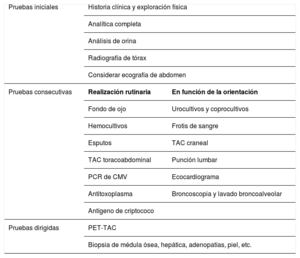

Con la terapia antirretrovírica, la incidencia de las infecciones oportunistas ha descendido, no obstante, la fiebre en el paciente con infección por el VIH es un síntoma frecuente. Debe realizarse un estudio completo (anamnesis y exploración física) y pruebas complementarias que pueden ser de gran utilidad como: hemocultivos, pruebas de imagen como la TAC toracoabdominal o PET-TAC y biopsias de médula ósea, hepática o de ganglio. Las infecciones son la causa más frecuente (80%) de fiebre de origen desconocido, entre ellas la tuberculosis es la más frecuente. Otras causas frecuentes son: Mycobacterium avium complex, Leishmania (sobre todo en el área mediterránea), toxoplasmosis, citomegalovirus, Pneumocystis jiroveci, criptococo e histoplasmosis (en áreas con alta prevalencia). Otras causas posibles de fiebre pueden ser debidas a neoplasia como el linfoma, el síndrome de reconstitución inmune y la fiebre asociada a fármacos.
With antirretroviral therapy, the incidence of opportunistic infections has decreased; nevertheless, fever in HIV-infected patients is a common symptom. A complete study should be made (history and physical examination) and complementary tests can be very useful: blood cultures, imaging tests such as thoracoabdominal CT or PET-CT, and bone marrow, hepatic or lymph biopsies. Infections are the most frequent cause (80%) of fever of unknown origin, and tuberculosis is the most common. Other common causes are: Mycobacterium avium complex, Leishmania (especially in the Mediterranean area), toxoplasmosis, cytomegalovirus, Pneumocystis jiroveci, cryptococcus and histoplasmosis (in areas of high prevalence). Other possible causes of fever can be due to neoplasias such as lymphoma, immune reconstitution inflammatory syndrome and drug-associated fever.
Identifíquese
¿Aún no es suscriptor de la revista?

Comprar el acceso al artículo
Comprando el artículo el pdf del mismo podrá ser descargado
Teléfono para incidencias
De lunes a viernes de 9h a 18h (GMT+1) excepto los meses de julio y agosto que será de 9 a 15h
