
Vol. 12. Núm. 21.
Páginas 1213-1223 (Noviembre 2016)

Actualización
Síndromes mieloproliferativos

Myeloproliferative syndromes

O.J. FerréF. Sánchez-Guijo
Doi : https://10.1016/j.med.2016.10.012
Opciones
Resumen
Introducción

Los síndromes mieloproliferativos crónicos (SMP) son un conjunto de entidades de curso inicialmente crónico que se caracteriza por la proliferación de una o más líneas celulares mieloides (hematíes, células granulomonocíticas y/o plaquetas), como consecuencia de una alteración clonal que afecta a la célula stem hematopoyética.

Clasificación

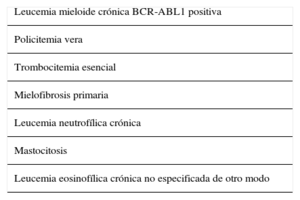
Actualmente se clasifican según los criterios de la OMS, aunque las entidades clásicas de este grupo de enfermedades son la leucemia mieloide crónica (LMC), la policitemia vera, la trombocitemia esencial y la mielofibrosis primaria.

Manifestaciones clínicas

Son secundarias a la proliferación celular, siendo los síntomas constitucionales, el síndrome anémico, las infecciones, los eventos hemorrágicos (y trombóticos) y las manifestaciones relacionadas con la esplenomegalia (que es frecuente en estas entidades) las más comunes.

Tratamiento

Salvo en el caso de la LMC cuyo tratamiento estándar son los inhibidores de tirosina cinasa (ITK), en el resto de los SMP el tratamiento se basa en la citorreducción y el control de los síntomas. En alguna de estas entidades, como en la mielofibrosis primaria, se están utilizando inhibidores de JAK. En todo caso, el único tratamiento curativo en estas entidades sigue siendo el alotrasplante hematopoyético del que pueden beneficiarse solo una pequeña parte de estos pacientes.

Palabras clave
Síndromes mieloproliferativos
Leucemia mieloide crónica
Policitemia vera
Trombocitemia esencial
Mielofibrosis primaria
Abstract
Introduction

Myeloproliferative diseases (MPD) are a set of entities with an initially chronic course, characterized by the proliferation of one or more myeloid cell lineages (red blood cells, granulocytes and / or platelets) as a result of a clonal alteration of the hematopoietic stem cell.

Classification

MPD are currently classified according to the WHO criteria, although the four classic entities included in this group of diseases were chronic myeloid leukemia (CML), polycythemia vera, essential thrombocythemia and primary myelofibrosis.

Clinical manifestations

Most signs and symptoms of CMPD are secondary to cell proliferation. The most common are constitutional symptoms, anemia, infections, bleeding (and thrombotic) events, and symptoms related to splenomegaly (which is common in these entities)

Treatment

Except in CML, where tyrosine kinase inhibitors (TKI) are the standard treatment, in the remaining MPD the treatment is based on cyto-reduction and control of symptoms. In some of these entities, as in primary myelofibrosis, JAK inhibitors are being used. In any case allogeneic hematopoietic stem cell transplantation remains the only curative treatment, although only a small portion of these patients can benefit from this procedure.

Keywords
Myeloproliferative diseases
Chronic myeloid leukemia
Polycythemia vera
Essential thrombocythemia
Primary myelofibrosis

Identifíquese

¿Aún no es suscriptor de la revista?

Comprar el acceso al artículo

Comprando el artículo el pdf del mismo podrá ser descargado

Teléfono para incidencias

De lunes a viernes de 9h a 18h (GMT+1) excepto los meses de julio y agosto que será de 9 a 15h

Llamadas desde España 932 415 960
Llamadas desde fuera de España +34 932 415 960
Bibliografía
[1]
J.F. San Miguel, F. Sánchez-Guijo, Hematología:.
Manual básico razonado.
4ª ed., Elsevier, (2015),
[2]
W. Dameshek.
Some speculations on the myeloproliferative syndromes.
Blood, (1951), 6 pp. 372-375
[3]
A. Tefferi.
The history of myeloproliferative disorders: before and after Dameshek.
Leukemia, (2008), 22 pp. 3-13
[4]
A.M. Vannucchi, P. Guglielmelli, A. Tefferi.
Advances in understanding and management of myeloproliferative neoplasms.
CA Cancer J Clin., (2009), 59 pp. 171-191
[5]
E.S.H.N. Jaffe, H. Stein, J.W. Vardiman.
World Health Organization Classification of Tumors: Tumours of the Haematopoietic and Lymphoid Tissues.
International Agency for Research on Cancer (IARC), (2001),
[6]
201611010014123378
S.H. Swerdlow, E. Campo, N. Lee Harris, E. Jaffe, S. Pileri, H. Stein, et al.
WHO classification of tumours of haematopoietic and lymphoid tissues.
4th ed., IARC, (2008),
[7]
201611010014123379
S. Osorio, L.F. Casado, P. Giraldo, B. Maestro, M. Andrade, S. Redondo, et al.
Chronic myeloid leukaemia in Spain: Its presentation characteristics have changed. Spanish section of the EUTOS population-based registry.
Rev Clin Esp., (2016), 216 pp. 293-300
[8]
2016110100141233710
X. Huang, J. Cortes, H. Kantarjian.
Estimations of the increasing prevalence and plateau prevalence of chronic myeloid leukemia in the era of tyrosine kinase inhibitor therapy.
Cancer, (2012), 118 pp. 3123-3127
[9]
P.C. Nowell, D.A. Hungerford.
Chromosome studies on normal and leukemic human leukocytes.
J Natl Cancer Inst., (1960), 25 pp. 85-109
[10]
J.D. Rowley.
Letter: A new consistent chromosomal abnormality in chronic myelogenous leukaemia identified by quinacrine fluorescence and Giemsa staining.
Nature, (1973), 243 pp. 290-293
[11]
N.C. Cross, H.E. White, D. Colomer, H. Ehrencrona, L. Foroni, E. Gottardi, et al.
Laboratory recommendations for scoring deep molecular responses following treatment for chronic myeloid leukemia.
Leukemia, (2015), 29 pp. 999-1003
[12]
2016110100141233711
M. Baccarani, M.W. Deininger, G. Rosti, A. Hochhaus, S. Soverini, J.F. Apperley, et al.
European LeukemiaNet recommendations for the management of chronic myeloid leukemia: 2013.
[13]
R. Hoffman, E.J. Benz, S.J. Shattil, B. Furie, L. Silberstein, P. McGlave, et al.
Hematology: basic principles and practice.
6th ed, Elsevier, (2013),
[14]
C. James, V. Ugo, J.P. Le Couedic, J. Staerk, F. Delhommeau, C. Lacout, et al.
A unique clonal JAK2 mutation leading to constitutive signalling causes polycythaemia vera.
Nature, (2005), 434 pp. 1144-1148
[15]
R.L. Levine, M. Wadleigh, J. Cools, B.L. Ebert, G. Wernig, B.J. Huntly, et al.
Activating mutation in the tyrosine kinase JAK2 in polycythemia vera, essential thrombocythemia, and myeloid metaplasia with myelofibrosis.
Cancer Cell, (2005), 7 pp. 387-397
[16]
R. Kralovics, F. Passamonti, A.S. Buser, S.S. Teo, R. Tiedt, J.R. Passweg, et al.
A gain-of-function mutation of JAK2 in myeloproliferative disorders.
N Engl J Med., (2005), 352 pp. 1779-1790
[17]
W. Vainchenker, F. Delhommeau, S.N. Constantinescu, O.A. Bernard.
New mutations and pathogenesis of myeloproliferative neoplasms.
Blood, (2011), 118 pp. 1723-1735
[18]
2016110100141233712
S. Verstovsek, A.M. Vannucchi, M. Griesshammer, T. Masszi, S. Durrant, F. Passamonti, et al.
Ruxolitinib versus best available therapy in patients with Polycythemia Vera: 80 Week follow up from the RESPONSE trial.
Haematologica, (2016), 101 pp. 821-829
[19]
T. Klampfl, H. Gisslinger, A.S. Harutyunyan, H. Nivarthi, E. Rumi, J.D. Milosevic, et al.
Somatic mutations of calreticulin in myeloproliferative neoplasms.
N Engl J Med., (2013), 369 pp. 2379-2390
[20]
2016110100141233713
F. Cervantes, B. Dupriez, A. Pereira, F. Passamonti, J.T. Reilly, E. Morra, et al.
New prognostic scoring system for primary myelofibrosis based on a study of the International Working Group for Myelofibrosis Research and Treatment.
Blood, (2009), 113 pp. 2895-2901
[21]
F. Passamonti, F. Cervantes, A.M. Vannucchi, E. Morra, E. Rumi, A. Pereira, et al.
A dynamic prognostic model to predict survival in primary myelofibrosis: a study by the IWG-MRT (International Working Group for Myeloproliferative Neoplasms Research and Treatment).
Blood, (2010), 115 pp. 1703-1708
[22]
N. Gangat, D. Caramazza, R. Vaidya, G. George, K. Begna, S. Schwager, et al.
DIPSS plus: a refined Dynamic International Prognostic Scoring System for primary myelofibrosis that incorporates prognostic information from karyotype, platelet count, and transfusion status.
J Clin Oncol., (2011), 29 pp. 392-397
[23]
2016110100141233714
S. Verstovsek, R.A. Mesa, J. Gotlib, R.S. Levy, V. Gupta, J.F. DiPersio, et al.
A double-blind, placebo-controlled trial of ruxolitinib for myelofibrosis.
N Engl J Med., (2012), 366 pp. 799-807
[24]
2016110100141233715
S. Verstovsek, R.A. Mesa, J. Gotlib, R.S. Levy, V. Gupta, J.F. DiPersio, et al.
Efficacy, safety and survival with ruxolitinib in patients with myelofibrosis: results of a median 2-year follow-up of COMFORT-I.
Haematologica, (2013), 98 pp. 1865-1871
[25]
H. Alchalby, N. Kroger.
Reduced-intensity conditioning followed by allogeneic hematopoietic stem cell transplantation in myelofibrosis.
Curr Hematol Malig Rep., (2010), 5 pp. 53-61