

Vol. 13. Núm. 53.
Páginas 3088-3099 (Abril 2022)

Tuberculosis extrapulmonar. Formas clínicas en pacientes en situaciones especiales

Extrapulmonary tuberculosis. Clinical forms in patients in special situations

E. Ruíz BlascoE. Segura FernándezJ. Lanseros TenlladoM.T. Fábregas Ruano
Doi : https://10.1016/j.med.2022.03.020
Opciones
Resumen

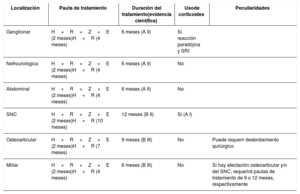
El término tuberculosis extrapulmonar se usa para describir la afectación por M. tuberculosis de cualquier órgano, sin afectación pulmonar demostrada. En ocasiones se produce afectación simultánea pulmonar y extrapulmonar, en cuyo caso se clasifica como pulmonar. A nivel mundial, supone el 20% del total de casos de tuberculosis. Su incidencia ha aumentado desde los años 80 del siglo pasado a raíz de la infección por el VIH. Las zonas afectadas con más frecuencia son: pleura, ganglios linfáticos, riñón y vías urinarias, huesos y articulaciones, sistema nervioso central (SNC) y abdomen. La clínica dependerá del órgano afectado. Siempre es necesario descartar una infección pulmonar concomitante. Para el diagnóstico hay que demostrar la existencia de la micobacteria en muestras obtenidas por punción o por biopsia mediante tinción, cultivos o técnicas de amplificación de ácidos nucleicos. También puede diagnosticarse al demostrar la existencia de granulomas caseificantes con necrosis caseosa central. El tratamiento en general es el mismo que el de la tuberculosis pulmonar, salvo en la afectación del SNC y osteoarticular, que precisan una prolongación en el tiempo de tratamiento. En la afectación del SNC es preciso además asociar corticoides.

Palabras clave
Tuberculosis extrapulmonar
Clínica
Diagnóstico
Tratamiento
Tuberculosis miliar
Abstract

The term extrapulmonary tuberculosis is used to describe M. tuberculosis infection of any organ without demonstrated pulmonary involvement. On occasion, simultaneous pulmonary and extrapulmonary infection occurs, in which case it is classified as pulmonary tuberculosis. It represents 20% of all tuberculosis cases worldwide. Its incidence has increased since the 1980s as a result of HIV infection. The most frequently affected areas are the pleura, lymph nodes, kidney and urinary tracts, bones and joints, central nervous system (CNS), and abdomen. Symptoms will depend on the organ involved. It is always necessary to rule out concomitant lung infection. In order to diagnose it, the existence of mycobacteria must be demonstrated through staining, cultures, or nucleic acid amplification techniques in samples obtained via puncture or biopsy. It can also be diagnosed by means of caseating granulomas with central caseous necrosis. Treatment is generally the same as that of pulmonary tuberculosis except when there is CNS or bone and joint involvement, which require a longer treatment time. When there is CNS involvement, glucocorticoids must also be administered.

Keywords
Extrapulmonary tuberculosis
Symptoms
Diagnosis
Treatment
Miliary tuberculosis

Identifíquese

¿Aún no es suscriptor de la revista?

Comprar el acceso al artículo

Comprando el artículo el pdf del mismo podrá ser descargado

Teléfono para incidencias

De lunes a viernes de 9h a 18h (GMT+1) excepto los meses de julio y agosto que será de 9 a 15h

Llamadas desde España 932 415 960
Llamadas desde fuera de España +34 932 415 960
Bibliografía
[1]
S.K.
202205042024080968
Sharma, A. Mohan.
Extrapulmonary tuberculosis.
Indian J Med Res., (2004), 120 pp. 316-353
[2]
U.
202205042024080969
Handa, I. Mundi, S. Mohan.
Nodal tuberculosis revisited: a review.
J Infect Dev Ctries., (2012), 6 pp. 6-12
[3]
D.W.
2022050420240809610
2022050420240809611
Fitzgerald, T.R. Sterling, D.W. Haas.
Mycobacterium tuberculosis.
Mandell, Douglas, and Bennett's Principles and practice of infectious diseases, 9ª ed., Elsevier, pp. 2985-3021
[4]
H. Chahed, H. Hachicha, A. Berriche, R. Abdelmalek, A. Mediouni, B. Kilani, et al.
Paradoxical reaction associated with cervical lymph node tuberculosis: predictive factors and therapeutic management.
Int J Infect Dis., (2017), 54 pp. 4-7
[5]
A.A.
2022050420240809612
Figueiredo, A.M. Lucon, M. Srougi.
Urogenital tuberculosis.
Microbiol Spectr., (2017), 5 pp. 355-370
[6]
D.
2022050420240809613
Natali, G. Cloatre, C. Brosset, P. Verdalle, A. Fauvy, J.P. Massart, et al.
What pulmonologists need to know about extrapulmonary tuberculosis.
Breathe (Sheff)., (2020), 16 pp. 200216
[7]
E.
2022050420240809614
De Francesco, G. Bezerra, E. Guardao.
Review: Renal tuberculosis in the Modern Era.
Am J Trop Med Hyg., (2013), 88 pp. 54-64
[8]
X.C.
2022050420240809615
Shi, L.F. Zhang, Y.Q. Zhang, X.Q. Liu, G.J. Fei.
Clinical and laboratory diagnosis of intestinal tuberculosis.
Chin Med J., (2016), 129 pp. 1330-1333
[9]
B. Bhandari, S.A. Snyder, J.D. Goldman.
Thinking outside the lungs: A case of disseminated abdominal tuberculosis.
Am J Case Rep., (2020), 21 pp. e926194
[10]
T. Yamane, A. Umeda, H. Shimao.
Analysis of recent cases of intestinal tuberculosis in Japan.
Intern Med., (2014), 53 pp. 957-962
[11]
A. Tanoglu, H. Erdem, J.S. Friedland, F.M. Almajid, A. Batirel, S. Kulzhanova, et al.
Clinicopathological profile of gastrointestinal tuberculosis: a multinational ID-IRI study.
Eur J Clin Microbiol Infect Dis., (2020), 39 pp. 493-500
[12]
F.M.
2022050420240809616
Abu-Zidan, M. Sheek-Hussein.
Diagnosis of abdominal tuberculosis: lessons learned over 30 years: pectoral assay.
World J Emerg Surg., (2019), 14 pp. 33
[13]
P.
2022050420240809617
García, M. Varela, J.J. Palacios, L. Rodrigo.
Tuberculosis peritoneal por Mycobacterium bovis en paciente cirrótico.
Gastroenterol Hepatol., (2009), 32 pp. 495-498
[14]
S. Sneh, J. Promil, A. Garima, D. Pratibha, S. Sunita, S. Rajeev.
Primary hepatic tuberculosis: A rare but fatal clinical entity if undiagnosed.
Asian Pac J Trop Med., (2012), 5 pp. 498-499
[15]
A.J.
2022050420240809618
Hickey, L. Gounder, M.Y.S. Moosa, P.K. Drain.
A systematic review of hepatic tuberculosis with considerations in human immunodeficiency virus co-infection.
BMC Infect Dis., (2015), 15 pp. 209-219
[16]
G.
2022050420240809619
Kharrasse, M. Soufi, H. Berekhli, H. Intissar, M. Bouziane, Z. Ismaili.
Primary tuberculoma of the liver: a case report and literature review.
Pan Afr Med J., (2014), 19 pp. 321
[17]
F.
2022050420240809620
Brancusi, J. Farrar, D. Heemskerk.
Tuberculous meningitis in adults: a review of a decade of developments focusing on prognostic factors for outcome.
Future Microbiol., (2012), 7 pp. 1101-1116
[18]
C.M.
2022050420240809621
Manyelo, R.S. Solomons, G. Walzl, N.N. Chegou.
Tuberculous meningitis: Pathogenesis, immune responses, diagnostic challenges, and the potential of biomarker-based approaches.
J Clin Microbiol., (2021), 59 pp. e01771-e1820
[19]
J.M.
2022050420240809622
2022050420240809623
Leonard.
Central nervous system tuberculosis.
Microbiol Spectr., (2017), 5
[20]
V.
2022050420240809624
Chaudhary, S. Bano, U.C. Garga.
Central nervous system tuberculosis: An imaging perspective.
Can Assoc Radiol J., (2017), 68 pp. 161-170
[21]
M.
2022050420240809625
Peghin, D. Rodríguez-Pardo, A. Sánchez-Montalva, F. Pellisé.
The changing epidemiology of spinal tuberculosis: the influence of international immigration in Catalonia, 1993-2014.
Epidemiol Infect., (2017), 145 pp. 2152-2160
[22]
A. Guillouzouic, C. Andrejak, O. Peuchant, G. Hery-Arnaud, F. Hamdad, P. Lanotte, et al.
Treatment of bone and joint tuberculosis in France: A multicentre retrospective study.
J Clin Med., (2020), 9 pp. 2529
[23]
M.
2022050420240809626
Fuentes Ferrer, L. Gutiérrez Torres, O. Ayala Ramírez, M. Rumayor Zarzuelo, N. del Prado González.
Tuberculosis of the spine. A systematic review of case series.
Int Orthop., (2012), 36 pp. 221-231
[24]
P.
2022050420240809627
2022050420240809628
Nahid, S.E. Dorman, N. Alipanah, P.M. Barry, J.L. Brozek, A. Cattamanchi, et al.
Official American Thoracic Society/Centers for Disease Control and Prevention/Infectious Diseases Society of America Clinical Practice Guidelines: Treatment of Drug-Susceptible Tuberculosis.
Clin Infect Dis-, (2016), 63 pp. e147-e195
[25]
J.Y.
2022050420240809629
Lee.
Diagnosis and treatment of extrapulmonary tuberculosis.
Tuberc Respir Dis Seoul, (2015), 78 pp. 47-55
[26]
S.K.
2022050420240809630
2022050420240809631
Sharma, A. Mohan, A. Sharma.
Miliary tuberculosis: A new look at an old foe.
J Clin Tuberc Other Mycobact Dis., (2016), 3 pp. 13-27
[27]
J.
2022050420240809632
Bernardo.
Clinical manifestations, diagnosis, and treatment of miliary tuberculosis.
(2020),
[28]
G. Maartens, P.A. Willcox, S.R. Benatar.
Miliary tuberculosis: rapid diagnosis, hematologic abnormalities, and outcome in 109 treated adults.
Am J Med., (1990), 89 pp. 291-296
[29]
A.
2022050420240809633
2022050420240809634
Domínguez-Castellano, A. del Arco, J. Canueto-Quintero, A. Rivero-Román, J.M. Kindelán, R. Creagh, et al.
Guía de práctica clínica de la Sociedad Andaluza de Enfermedades Infecciosas (SAEI) sobre el tratamiento de la tuberculosis.
Enferm Infecc Microbiol Clin., (2007), 25 pp. 519-534
[30]
I.
2022050420240809635
2022050420240809636
Machuca, E. Vidal, J. de la Torre-Cisneros, A. Rivero-Román.
Tuberculosis in immunosuppressed patients.
Enferm Infecc Microbiol Clin (Engl Ed)., (2018), 36 pp. 366-374
[31]
L.E.
2022050420240809637
Hoppe, R. Kettle, M. Eisenhut, I. Abubakar.
Guideline Development Group. Tuberculosis--diagnosis, management, prevention, and control: summary of updated NICE guidance.
BMJ, (2016), 352 pp. h6747
[32]
O.Y. Saliu, C. Sofer, D.S. Stein, S.K. Schwander, R.S. Wallis.
Tumor-necrosis-factor blockers: differential effects on mycobacterial immunity.
J Infect Dis., (2006), 194 pp. 486-492
[33]
J.A.
2022050420240809638
Singh, K.G. Saag, S.L. Bridges Jr., E.A. Akl, R.R. Bannuru, M.C. Sullivan, et al.
2015 American College of Rheumatology Guideline for the Treatment of Rheumatoid Arthritis.
Arthritis Rheumatol., (2016), 68 pp. 1-26