

Vol. 14. Núm. 17.
Páginas 994-1003 (Octubre 2024)

Actualización
Síndrome de secreción inadecuada de hormona antidiurética

Syndrome of inappropriate antidiuretic hormone secretion

J. Atencia GoñiI. Losada GataR. García-CentenoO. González Albarrán
Doi : https://10.1016/j.med.2024.09.002
Opciones
Resumen

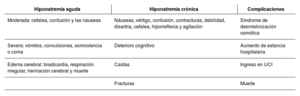
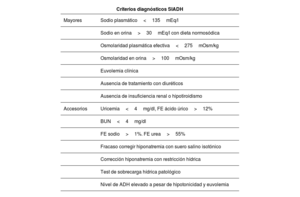
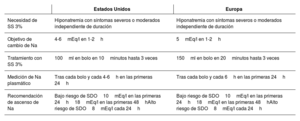
El síndrome de secreción inadecuada de hormona antidiurética (SIADH) se define como un trastorno en el control de la excreción renal del agua libre por la incapacidad de suprimir la secreción de la hormona antidiurética (ADH) o vasopresina. Las causas más frecuentes suelen ser adquiridas, destacando la afectación del sistema nervioso central, la malignidad, las enfermedades pulmonares o los fármacos. Hasta un 35% de pacientes ingresados tienen hiponatremia, de los cuales hasta en un 40% puede atribuirse al SIADH. Cuando se instaura en menos de 48horas se considera agudo y puede desencadenar vómitos, convulsiones, coma y muerte por herniación cerebral derivada del aumento de presión intracraneal. Las formas crónicas son más frecuentes y presentan síntomas como náuseas, confusión, debilidad o agitación. Para el diagnóstico es necesario identificar la presencia de una hiponatremia verdadera hipoosmolar euvolémica, descartando otras alteraciones hormonales o el uso de fármacos. El tratamiento de la forma aguda se basa en la utilización emergente de suero salino hipertónico, evitando una corrección excesivamente rápida del sodio que desencadene un síndrome de desmielinización osmótica. En el caso de la hiponatremia crónica pueden utilizarse la restricción hídrica, el aumento de la ingesta de osmoles y el tolvaptán; además de actuar sobre las causas desencadenantes.

Palabras clave
Hipófisis
Secreción inadecuada de hormona antidiurética
Hiponatremia
Diagnóstico
Tratamiento
Abstract

Syndrome of inappropriate antidiuretic hormone secretion (SIADH) is defined as a disorder in renal free water excretion control due to the inability to suppress the secretion of antidiuretic hormone (ADH) or vasopressin. The most frequent causes are usually acquired, notable among which are central nervous system involvement, malignancy, pulmonary diseases, or drugs. Up to 35% of admitted patients have hyponatremia, of which up to 40% can be attributed to SIADH. It is considered acute when it occurs in less than 48hours. It can trigger vomiting, convulsions, coma, and death due to cerebral herniation resulting from increased intracranial pressure. Chronic forms are more common and entail symptoms such as nausea, confusion, weakness, or agitation. In order to diagnose it, it is necessary to identify the presence of a true hypoosmolar euvolemic hyponatremia, ruling out other hormonal abnormalities or drug use. Treatment of the acute form is based on the emergency use of hypertonic saline solution, avoiding excessively rapid sodium correction that would trigger an osmotic demyelination syndrome. In the case of chronic hyponatremia, water restriction, increased osmole intake, and tolvaptan can be used in addition to acting on the triggering causes.

Keywords
Pituitary gland
Inappropriate antidiuretic hormone secretion
Hyponatremia
Diagnosis
Treatment

Identifíquese

¿Aún no es suscriptor de la revista?

Comprar el acceso al artículo

Comprando el artículo el pdf del mismo podrá ser descargado

Teléfono para incidencias

De lunes a viernes de 9h a 18h (GMT+1) excepto los meses de julio y agosto que será de 9 a 15h

Llamadas desde España 932 415 960
Llamadas desde fuera de España +34 932 415 960
Bibliografía
[1]
E. Poch
202409250618003228
202409250618003229
, A. Molina, G. Piñeiro.
Syndrome of inappropriate antidiuretic hormone secretion. Síndrome de secreción inadecuada de hormona antidiurética.
Med Clin (Barc)., (2022), 159 pp. 139-146
[2]
E. Carpentier
2024092506180032210
, L.A. Greenbaum, D. Rochdi, R. Abrol, W.A. Goddard 3rd, D.G. Bichet, et al.
Identification and characterization of an activating F229V substitution in the V2 vasopressin receptor in an infant with NSIAD.
JASN., (2012), 23 pp. 1635-1640
[3]
W. Tian
2024092506180032211
, Y. Fu, A. García-Elias, J.M. Fernández-Fernández, R. Vicente, P.L. Kramer, et al.
A loss-of-function nonsynonymous polymorphism in the osmoregulatory TRPV4 gene is associated with human hyponatremia.
Proc Natl Acad Sci U S A., (2009), 106 pp. 14034-14039
[4]
D.H. Ellison
2024092506180032212
2024092506180032213
, T. Berl.
Clinical practice. The syndrome of inappropriate antidiuresis.
N Engl J Med., (2007), 356 pp. 2064-2072
[5]
M. Sherlock
2024092506180032214
, E. O'Sullivan, A. Agha, L.A. Behan, D. Rawluk, P. Brennan, et al.
The incidence and pathophysiology of hyponatraemia after subarachnoid haemorrhage.
Clin Endocrinol (Oxf)., (2006), 64 pp. 250-254
[6]
B.E. Johnson
2024092506180032215
, J.P. Chute, J. Rushin, J. Williams, P.T. Le, D. Venzon, et al.
A prospective study of patients with lung cancer and hyponatremia of malignancy.
Am J Respir Crit Care Med., (1997), 156 pp. 1669-1678
[7]
G. Mentrasti
2024092506180032216
, L. Scortichini, M. Torniai, R. Giampieri, F. Morgese, S. Rinaldi, et al.
Syndrome of Inappropriate Antidiuretic Hormone Secretion (SIADH): Optimal management.
Ther Clin Risk Manag., (2020), 16 pp. 663-672
[8]
D.K. Kim
2024092506180032217
, K.W. Joo.
Hyponatremia in patients with neurologic disorders.
Electrolyte Blood Press., (2009), 7 pp. 51-57
[9]
A.M. Warren
2024092506180032218
2024092506180032219
, M. Grossmann, M. Christ-Crain, N. Russell.
Syndrome of inappropriate antidiuresis: From pathophysiology to management.
Endocr Rev., (2023), 44 pp. 819-861
[10]
G.L. Robertson
2024092506180032220
.
Regulation of arginine vasopressin in the syndrome of inappropriate antidiuresis.
Am J Med., (2006), 119 pp. S36-S42
[11]
G.L. Robertson
2024092506180032221
, R.L. Shelton, S. Athar.
The osmoregulation of vasopressin.
Kidney Int., (1976), 10 pp. 25-37
[12]
W.K. Fenske
2024092506180032222
, M. Christ-Crain, A. Hörning, J. Simet, G. Szinnai, M. Fassnacht, et al.
A copeptin-based classification of the osmoregulatory defects in the syndrome of inappropriate antidiuresis.
J Am Soc Nephrol., (2014), 25 pp. 2376-2383
[13]
J.R. Jaenike
2024092506180032223
, C. Waterhouse.
The renal response to sustained administration of vasopressin and water in man.
J Clin Endocrinol Metab., (1961), 21 pp. 231-242
[14]
Sterns
2024092506180032224
2024092506180032225
RH. Pathophysiology and etiology of the syndrome ofinappropriate antidiuretic hormone secretion (SIADH). UpToDate 2024. Disponible en: www.uptodate.com.
[15]
H.J. Adrogué
2024092506180032226
2024092506180032227
, N.E. Madias.
The syndrome of inappropriate antidiuresis.
N Engl J Med., (2023), 389 pp. 1499-1509
[16]
J.G. Verbalis
2024092506180032228
, A. Greenberg, V. Burst, J.P. Haymann, G. Johannsson, A. Peri, et al.
Diagnosing and treating the syndrome of inappropriate antidiuretic hormone secretion.
Am J Med., (2016), 129 pp. 537
[17]
Sterns
2024092506180032229
2024092506180032230
RH. Diagnostic evaluation of adults with hiponatremia. UpToDate 2024. Disponible en: www.uptodate.com.
[18]
R.L. Usala
2024092506180032231
, S.J. Fernández, M. Mete, L. Cowen, N.M. Shara, J. Barsony, et al.
hyponatremia is associated with increased osteoporosis and bone fractures in a large us health system population.
J Clin Endocrinol Metab., (2015), 100 pp. 3021-3031
[19]
G. Corona
2024092506180032232
, C. Giuliani, G. Parenti, D. Norello, J.G. Verbalis, G. Forti, et al.
Moderate hyponatremia is associated with increased risk of mortality: evidence from a meta-analysis.
[20]
W.B. Schwartz
2024092506180032233
, W. Bennett, S. Curelop, F.C. Bartter.
A syndrome of renal sodium loss and hyponatremia probably resulting from inappropriate secretion of antidiuretic hormone.
Am J Med., (1957), 23 pp. 529-542
[21]
H.J. Adrogué
2024092506180032234
2024092506180032235
, B.M. Tucker, N.E. Madias.
Diagnosis and management of hyponatremia: A review.
JAMA., (2022), 328 pp. 280-291
[22]
I. Runkle
2024092506180032236
2024092506180032237
, C. Villabona, A. Navarro, A. Pose, F. Formiga, A. Tejedor, et al.
European hyponatremia network. El tratamiento de la hiponatremia secundaria al síndrome de secreción inadecuada de la hormona antidiurética [The treament of hyponatremia secundary to the syndrome of inappropriate antidiuretic hormone secretion].
Med Clin (Barc)., (2013), 141
Copyright © 2024. Elsevier España, S.L.U. Todos los derechos reservados