

Vol. 12. Núm. 60.
Páginas 3524-3532 (Junio 2018)

Actualización
Síndrome de dolor regional complejo

Complex regional pain syndrome

L. Pérez-GarridoL. Gómez-LechónG. Manzano-CanabalO. Martínez GonzálezA. Turrión NievesJ. del Pino-Montes
Doi : https://10.1016/j.med.2018.06.021
Opciones
Resumen

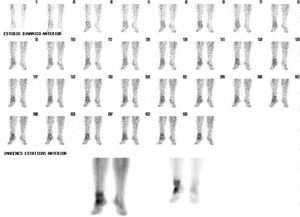
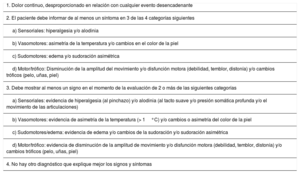
El síndrome de dolor regional complejo (SDRC), antes distrofia simpático refleja o síndrome Sudeck, es una situación clínica con dolor continuo y desproporcionado ocurrido semanas o meses después de un traumatismo o fractura. Generalmente localizado en zonas distales de las extremidades. El dolor se acompaña de hiperalgesia y alodinia. Otras manifestaciones son el edema, cambios de temperatura y coloración cutáneas locales, alteraciones del trofismo de vello, uñas y piel, así como modificaciones de la sudoración. En las fases más crónicas puede haber manifestaciones motoras como debilidad muscular, temblor esencial, mioclonías y distonías. El diagnóstico es principalmente clínico y son de utilidad los criterios de la IASP de 2013. Son de poca ayuda las exploraciones complementarias, aunque la gammagrafía ósea en 3 fases puede confirmar el diagnóstico. El pronóstico es incierto, generalmente se resuelve en los primeros 12 meses. La respuesta al tratamiento es variable y precisa un abordaje multidisciplinar con terapia física y ocupacional, fármacos y, en casos de mala evolución, intervencionista y psicológico. Entre los fármacos son eficaces en los primeros estadios los glucocorticoides, los bisfosfonatos y los analgésicos. Como medidas preventivas se recomienda la movilización precoz tras fracturas o traumatismos. La vitamina C también parece reducir la frecuencia de SDRC.

Palabras clave
Síndrome de dolor regional complejo
Distrofia simpático refleja
Dolor crónico
Abstract

Complex regional pain syndrome (CRPS), formally known as reflex sympathetic dystrophy or Sudeck's syndrome, is a clinical situation with continuous, disproportionate pain occurring weeks or months after trauma or fracture. It is generally located in the distal areas of the limbs. The pain is accompanied by hyperalgesia and allodynia. Other manifestations are oedema, changes in local skin temperature and colouration, altered hair, nail and skin trophism, and changes in sweating. There can be motor manifestations in the more chronic phases, such as muscle weakness, essential tremor, myoclonus and dystonia. Diagnosis is principally clinical and the 2013 IASP criteria are useful. Complementary exploration is of little help, although 3-phase bone scan can confirm the diagnosis. The prognosis is uncertain; the condition generally resolves in the first 12 months. Response to treatment is variable and a multi-disciplinary approach is required with physical and occupational therapy, drugs, and in cases of poor outcome, an interventionist and psychological approach. Glucocorticoids, bisphosphonates and analgesics are effective in the primary stages. The recommended preventative measures include prompt mobilisation after fractures or trauma. Vitamin C also appears to reduce the frequency of CRPS.

Keywords
Complex regional pain syndrome
Reflex sympathetic dystrophy
Chronic pain

Identifíquese

¿Aún no es suscriptor de la revista?

Comprar el acceso al artículo

Comprando el artículo el pdf del mismo podrá ser descargado

Teléfono para incidencias

De lunes a viernes de 9h a 18h (GMT+1) excepto los meses de julio y agosto que será de 9 a 15h

Llamadas desde España 932 415 960
Llamadas desde fuera de España +34 932 415 960
Bibliografía
[1]
R.N. Harden, S. Bruehl, M. Stanton-Hicks, P.R. Wilson.
Proposed new diagnostic criteria for complex regional pain syndrome.
[2]
R.N. Harden, S. Bruehl, R.S.G.M. Perez, F. Birklein, J. Marinus, C. Maihofner, et al.
Validation of proposed diagnostic criteria (the “Budapest Criteria”) for Complex Regional Pain Syndrome.
[3]
201807080409332248
201807080409332249
R.N. Harden, A.L. Oaklander, A.W. Burton, R.S.G.M. Pérez, K. Richardson, M. Swan, et al.
Complex regional pain syndrome: practical diagnostic and treatment guidelines. 4th edition.
Pain Med, (2013), 14 pp. 180-229
[4]
P. Sandroni, L.M. Benrud-Larson, R.L. McClelland, P.A. Low.
Complex regional pain syndrome type I: incidence and prevalence in Olmsted county, a population-based study.
Pain, (2003), 103 pp. 199-207
[5]
M. de Mos, A.G.J. de Bruijn, F.J.P.M. Huygen, J.P. Dieleman, B.H.C. Stricker, M.C.J.M. Sturkenboom.
The incidence of complex regional pain syndrome: a population-based study.
[6]
A. Beerthuizen, D.L. Stronks, A. Van’t Spijker, A. Yaksh, B.M. Hanraets, J. Klein, et al.
Demographic and medical parameters in the development of complex regional pain syndrome type 1 (CRPS1): prospective study on 596 patients with a fracture.
Pain, (2012), 153 pp. 1187-1192
[7]
2018070804093322410
M. Bullen, C. Lang, P. Tran.
Incidence of complex regional pain syndrome i following foot and ankle fractures using the Budapest criteria.
Pain Med, (2016), 17 pp. 2353-2359
[8]
2018070804093322411
R. Weissmann, Y. Uziel.
Pediatric complex regional pain syndrome: a review.
Pediatr Rheumatol, (2016), 14 pp. 29
[9]
2018070804093322412
E.L. Goh, S. Chidambaram, D. Ma.
Complex regional pain syndrome: a recent update. Burn trauma.
BioMed Central, (2017), 5 pp. 2
[10]
2018070804093322413
T. Pons, E.A. Shipton, J. Williman, R.T. Mulder.
Potential risk factors for the onset of complex regional pain syndrome type 1: a systematic literature review.
Anesthesiol Res Pract, (2015), 2015 pp. 956539
[11]
M. Bussa, A. Mascaro, L. Cuffaro, S. Rinaldi.
Adult complex regional pain syndrome type I: a narrative review.
[12]
M. Schürmann, G. Gradl, J. Zaspel, M. Kayser, P. Löhr, H.J. Andress.
Peripheral sympathetic function as a predictor of complex regional pain syndrome type I (CRPS I) in patients with radial fracture.
Auton Neurosci, (2000), 86 pp. 127-134
[13]
S. Bruehl.
Complex regional pain syndrome.
BMJ, (2015), 351 pp. h2730
[14]
S. Bruehl, C. Maihöfner, M. Stanton-Hicks, R.S.G.M. Pérez, J.-J. Vatine, F. Brunner, et al.
Complex regional pain syndrome.
[15]
M. Tajerian, J.D. Clark.
New concepts in complex regional pain syndrome.
Hand Clin, (2016), 32 pp. 41-49
[16]
M. Bussa, A. Mascaro, L. Cuffaro, S. Rinaldi.
Adult complex regional pain syndrome type I: a narrative review.
PMR, (2017), 9 pp. 707-719
[17]
F. Birklein, D. O’Neill, T. Schlereth.
Complex regional pain syndrome: An optimistic perspective.
[18]
H.W. Kwon, J.C. Paeng, F.S. Nahm, S.G. Kim, T. Zehra, S.W. Oh, et al.
Diagnostic performance of three-phase bone scan for complex regional pain syndrome type 1 with optimally modified image criteria.
Nucl Med Mol Imaging, (2011), 45 pp. 261-267
[19]
2018070804093322414
M.M. Wertli, F. Brunner, J. Steurer, U. Held.
Usefulness of bone scintigraphy for the diagnosis of complex regional pain syndrome 1: a systematic review and bayesian meta-analysis. Harhaus L, editor.
PLoS One, (2017), 12 pp. e0173688
[20]
A.T. Borchers, M.E. Gershwin.
The clinical relevance of complex regional pain syndrome type I: The Emperor's New Clothes.
Autoimmun Rev, (2017), 16 pp. 22-33
[21]
2018070804093322415
D.J. Bean, M.H. Johnson, R.R. Kydd.
The Outcome of complex regional pain syndrome type 1: a systematic review.
[22]
2018070804093322416
R.S. Pérez, P.E. Zollinger, P.U. Dijkstra, W.W. Thomassen-Hilgersom Zuurmond, K.C. Rosenbrand, et al.
Evidence based guidelines complexregional pain syndrome type 1.
BMC Neurol, (2010), 10 pp. 20
[23]
2018070804093322417
F. Aïm, S. Klouche, A. Frison, T. Bauer, P. Hardy.
Efficacy of vitamin preventing complex regional pain syndrome after wrist fracture: systematic review and meta-analysis.
Orthop Traumatol Surg, (2017), 103 pp. 465-470
[24]
2018070804093322418
N.E. O’Connell, B.M. Wand, J. McAuley, L. Marston, G.L. Moseley.
Interventions for treating pain and disability in adults with complex pain syndrome-an overview of systematic reviews.
Cochrane Syst Rev, (2013 Apr 30), pp. CD009416
[25]
M.H. Buch, J.S. Smolen, N. Betteridge, F.C. Breedveld, T. Burmester Dörner, et al.
Updated consensus statement on the use of rituximab patients with rheumatoid arthritis.
Ann Rheum Dis, (2011), 70 pp. 909-920
[26]
2018070804093322419
S. Duong, D. Bravo, K.J. Todd, R.J. Finlayson, D.Q. Tran.
Treatment complex regional pain syndrome: an updated systematic review and synthesis.
Can J Anaesth, (2018), 65 pp. 658-684
[27]
2018070804093322420
K.M. Smart, B.M. Wand, N.E. O’Connell.
Physiotherapy for pain disability in adults with complex regional pain syndrome (CRPS) types II.
Cochrane database Syst Rev, (2016), 2 pp. CD010853
[28]
2018070804093322421
N.E. O’Connell, B.M. Wand, W. Gibson, D.B. Carr, F. Birklein, T.R. Stanton.
Local anaesthetic sympathetic blockade for complex regional syndrome.
Cochrane Database Syst Rev, (2016), 7 pp. CD004598