


Vol. 12. Núm. 37.
Páginas 2205-2216 (Junio 2017)

Actualización
Síndrome coronario agudo sin elevación del segmento ST

Acute coronary syndrome with non- ST segment elevation

E. García CamachoF. Sabatel PérezC. Martín SierraM. Flores HernánC. Robles Gamboa
Doi : https://10.1016/j.med.2017.06.019
Opciones
Resumen
Introducción

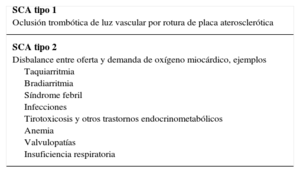
El síndrome coronario agudo sin elevación del segmento ST (SCASEST) es una entidad potencialmente letal secundaria a la rotura de una placa de ateroma. El síntoma principal es el dolor torácico.

Diagnóstico

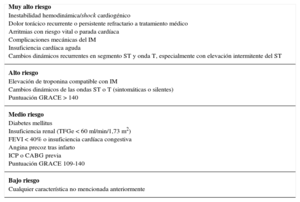
El diagnóstico inicial se realiza mediante la estratificación del riesgo isquémico y hemorrágico combinando la historia clínica, síntomas, signos vitales, ECG y elevación de troponina.

Tratamiento

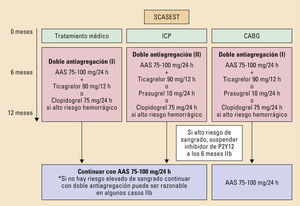
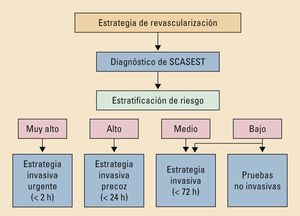
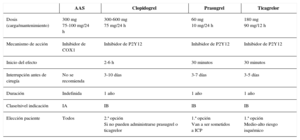
El tratamiento con doble antiagregación debe establecerse lo antes posible con ácido acetilsalicílico (AAS) y un inhibidor de P2Y durante un año. La coronariografía y la estrategia de revascularización se realizan en función de la estratificación de riesgo, clínica y comorbilidades asociadas.

Palabras clave
Dolor torácico
Elevación de troponina
Alteraciones de repolarización
Antiagregación
Abstract
Introduction

Non- ST- elevation syndrome (NSTEMI) is a potentially lethal entity secondary to the rupture of a plaque of atheroma. The leading sympton is the chest pain.

Diagnosis

The diagnosis is based on ischaemic and bleeding risk stratification on a combination of clinical history, symptoms, ECG and cardiac troponins.

Treatment

The treatment antiplatelet therapy with aspirin and a platelet P2Y12 receptor blocker is indicated in all patients. Invasive coronary angiography and the selection of the revascularization modality depend on numerous factors, including clinical presentation, comorbidities, risk stratification.

Keywords
Chest pain
Antiplatelet therapy
Cardiac troponin
Abnormal repolarization

Identifíquese

¿Aún no es suscriptor de la revista?

Comprar el acceso al artículo

Comprando el artículo el pdf del mismo podrá ser descargado

Teléfono para incidencias

De lunes a viernes de 9h a 18h (GMT+1) excepto los meses de julio y agosto que será de 9 a 15h

Llamadas desde España 932 415 960
Llamadas desde fuera de España +34 932 415 960
Bibliografía
[1]
201707010022209118
201707010022209119
M. Roffi, C. Patrono, J.P. Collet, C. Mueller, M. Valgimigli, F. Andreotti, et al.
2015 ESC Guidelines for the management of acute coronary syndromes in patients presenting without persistent ST-segment elevation.
Eur Heart J., (2016), 37 pp. 267-315
[2]
2017070100222091110
I.R. Dégano, R. Elousa, J. Marrugat.
Epidemiology of acute coronary síndromes in Spain: estimation of the number of cases and trends from 2005 to 2049.
Rev Esp Cardiol., (2013), 66 pp. 472-481
[3]
2017070100222091111
2017070100222091112
R.W. Yeah, S. Sidney, M. Chandra, M. Sorel, J.V. Selby, A.S. Go.
Population trends in the incidence and outcomes of acute myocardical infarction.
N Engl J Med., (2010), 362 pp. 2155-2165
[4]
2017070100222091113
Thygesen K, Alpert JS, Jaffe AS, Simoons ML, Chaitman BR, White HD; Writing Group on the Joint ESC/ACCF/AHA/WHF Task Force for the Universal Definition of Myocardial Infarction, Thygesen K, Alpert JS, White HD, Jaffe AS, Katus HA, Apple FS, et al; ESC Committee for Practice Guidelines (CPG). Third universal definition of myocardial infarction. Eur Heart J. 2012;33:2551-67.
[5]
2017070100222091114
E. Falk, M. Nakano, J.F. Bentzon, A.V. Finn, R. Virmani.
Update on acute coronary syndromes: the pathologists¿view.
Eur Heart J., (2013), 34 pp. 719-728
[6]
2017070100222091115
2017070100222091116
C.J. Pepine, K.E. Ferdinand, L.J. Shaw, K.A. Light-McGroary, R.U. Shah, M. Gulati, et al.
Emergence of nonobstructive coronary artery disease: a woman's problem and need for change in definition on angiography.
J Am Coll Cardiol., (2015), 66 pp. 1918-1933
[7]
2017070100222091117
M. Rubini Gimenez, M. Reiter, R. Twerenbold, T. Reichlin, K. Wildi, P. Haaf, et al.
Sex- specific chest pain characteristics in the early diagnosis of acute myocardial infarction.
JAMA Intern Med, (2014), 174 pp. 241-249
[8]
2017070100222091118
J.G. Canto, C. Fincher, C.I. Kiefe, J.J. Allison, Q. Li, E. Funkhouser, et al.
Atypical presentations among Medicare beneficiaries with unstable angina pectoris.
Am J Cardiol., (2002), 90 pp. 248-253
[9]
2017070100222091119
K.A. Fox, O.H. Dabbous, R.J. Goldberg, K.S. Pieper, K.A. Eagle, F. Van de Werf, et al.
Prediction of risk of death and myocardial infarction in the six months after presentation with acute coronary syndrome: prospective multinational observational study (GRACE).
[10]
2017070100222091120
A. Persson, M. Hartford, J. Herlitz, T. Karlsson, T. Omland, K. Caidahl.
Long-term prognostic value of mitral regurgitation in acute coronary syndromes.
Heart., (2010), 96 pp. 1803-1808
[11]
2017070100222091121
E.M. Antman, M. Cohen, P.J. Bernink, C.H. McCabe, T. Horacek, G. Papuchis, et al.
The TIMI risk score for unstable angina/non-ST elevation MI: a method for prognostication and therapeutic decision making.
JAMA, (2000), 284 pp. 835-842
[12]
2017070100222091122
K.A. Fox, G. Fitzgerald, E. Puymirat, W. Huang, K. Carruthers, T. Simon, et al.
Should patients with acute coronary disease be stratified for management according to their risk? Derivation, external validation and outcomes using the updated GRACE risk score.
BMJ Open, (2014), 4 pp. e004425
[13]
2017070100222091123
S. Subherwal, R.G. Bach, A.Y. Chen, B.F. Gage, S.V. Rao, L.K. Newby, et al.
Base- line risk of major bleeding in non-ST-segment-elevation myocardial infarction: the CRUSADE (Can Rapid risk stratification of Unstable angina patients Suppress ADverse outcomes with Early implementation of the ACC/AHA guidelines) bleeding score.
Circulation., (2009), 119 pp. 1873-1882
[14]
2017070100222091124
S. Savonitto, D. Ardissino, C.B. Granger, G. Morando, M.D. Prando, A. Mafrici, et al.
Prognostic value of the admission electrocardiogram in acute coronary syndromes.
JAMA., (1999), 281 pp. 707-713
[15]
2017070100222091125
L. Holmvang, P. Clemmensen, B. Lindahl, B. Lagerqvist, P. Venge, G. Wagner, et al.
Quantitative analysis of the admission electrocardiogram identifies patients with unstable coronary artery disease who benefit the most from early invasive treatment.
J Am Coll Cardiol., (2003), 41 pp. 905-915
[16]
2017070100222091126
2017070100222091127
C. Mueller.
Biomarkers and acute coronary syndromes: an update.
Eur Heart J., (2014), 35 pp. 552-556
[17]
2017070100222091128
2017070100222091129
Thygesen K, Mair J, Katus H, Plebani M, Venge P, Collinson P, et al and Study Group on Biomarkers in Cardiology of the ESCWGoACC.
[18]
2017070100222091130
Recommendations for the use of cardiac troponin measurement in acute cardiac care. Eur Heart J. 2010;31:2197-204.
[19]
2017070100222091131
K. Thygesen, J. Mair, E. Giannitsis, C. Mueller, B. Lindahl, S. Blankenberg, et al.
and Study Group on Biomarkers in Cardiology of ESCWGoACC How to use high-sensitivity cardiac troponins in acute cardiac care.
Eur Heart J., (2012), 33 pp. 2252-2257
[20]
2017070100222091132
2017070100222091133
A. Irfan, R. Twerenbold, M. Reiter, T. Reichlin, C. Stelzig, M. Freese, et al.
Determinants of high-sensitivity troponin T among patients with a noncardiac cause of chest pain.
Am J Med., (2012), 125 pp. 491-498
e491
[21]
2017070100222091134
M. Rubini Gimenez, R. Twerenbold, T. Reichlin, K. Wildi, P. Haaf, M. Schaefer, et al.
Direct comparison of high-sensitivity-cardiac troponin I vs. T for the early diagnosis of acute myocardial infarction.
Eur Heart J., (2014), 35 pp. 2303-2311
[22]
2017070100222091135
2017070100222091136
P. Lancellotti, S. Price, T. Edvardsen, B. Cosyns, A.N. Neskovic, R. Dulgheru, et al.
The use of echocardiography in acute cardiovascular care: recommendations of the European Association of Cardiovascular Imaging and the Acute Cardiovascular Care Association.
Eur Heart J Acute Cardiovasc Care, (2015), 4 pp. 3-5
[23]
2017070100222091137
2017070100222091138
Z. Samad, A. Hakeem, S.S. Mahmood, K. Pieper, M.R. Patel, D.L. Simel, et al.
A meta-analysis and systematic review of computed tomography angiography as a diagnostic triage tool for patients with chest pain presenting to the emergency department.
J Nucl Cardiol, (2012), 19 pp. 364-376
[24]
2017070100222091139
R.C. Cury, K. Shash, J.T. Nagurney, G. Rosito, M.D. Shapiro, C.H. Nomura, et al.
Cardiac magnetic resonance with T2-weighted imaging improves detection of patients with acute coronary syndrome in the emergency department.
Circulation, (2008), 118 pp. 837-844
[25]
2017070100222091140
C. Mueller, F.J. Neumann, W. Perach, A.P. Perruchoud, H.J. Buettner.
Prognostic value of the admission electrocardiogram in patients with unstable angina/non-ST-segment elevation myocardial infarction treated with very early revascularization.
Am J Med., (2004), 117 pp. 145-150
[26]
2017070100222091141
M. Mockel, J. Searle, C. Hamm, A. Slagman, S. Blankenberg, K. Huber, et al.
Early discharge using single cardiac troponin and copeptin testing in patients with suspected acute coronary syndrome (ACS): a randomized, controlled clinical process study.
Eur Heart J., (2015), 36 pp. 369-376
[27]
2017070100222091142
S.K. James, P. Armstrong, E. Barnathan, R. Califf, B. Lindahl, A. Siegbahn, et al.
GUSTO-IV-ACS Investigators. Troponin and C-reactive protein have different relations to subsequent mortality and myocardial infarction after acute coronary syndrome: a GUSTO-IV substudy.
J Am Coll Cardiol, (2003), 41 pp. 916
[28]
2017070100222091143
E.M. Antman, M. Cohen, P.J. Bernink, C.H. McCabe, T. Horacek, G. Papuchis, et al.
The TIMI risk score for unstable angina/non-ST elevation MI: a method for prognostication and therapeutic decision making.
JAMA, (2000), 284 pp. 835-842
[29]
2017070100222091144
P. Araujo Goncalves, J. Ferreira, C. Aguiar, R. Seabra-Gomes.
TIMI, PURSUIT and GRACE risk scores: sustained prognostic value and interaction with revascularization in NSTE-ACS.
Eur Heart J., (2005), 26 pp. 865-872
[30]
2017070100222091145
S. Subherwal, R.G. Bach, A.Y. Chen, B.F. Gage, S.V. Rao, L.K. Newby, et al.
Baseline risk of major bleeding in non-ST-segment-elevation myocardial infarction: the CRUSADE (Can Rapid risk stratification of Unstable angina patients Suppress ADverse outcomes with Early implementation of the ACC/AHA guidelines) bleeding score.
Circulation, (2009), 119 pp. 1873-1882
[31]
2017070100222091146
2017070100222091147
G.N. Levine, E.R. Bates, J.A. Bittl, R.G. Brindis, S.D. Fihn, L.A. Fleisher, et al.
2016 ACC/AHA Guideline Focused Update on Duration of Dual Antiplatelet Therapy in Patients With Coronary Artery Disease: A Report of the American College of Cardiology/American Heart Association Task Force on Clinical Practice Guidelines.
Circulation, (2016), 6 pp. e123-e155
[32]
2017070100222091148
C.P. Cannon, W.S. Weintraub, L.A. Demopoulos, R. Vicari, M.J. Frey, N. Lakkis, et al.
Comparison of early invasive and conservative strategies in patients with unstable coronary syndromes treated with the glycoprotein IIb/IIIa inhibitor tirofiban.
N Engl J Med., (2001), 344 pp. 1879
[33]
2017070100222091149
S.D. Wiviott, E. Braunwald, C.H. McCabe, I. Horvath, M. Keltai, J.P. Herrman, et al.
Intensive oral antiplatelet therapy for reduction of ischaemic events including stent thrombosis in patients with acute coronary syndromes treated with percutaneous coronary intervention and stenting in the TRITON-TIMI 38 trial: a subanalysis of a randomised trial.
Lancet, (2008), 371 pp. 1353-1363
[34]
2017070100222091150
D. Lindholm, C. Varenhorst, C.P. Cannon, R.A. Harrington, A. Himmelmann, J. Maya, et al.
Ticagrelor vs clopidogrel in patients with non-ST-elevation acute coronary syndrome with or without revascularization: results from the PLATO trial.
Eur Heart J., (2014), 35 pp. 2083-2093
[35]
2017070100222091151
J.H. Alexander, R.D. Lopes, S. James, R. Kilaru, Y. He, P. Mohan, et al.
Apixaban with antiplatelet therapy after acute coronary syndrome.
N Engl J Med., (2011), 365 pp. 699-708
[36]
2017070100222091152
J.L. Mega, E. Braunwald, S.D. Wiviott, J.P. Bassand, D.L. Bhatt, C. Bode, et al.
Rivaroxaban in patients with a recent acute coronary syndrome.
N Engl J Med., (2012), 366 pp. 9-19
[37]
2017070100222091153
2017070100222091154
P. Kirchhof, S. Benussi, D. Kotecha, A. Ahlsson, D. Atar, B. Casadei, et al.
2016 ESC Guidelines for the management of atrial fibrillation developed in collaboration with EACTS.
Eur Heart J., (2016), 37 pp. 2893-2962
[38]
2017070100222091155
2017070100222091156
Patel MR, Calhoon JH, Dehmer GJ, Grantham JA, Maddox TM, Maron DJ, et al. Appropriate Use Criteria for Coronary Revascularization in Patients With Acute Coronary Syndromes: A Report of the American College of Cardiology Appropriate Use Criteria Task Force, American Association for Thoracic Surgery, American Heart Association, American Society of Echocardiography, American Society of Nuclear Cardiology, Society for Cardiovascular Angiography and Interventions, Society of Cardiovascular Computed Tomography, and the Society of Thoracic Surgeons. J Am Coll Cardiol. 2017;69(5):570-91.
[39]
2017070100222091157
2017070100222091158
P. Kolh, S. Windecker.
2014 ESC/EACTS Guidelines on myocardial revascularization.
Eur Heart J., (2014), 35 pp. 3235-3236