

Vol. 13. Núm. 50.
Páginas 2937-2944 (Marzo 2022)

Protocolo para el manejo de las infecciones graves por Staphylococcus aureus

Protocol for the management of severe Staphylococcus aureus infections

J. Calderón-ParraabcS. de la Fuente MoralabcA. Díaz de Santiagoabc
Doi : https://10.1016/j.med.2022.02.023
Opciones
Resumen

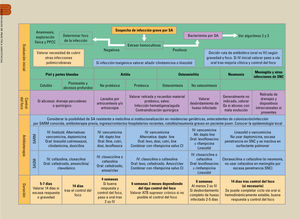
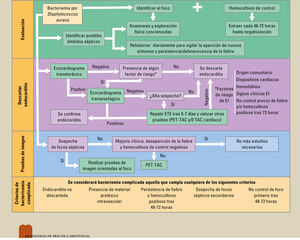
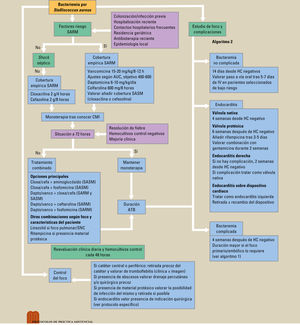
Las infecciones por Staphylococcus aureus (SA) son frecuentes y suponen una elevada morbimortalidad. Los principales antibióticos en el tratamiento de SA sensible a meticilina (SASM) son cloxacilina y cefazolina. En el tratamiento de SA resistente a meticilina (SARM), los principales fármacos son vancomicina y daptomicina. Otros antibióticos que pueden tener utilidad incluyen linezolid, rifampicina o fluoroquinolonas. En el tratamiento empírico de las infecciones por SA se deberá tener en cuenta el riesgo de SARM. El tratamiento dirigido y la duración del mismo, en ausencia de bacteriemia, está condicionado en gran medida por el foco de la infección y su adecuado control o no. En presencia de bacteriemia, se deberá valorar la posibilidad de endocarditis infecciosa y se deberán realizar hemocultivos de control hasta su negativización. Para bacteriemia no complicada serán necesarios 14 días de tratamiento desde el primer hemocultivo negativo, mientras que si la bacteriemia es complicada la duración será de al menos 28 días.

Palabras clave
Staphylococcus aureus
Estafilococo sensible a meticilina
Estafilococo resistente a meticilina
Abstract

Staphylococcus aureus (SA) infections are common and have a high morbidity and mortality. The main antibiotics for treating methicillin-sensitive SA (MSSA) are cloxacillin and cefazolin. The main drugs for treating methicillin-resistant SA (MRSA) are vancomycin and daptomycin. Other antibiotics that may be of use include linezolid, rifampicin, or fluoroquinolones. In the empirical treatment of SA infections, the risk of MRSA must be taken into account. The treatment target and its duration, in absence of bacteremia, is conditioned in large part by the source of the infection and whether it is suitably controlled or not. When bacteremia is present, the possibility of infectious endocarditis must be evaluated and follow-up blood cultures must be conducted until they are negative. For uncomplicated bacteremia, 14 days of treatment from the first negative blood culture are necessary whereas if the bacteremia is complicated, treatment must have a duration of at least 28 days.

Keywords
Staphylococcus aureus
Methicillin-sensitive staphylococcus
Methicillin-resistant staphylococcus

Identifíquese

¿Aún no es suscriptor de la revista?

Comprar el acceso al artículo

Comprando el artículo el pdf del mismo podrá ser descargado

Teléfono para incidencias

De lunes a viernes de 9h a 18h (GMT+1) excepto los meses de julio y agosto que será de 9 a 15h

Llamadas desde España 932 415 960
Llamadas desde fuera de España +34 932 415 960
Bibliografía
[1]
B.
202203090645021728
Mandell.
Staphylococcus aureus.
Mandell, Duglas and Bennett's Principles and Practice of Infectious Diseases, 9ª ed., Elsevier, pp. 2432-2443
[2]
F.D.
202203090645021729
Lowy.
Infecciones estafilocócicas.
Harrison. Principios de Medicina Interna, 20ª ed., McGraw Hill, pp. 21
[3]
F.
2022030906450217210
2022030906450217211
Gudiol, J.M. Aguado, B. Almirante, E. Bouza, E. Cercenado, M.A. Domínguez, et al.
Diagnosis and treatment of bacteremia and endocarditis due to Staphylococcus aureus. A clinical guideline from the Spanish Society of Clinical Microbiology and Infectious Diseases (SEIMC).
Enferm Infecc Microbiol Clin., (2015), 33
[4]
W.R. Miller, C. Seas, L.P. Carvajal, L. Díaz, A.M. Echeverri, C. Ferro, et al.
The cefazolin inoculum effect is associated with increased mortality in methicillin-susceptible staphylococcus aureus bacteremia.
Open Forum Infect Dis., (2018), 5 pp. ofy123
[5]
S.
2022030906450217212
Weis, M. Kesselmeier, J.S. Davis, A.M. Morris, S. Lee, A. Scherag, et al.
Cefazolin versus anti-staphylococcal penicillins for the treatment of patients with Staphylococcus aureus bacteraemia.
Clin Microbiol Infect., (2019), 25 pp. 818-827
[6]
A. Henderson, P. Harris, G. Hartel, D. Paterson, J. Turnidge, J.S. Davis, et al.
Benzylpenicillin versus flucloxacillin for penicillin-susceptible Staphylococcus aureus bloodstream infections from a large retrospective cohort study.
Int J Antimicrob Agents., (2019), 54 pp. 491-495
[7]
N.M.
2022030906450217213
2022030906450217214
Brown, A.L. Goodman, C. Horner, A. Jenkins, E.M. Brown.
Treatment of methicillin-resistant Staphylococcus aureus (MRSA): updated guidelines from the UK.
JAC-Antimicrob Resist [Internet]., (2021), 3 pp. dlaa114
[8]
M.J.
2022030906450217215
2022030906450217216
Rybak, J. Le, T.P. Lodise, D.P. Levine, J.S. Bradley, C. Liu, et al.
Therapeutic monitoring of vancomycin for serious methicillin-resistant Staphylococcus aureus infections: A revised consensus guideline and review by the American Society of Health-System Pharmacists, the Infectious Diseases Society of America, the Pediatric Infectious Diseases Society, and the Society of Infectious Diseases Pharmacists.
Am J Health Syst Pharm., (2020), 77 pp. 835-864
[9]
R.L. Crass, K.L. Powell, A.M. Huang.
Daptomycin for the treatment of Staphylococcus aureus infections complicated by septic pulmonary emboli.
Diagn Microbiol Infect Dis., (2019), 93 pp. 131-135
[10]
S.J.
2022030906450217217
van Hal, T.P. Lodise, D.L. Paterson.
The clinical significance of vancomycin minimum inhibitory concentration in Staphylococcus aureus infections: a systematic review and meta-analysis.
Clin Infect Dis., (2012), 54 pp. 755-771
[11]
J. Li, Q.-H. Zhao, K.-C. Huang, Z.-Q. Li, L.-Y. Zhang, D.-Y. Qin, et al.
Linezolid vs. vancomycin in treatment of methicillin-resistant staphylococcus aureus infections: a meta-analysis.
Eur Rev Med Pharmacol Sci., (2017), 21 pp. 3974-3979
[12]
S.Y.C.
2022030906450217218
Tong, J.S. Davis, E. Eichenberger, T.L. Holland, V.G. Fowler.
Staphylococcus aureus infections: epidemiology, pathophysiology, clinical manifestations, and management.
Clin Microbiol Rev., (2015), 28 pp. 603-661
[13]
S.Y.C.
2022030906450217219
2022030906450217220
Tong, D.C. Lye, D. Yahav, A. Sud, J.O. Robinson, J. Nelson, et al.
Effect of Vancomycin or Daptomycin With vs Without an Antistaphylococcal b-Lactam on Mortality, Bacteremia, Relapse, or Treatment Failure in Patients With MRSA Bacteremia: A Randomized Clinical Trial.
JAMA., (2020), 323 pp. 527-537
[14]
W. Zimmerli, P. Sendi.
Role of rifampin against staphylococcal biofilm infections in vitro, in animal models, and in orthopedic-device-related infections.
Antimicrob Agents Chemother., (2019), 63 pp. e01746-e1818
[15]
G. Heriot, J. Yeoh, A. Street, I. Ratnam.
Echocardiography has minimal yield and may not be warranted in Staphylococcus aureus bacteremia without clinical risk factors for endocarditis.
Eur J Clin Microbiol Infect Dis, (2015), 34 pp. 1231-1236
[16]
J.S.
2022030906450217221
Peinado-Acevedo, J.J. Hurtado-Guerra, C. Hincapié-Osorno, J. Mesa-Abad, J.R. Uribe-Delgado, S. Giraldo-Ramírez, et al.
Validation of VIRSTA and PREDICT scores to determine the priority of echocardiography in patients with Staphylococcus aureus bacteremia.
Clin Infect Dis., (2021), pp. ciaa1844
[17]
T.W.
2022030906450217222
van der Vaart, J.M. Prins, R. Soetekouw, G. van Twillert, J. Veenstra, B.L. Herpers, et al.
Prediction rules for ruling out endocarditis in patients with Staphylococcus aureus bacteremia.
Clin Infect Dis., (2021), pp. ciab632
[18]
G.S.
2022030906450217223
Heriot, S.Y.C. Tong, A.C. Cheng, D. Liew.
What risk of endocarditis is low enough to justify the omission of transoesophageal echocardiography in Staphylococcus aureus bacteraemia?. A narrative review.
Clin Microbiol Infect Dis., (2018), 24 pp. 1251-1256
[19]
A.L. Sullenberger, L.S. Avedissian, S.M. Kent.
Importance of transesophageal echocardiography in the evaluation of Staphylococcus aureus bacteremia.
J Heart Valve Dis., (2005), 14 pp. 23-28
[20]
S.J. Mun, S.-H. Kim, K. Huh, S.Y. Cho, C.-I. Kang, D.R. Chung, et al.
Role of echocardiography in uncomplicated Staphylococcus aureus catheter-related bloodstream infections.
Medicine (Baltimore)., (2021), 100 pp. e25679