



Vol. 14. Núm. 15.
Páginas 909-916 (Septiembre 2024)

Protocolos de práctica asistencial
Protocolo diagnóstico y tratamiento integral de la obesidad mórbida

Diagnostic and comprehensive treatment protocol for morbid obesity

C. Tasende FernándezS. Khoruzha AleksandrovychD.S. Trifu
Doi : https://10.1016/j.med.2024.08.007
Opciones
Resumen

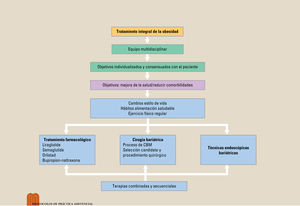
La obesidad es una enfermedad crónica, recurrente y multicausal extremadamente heterogénea y compleja, por lo que requiere un diagnóstico y tratamiento integral dentro de un equipo multidisciplinar. El objetivo principal del tratamiento es la mejora en la salud del paciente obeso, para ello debemos realizar un manejo multimodal centrado en el paciente e individualizado. Para su evaluación contamos con nuevas herramientas que nos permiten fenotipar al paciente, pudiendo aportar una terapia personalizada y a la vez monitorizarle de manera más precisa. Las estrategias terapéuticas deben abordarse de manera integral, teniendo como base los cambios en el estilo de vida, el ejercicio físico y la alimentación saludable que habitualmente precisan ser combinados con tratamiento médico antiobesidad y procedimientos endoscópicos o quirúrgicos bariátricos, incluyendo terapias combinadas y secuenciales que amplían las opciones terapéuticas y facilitan el tratamiento individualizado. La cirugía bariátrica continúa siendo el tratamiento más efectivo para la obesidad grave, capaz de producir una pérdida de peso significativa y mantenida en el tiempo con resolución o mejoría de gran parte de las comorbilidades asociadas.

Palabras clave
Cirugía bariátrica
Gastrectomía tubular
Bypass gástrico
Tratamiento endoscópico
Abstract

Obesity is a chronic, recurrent, multicausal disease that is extremely heterogeneous and complex. It requires a comprehensive diagnosis and treatment by a multidisciplinary team. The main objective of treatment is to improve the health of patients with obesity. Therefore, management must be multimodal, patient-centered, and individualized. New tools are available for its evaluation that allow for phenotyping the patient, which can lead to personalized therapy and at the same time monitor the patient more precisely. Therapeutic strategies must be approached in a comprehensive manner. They should be based on lifestyle changes, physical exercise, and healthy eating that usually needs to be combined with anti-obesity medical treatment and endoscopic or bariatric surgical procedures, including combined and sequential therapies that broaden the therapeutic options and facilitate individualized treatment. Bariatric surgery continues to be the most effective treatment for severe obesity. It is capable of producing significant, sustained weight loss with the resolution of or improvement in most associated comorbidities.

Keywords
Bariatric surgery
Sleeve gastrectomy
Gastric bypass
Endoscopic treatment

Identifíquese

¿Aún no es suscriptor de la revista?
Comprar el acceso al artículo

Comprando el artículo el pdf del mismo podrá ser descargado

Teléfono para incidencias

De lunes a viernes de 9h a 18h (GMT+1) excepto los meses de julio y agosto que será de 9 a 15h
Llamadas desde España 932 415 960
Llamadas desde fuera de España +34 932 415 960
Bibliografía
[1]
A.M. Jastreboff
202408270536032068
, C.M. Kotz, S. Kahan, A.S. Kelly, S.B. Heymsfield.
Obesity as a Disease: The Obesity Society 2018 position statement.
Obesity (Silver Spring)., (2019), 27 pp. 7-9
[2]
A. Bosy-Westphal
202408270536032069
, M.J. Müller.
Diagnosis of obesity based on body composition-associated health risks-Time for a change in paradigm.
Obes Rev., (2021), 22Suppl2 pp. e13190
[3]
D. Bellido
2024082705360320610
, M.A. Cornejo, J.M. García Almeida.
Técnicas morfológicas en evaluación morfofuncional.
Manual de endocrinología y nutrición, SEEN,
[4]
A. Lecube
2024082705360320611
2024082705360320612
, S. Monereo, M.A. Rubio, P. Martínez-De-Icaya, A. Martí, J. Salvador, et al.
Prevention, diagnosis, and treatment of obesity. 2016 position statement of the Spanish Society for the Study of Obesity.
Endocrinol Diabetes Nutr., (2017), 64
[5]
M.D. Ballesteros Pomar
2024082705360320613
, N. Vilarrasa García, Rubio Herrera MÁ, M.J. Barahona, M. Bueno, A. Caixàs, et al.
The SEEN comprehensive clinical survey of adult obesity: Executive summary.
Endocrinol Diabetes Nutr (Engl Ed)., (2021), 68 pp. 130-136
[6]
C.M. Perdomo
2024082705360320614
2024082705360320615
, R. Cohen, P. Sumithran, K. Clément, G. Frühbeck.
Contemporary medical, device, and surgical therapies for obesity in adults.
Lancet., (2023), 401 pp. 1116-1130
[7]
M.A. Rubio
2024082705360320616
.
Tratamiento farmacológico de la obesidad.
Manual de endocrinología y nutrición, SEEN,
[8]
J.I. Mechanick
2024082705360320617
2024082705360320618
, C.M. Apovian, S.A. Brethauer, W.T. Garvey, A.M. Joffe, J. Kim, et al.
Clinical practice guidelines for the perioperative nutrition, metabolic, and nonsurgical support of patients undergoing bariatric procedures – 2019 update: cosponsored by American Association of Clinical Endocrinologists/American College of Endocrinology, The Obesity Society, American Society for Metabolic & Bariatric Surgery, Obesity Medicine Association, and American Society of Anesthesiologists.
Endocr Pract., (2019), 25 pp. 1346-1359
[9]
A. Acosta
2024082705360320619
2024082705360320620
, S.E. Streett, M.D. Kroh, L.J. Cheskin, K.H. Saunders, M. Kurian, et al.
White Paper AGA: POWER - practice guide on obesity and weight management, education, and resources.
Clin Gastroenterol Hepatol., (2017), 15
[10]
D. Eisenberg
2024082705360320621
2024082705360320622
, S.A. Shikora, E.O. Aarts, A. Aminian, L. Angrisani, R.V. Cohen, et al.
2022 American Society for Metabolic and Bariatric Surgery (ASMBS) and International Federation for the Surgery of Obesity and Metabolic Disorders (IFSO): Indications for Metabolic and Bariatric Surgery.
Surg Obes Relat Dis., (2022), 18 pp. 1345-1356
[11]
W.T. Garvey.
New horizons. A new paradigm for treating to target with second-generation obesity medications.
J Clin Endocrinol Metab., (2022), 107 pp. e1339-e1347