

Vol. 12. Núm. 57.
Páginas 3385-3389 (Mayo 2018)

Protocolos de práctica asistencial
Protocolo diagnóstico del síndrome febril importado

Diagnostic protocol for imported febrile syndrome

E. García VázquezabA. Hernández TorresabE. Moral EscuderoaJ.A. Herrero MartínezabJ. Gómez GómezabM. Segovia Hernándezc
Doi : https://10.1016/j.med.2018.05.007
Opciones
Resumen

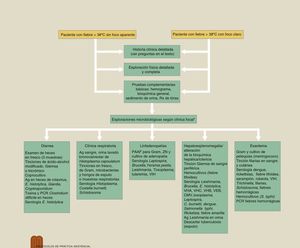
En este protocolo expondremos los pasos a seguir en la evaluación clínica del paciente con fiebre y antecedente epidemiológico de estancia en zonas tropicales o subtropicales. No pretendemos ser exhaustivos, sino proporcionar una guía al médico que se enfrenta a una primera aproximación diagnóstica, en el Servicio de Urgencias o en la sala de hospitalización, de un enfermo procedente del trópico y que consulta por fiebre. El diagnóstico diferencial debe ir encaminado sobre todo y en primer lugar a excluir la malaria, pero también fiebres hemorrágicas, ricketsiosis, fiebre tifoidea y otras muchas infecciones, algunas solo propias de zonas tropicales y otras cosmopolitas pero de mayor prevalencia en dichas áreas.

Palabras clave
Infecciones importadas
Malaria
Fiebre hemorrágica
Ricketsiosis
Fiebre tifoidea
Abstract

In this protocol we shall set out the steps to follow in the clinical assessment of the patient with fever and where there is an epidemiological history of travel to tropical or subtropical areas. This is not intended to be exhaustive, but as a guide to doctors in their initial diagnostic approach to the patient who has come from the tropics consulting with a fever in the Emergency Department or the hospital ward. Differential diagnosis should be approached first and foremost on the basis of excluding malaria, but haemorrhagic fevers, rickettsiosis, typhoid fever and many other infections, some that are unique to tropical areas, and others that are cosmopolitan but more prevalent in such areas should also be taken into account.

Keywords
Imported infections
Malaria
Haemorrhagic fever
Rickettsiosis
Typhoid fever

Identifíquese

¿Aún no es suscriptor de la revista?

Comprar el acceso al artículo

Comprando el artículo el pdf del mismo podrá ser descargado

Teléfono para incidencias

De lunes a viernes de 9h a 18h (GMT+1) excepto los meses de julio y agosto que será de 9 a 15h

Llamadas desde España 932 415 960
Llamadas desde fuera de España +34 932 415 960
Bibliografía
[1]
201806010418596798
S.C. Carneiro, T. Cestari, S.H. Allen, M. Ramos e-Silva.
Viral exanthems in the tropics.
Clin Dermatol., (2007), 25 pp. 212-220
[2]
Centers for
201806010418596799
Disease Control and Prevention.
Zika virus - What clinicians need to know? Clinician Outreach and Communication Activity (COCA) Call, January 26.
[3]
2018060104185967910
2018060104185967911
H.R. House, J.P. Ehlers.
Travel-related infections.
Emerg Med Clin North Am., (2008), 26 pp. 499-516
[4]
2018060104185967912
2018060104185967913
S. Kotlyar, B.T. Rice.
Fever in the returning traveler.
Emerg Med Clin North Am., (2013), 31 pp. 927-944
[5]
2018060104185967914
2018060104185967915
J. Mensa, J.M. Gatell, J.E. García-Sánchez, E. Letang, E. López-Suñé, F. Marco.
Guía de terapéutica antimicrobiana. Barcelona: Antares; 2017. Powell J. Fever in the vaccinated returning traveller.
BMJ., (2009), 339 pp. b2985
[6]
2018060104185967916
E.A. Reddy, A.V. Shaw, J.A. Crump.
Community-acquired bloodstream infections in Africa: a systematic review and meta-analysis.
Lancet Infect Dis., (2010), 10 pp. 417-432
[7]
2018060104185967917
2018060104185967918
P. Schlagenhauf, L. Weld, A. Goorhuis, P. Gautret, R. Weber, F. von Sonnenburg, et al.
EuroTravNet. Travel-associated infection presenting in Europe (2008-12): an analysis of EuroTravNet longitudinal, surveillance data, and evaluation of the effect of the pre-travel consultation.
Lancet Infect Dis., (2015), 15 pp. 55-64
[8]
S.M. Taylor, M.E. Molyneux, D.L. Simel, S.R. Meshnick, J.J. Juliano.
Does this patient have malaria?.
JAMA., (2010), 304 pp. 2048-2056
[9]
2018060104185967919
2018060104185967920
M.E. Wilson, D.O. Freedman.
Etiology of travel-related fever.
Curr Opin Infect Dis., (2007), 20 pp. 449-453