

Vol. 12. Núm. 76.
Páginas 4469-4477 (Abril 2019)

Actualización
Miastenia gravis y trastornos relacionados con la unión neuromuscular

Myasthenia gravis and disorders of neuromuscular junction

G. Morís
Doi : https://10.1016/j.med.2019.04.001
Opciones
Resumen

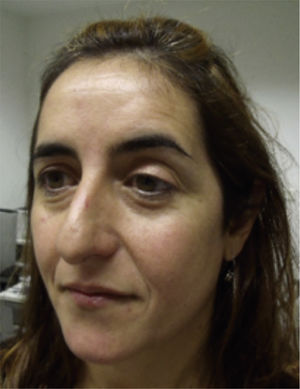
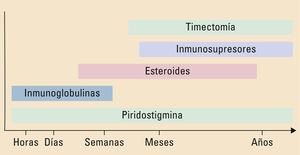
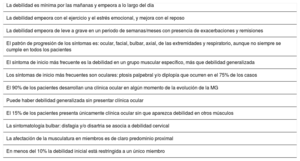
La miastenia gravis (MG) es la enfermedad de la unión neuromuscular más frecuente. Se trata de un trastorno adquirido de base autoinmune, en el que se detectan diferentes anticuerpos contra elementos del receptor muscular postsináptico. Los síntomas iniciales suelen aparecer en un grupo muscular aislado, preferentemente en la musculatura ocular con aparición de ptosis y diplopía. Posteriormente, los síntomas progresan con afectación muscular generalizada, apareciendo una afectación bulbar con síntomas de disfagia y disartria, debilidad de la musculatura cervical y a nivel proximal de las extremidades. Si la progresión clínica de la MG continúa, los pacientes desarrollan una crisis miasténica, asociándose fallo respiratorio. El rasgo clínico más característico de la MG es la variabilidad de la debilidad, con fluctuaciones clínicas dentro del mismo día, en relación con el ejercicio o factores agravantes, alcanzando en ocasiones una remisión espontánea. La sospecha clínica es clave tras reconocer este patrón clínico y confirmar el diagnóstico, principalmente con la determinación en sangre de los anticuerpos característicos de la MG acompañada del estudio neurofisiológico. El avance en el conocimiento de la inmunopatología subyacente ha permitido la optimización de las estrategias terapéuticas, combinando inhibidores de la acetilcolinesterasa, inmunosupresores y timectomía, con la consiguiente disminución en su morbimortalidad.

Palabras clave
Miastenia gravis
Unión neuromuscular
Fatigabilidad
Ptosis
Diplopía
Abstract

Myasthenia gravis (MG) is the most common disease of the neuromuscular junction. It is an acquired autoimmune disease, in which several antibodies against postsynaptic receptors are detected. Initial symptoms often manifest focally, mainly ocular weakness resulting in ptosis and diplopia. Subsequently, symptomatology evolves to generalized muscular involvement and bulbar symptoms: dysphagia and dysarthria, cervical musculature and proximal limb weakness. Clinical progression results on myasthenic crisis and respiratory failure. The clinical hallmark of MG is a fluctuating pronounced muscular weakness along the same day and related with physical activity or aggravating factors. Occasionally, spontaneous remissions have been reported. Diagnosis key is clinical suspicion achieving by clinical pattern recognition. Diagnostic confirmation is obtained by serological (MG antibodies) and neurophysiological tests. Thanks to advances in the knowledge about underlying immunopathology, the range of therapeutic strategies has grown (combining acetylcholinesterase inhibitors with immunosuppressant drugs and thymectomy), decreasing its morbidity and mortality.

Keywords
Myasthenia gravis
Neuromuscular junction
Fatigability
Ptosis
Diplopia

Identifíquese

¿Aún no es suscriptor de la revista?

Comprar el acceso al artículo

Comprando el artículo el pdf del mismo podrá ser descargado

Teléfono para incidencias

De lunes a viernes de 9h a 18h (GMT+1) excepto los meses de julio y agosto que será de 9 a 15h

Llamadas desde España 932 415 960
Llamadas desde fuera de España +34 932 415 960
Bibliografía
[1]
201911260632148588
J.M. Aragones, J. Altimiras, P. Roura, F. Alonso, E. Bufill, A. Munmany, et al.
Prevalence of myasthenia gravis in the Catalan county of Osona.
Neurologia, (2017), 32 pp. 1-5
[2]
201911260632148589
2019112606321485810
N.E. Gilhus.
Myasthenia gravis.
N Engl J Med, (2016), 375 pp. 2570-2581
[3]
2019112606321485811
2019112606321485812
N.E. Gilhus, J.J. Verschuuren.
Myasthenia gravis: subgroup classification and therapeutic strategies.
Lancet Neurol, (2015), 14 pp. 1023-1036
[4]
A. Marx, F. Pfister, B. Schalke, G. Saruhan-Direskeneli, A. Melms, P. Strobel.
The different roles of the thymus in the pathogenesis of the various myasthenia gravis subtypes.
Autoimmun Rev, (2013), 12 pp. 875-884
[5]
J.M. Weiss, P. Cufi, R. Le Panse, S. Berrih-Aknin.
The thymus in autoimmune Myasthenia Gravis: Paradigm for a tertiary lymphoid organ.
Rev Neurol (Paris), (2013), 169 pp. 640-649
[6]
Y. Fujii.
Thymus, thymoma and myasthenia gravis.
Surg Today, (2013), 43 pp. 461-466
[7]
2019112606321485813
J.P. Sieb.
Myasthenia gravis: an update for the clinician.
Clin Exp Immunol, (2014), 175 pp. 408-418
[8]
2019112606321485814
2019112606321485815
D. Grob, N. Brunner, T. Namba, M. Pagala.
Lifetime course of myasthenia gravis.
Muscle Nerve, (2008), 37 pp. 141-149
[9]
2019112606321485816
D. Grob, E.L. Arsura, N.G. Brunner, T. Namba.
The course of myasthenia gravis and therapies affecting outcome.
Ann N Y Acad Sci, (1987), 505 pp. 472-499
[10]
D.B. Sanders, K. El-Salem, J.M. Massey, J. McConville, A. Vincent.
Clinical aspects of MuSK antibody positive seronegative MG.
[11]
W.W. Liu, A. Chen.
Diagnosing myasthenia gravis with an ice pack.
N Engl J Med, (2016), 375 pp. e39
[12]
R.M. Pascuzzi.
The edrophonium test.
Semin Neurol, (2003), 23 pp. 83-88
[13]
A. Vincent, J. Newsom-Davis.
Acetylcholine receptor antibody as a diagnostic test for myasthenia gravis: results in 153 validated cases and 2967 diagnostic assays.
J Neurol Neurosurg Psychiatry, (1985), 48 pp. 1246-1252
[14]
W. Hoch, J. McConville, S. Helms, J. Newsom-Davis, A. Melms, A. Vincent.
Auto-antibodies to the receptor tyrosine kinase MuSK in patients with myasthenia gravis without acetylcholine receptor antibodies.
Nat Med, (2001), 7 pp. 365-368
[15]
O. Higuchi, J. Hamuro, M. Motomura, Y. Yamanashi.
Autoantibodies to low-density lipoprotein receptor-related protein 4 in myasthenia gravis.
Ann Neurol, (2011), 69 pp. 418-422
[16]
2019112606321485817
2019112606321485818
D.B. Sanders, G.I. Wolfe, M. Benatar, A. Evoli, N.E. Gilhus, I. Illa, et al.
International consensus guidance for management of myasthenia gravis: Executive summary.
Neurology, (2016), 87 pp. 419-425
[17]
2019112606321485819
2019112606321485820
N. Melzer, T. Ruck, P. Fuhr, R. Gold, R. Hohlfeld, A. Marx, et al.
Clinical features, pathogenesis, and treatment of myasthenia gravis: a supplement to the Guidelines of the German Neurological Society.
J Neurol, (2016), 263 pp. 1473-1494
[18]
2019112606321485821
2019112606321485822
J. Sussman, M.E. Farrugia, P. Maddison, M. Hill, M.I. Leite, D. Hilton-Jones.
Myasthenia gravis: Association of British Neurologists’ management guidelines.
Pract Neurol, (2015), 15 pp. 199-206
[19]
J.M. Pearce.
Mary Broadfoot Walker (1888-1974): a historic discovery in myasthenia gravis.
Eur Neurol, (2005), 53 pp. 51-53
[20]
R.M. Pascuzzi, H.B. Coslett, T.R. Johns.
Long-term corticosteroid treatment of myasthenia gravis: report of 116 patients.
Ann Neurol, (1984), 15 pp. 291-298
[21]
2019112606321485823
M. Benatar, M.P. McDermott, D.B. Sanders, G.I. Wolfe, R.J. Barohn, R.J. Nowak, et al.
Efficacy of prednisone for the treatment of ocular myasthenia (EPITOME): A randomized, controlled trial.
Muscle Nerve, (2016), 53 pp. 363-369
[22]
2019112606321485824
L. Buckley, G. Guyatt, H.A. Fink, M. Cannon, J. Grossman, K.E. Hansen, et al.
2017 American College of Rheumatology Guideline for the Prevention and Treatment of Glucocorticoid-Induced Osteoporosis.
Arthritis Rheumatol, (2017), 69 pp. 1521-1537
[23]
2019112606321485825
J. Palace, J. Newsom-Davis, B. Lecky.
A randomized double-blind trial of prednisolone alone or with azathioprine in myasthenia gravis. Myasthenia Gravis Study Group.
Neurology, (1998), 50 pp. 1778-1783
[24]
A.S. Witte, D.R. Cornblath, G.J. Parry, R.P. Lisak, N.J. Schatz.
Azathioprine in the treatment of myasthenia gravis.
Ann Neurol, (1984), 15 pp. 602-605
[25]
2019112606321485826
C. Farmakidis, M. Pasnoor, M.M. Dimachkie, R.J. Barohn.
Treatment of Myasthenia Gravis.
Neurol Clin, (2018), 36 pp. 311-337
[26]
2019112606321485827
R. Iorio, V. Damato, P.E. Alboini, A. Evoli.
Efficacy and safety of rituximab for myasthenia gravis: a systematic review and meta-analysis.
J Neurol, (2015), 262 pp. 1115-1119
[27]
2019112606321485828
2019112606321485829
Randomized trial of thymectomy in myasthenia gravis. N Engl J Med. 2017;376:2097.
[28]
A. Behin, R. Le Panse.
New pathways and therapeutic targets in autoimmune myasthenia gravis.
J Neuromuscul Dis, (2018), 5 pp. 265-277
[29]
2019112606321485830
M.J. Titulaer, B. Lang, J.J. Verschuuren.
Lambert-Eaton myasthenic syndrome: from clinical characteristics to therapeutic strategies.
Lancet Neurol, (2011), 10 pp. 1098-1107
[30]
2019112606321485831
A.G. Engel, X.M. Shen, D. Selcen, S.M. Sine.
Congenital myasthenic syndromes: pathogenesis, diagnosis, and treatment.
Lancet Neurol, (2015), 14 pp. 420-434
[31]
2019112606321485832
L.K. Rosow, J.B. Strober.
Infant botulism: review and clinical update.
Pediatr Neurol, (2015), 52 pp. 487-492
[32]
S.R. Sudulagunta, M. Sepehrar, M.B. Sodalagunta, A. Settikere Nataraju, S.K. Bangalore Raja, D. Sathyanarayana, et al.
Refractory myasthenia gravis - clinical profile, comorbidities and response to rituximab.
Ger Med Sci, (2016), 14
[34]
T.M. Burns, M. Conaway, D.B. Sanders.
The MG composite: A valid and reliable outcome measure for myasthenia gravis.
Neurology, (2010), 74 pp. 1434-1440