

Vol. 13. Núm. 19.
Páginas 1061-1071 (Octubre 2020)

Actualización
Hipercortisolismo de origen adrenal

Adrenal hypercortisolism

D. Medina-RiveroJ.M. Cornejo-DomínguezE. Sánchez-ToscanoM.M. Roca-Rodríguez
Doi : https://10.1016/j.med.2020.10.011
Opciones
Resumen

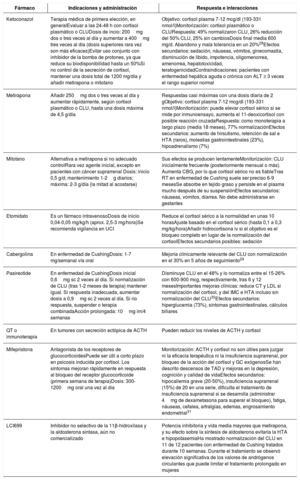
El hipercortisolismo tiene múltiples manifestaciones clínicas y morbimortalidad, aunque ningún signo o síntoma patognomónico. Una vez establecido el diagnóstico de síndrome de Cushing, debemos investigar la causa del mismo, detectando si es dependiente o independiente de ACTH. El tratamiento del hipercortisolismo debe dirigirse, siempre que sea posible, a la causa principal del síndrome. Se trata principalmente de forma quirúrgica, independientemente de su causa. Sin embargo, cuando la cirugía se retrasa, está contraindicada o no tiene éxito, a menudo se requiere terapia médica. Esta actualización revisa la evidencia científica actual respecto a la etiopatogenia, complicaciones, manejo clínico, diagnóstico y tratamiento del hipercortisolismo de origen adrenal.

Palabras clave
Hipercortisolismo
Adrenal
Diagnóstico
Tratamiento
Abstract

Although hypercortisolism has a broad clinical manifestation and high morbidity-mortality rate, it lacks any pathognomonic sign or symptom. Once Cushing's syndrome is diagnosed, the cause has to be stablished, that is, whether cortisol deficiency is dependent or independent of ACTH. When possible, hypercortisolism treatment has to be focused on main cause of the syndrome. Regardless of cause, surgery is the main treatment. Medical therapy is required when surgery is delayed, contraindicated or does not succeed. Present update reviews the current scientific evidence about etiology, complications, clinical management, diagnosis and treatment of adrenal hypercortisolism.

Keywords
Hypercortisolism
Adrenal
Diagnosis
Treatment

Identifíquese

¿Aún no es suscriptor de la revista?
Comprar el acceso al artículo

Comprando el artículo el pdf del mismo podrá ser descargado

Teléfono para incidencias

De lunes a viernes de 9h a 18h (GMT+1) excepto los meses de julio y agosto que será de 9 a 15h
Llamadas desde España 932 415 960
Llamadas desde fuera de España +34 932 415 960
Bibliografía
[1]
K.J. Griffin
202010180627410081
202010180627410082
, L.S. Kirschner, L. Matyakhina, S. Stergiopoulos, A. Robinson-White, S. Lenherr, et al.
Down-regulation of regulatory subunit type 1A of protein kinase A leads to endocrine and other tumors.
Cancer Res., (2004), 64 pp. 8811-8815
[2]
F.L. Vélayoudom-Céphise
202010180627410083
202010180627410084
, M. Haissaguerre, A. Tabarin.
Etiopathogeny of primary adrenal hypercortisolism.
Front Horm Res., (2016), 46 pp. 39-53
[3]
J. Lindholm
202010180627410085
, S. Juul, J.O.L. Jørgensen, J. Astrup, P. Bjerre, U. Feldt-Rasmussen, et al.
Incidence and late prognosis of Cushing's syndrome: A population-based study.
J Clin Endocrinol Metab., (2001), 86 pp. 117-123
[4]
K. Duan
202010180627410086
202010180627410087
, K.G. Hernández, O. Mete.
Clinicopathological correlates of adrenal Cushing's syndrome.
J Clin Pathol., (2015), 68 pp. 175-186
[5]
L. Tauchmanovà
202010180627410088
202010180627410089
, R. Rossi, B. Biondi, M. Pulcrano, V. Nuzzo, E.A. Palmieri, et al.
Patients with subclinical Cushing's syndrome due to adrenal adenoma have increased cardiovascular risk.
J Clin Endocrinol Metab., (2002), 87 pp. 4872-4878
[6]
R.F. Haskett
2020101806274100810
.
Diagnostic categorization of psychiatric disturbance in Cushing's syndrome.
Psychiatr Interpers Biol Process., (1985), pp. 911-916
[7]
L.T. Braun
2020101806274100811
2020101806274100812
, A. Riester, A. Obwal-Kopp, J. Fazel, G. Rubinstein, M. Bidlingmaier, et al.
Toward a diagnostic score in Cushing's syndrome.
Front Endocrinol., (2019), 10 pp. 766
[8]
J. Gutiérrez Restrepo
2020101806274100813
2020101806274100814
, G. Latorre Sierra, G. Campuzano Maya.
Síndrome de Cushing.
Medicina & Laboratorio., (2009), 15 pp. 411-430
[9]
L.K. Nieman
2020101806274100815
2020101806274100816
.
Cushing's syndrome: update on signs, symptoms and biochemical screening.
Eur J Endocrinol., (2015), 173 pp. M33
[10]
E. Yorke
2020101806274100817
, Y. Atiase, J. Akpalu, O. Sarfo-Kantanka.
Screening for Cushing Syndrome at the Primary Care Level: What every general practitioner must know.
Inter J Endocrinol., (2017), pp. 1-6
[11]
Y. García García
2020101806274100818
, S. Turcios Tristá, A. Acosta Cedeño, C. Díaz Socorro, M. Cabrera Gámez, E. Robles Torres.
Calidad de vida en pacientes operados de hipercortisolismo endógeno.
Revista Cubana de Endocrinología, (2014), 25 pp. 178-190
[12]
S. Santos
2020101806274100819
, E. Santos, S. Gaztambide, J. Salvador.
Diagnóstico y diagnóstico diferencial del síndrome de Cushing.
Endocrinol Nutr., (2009), 56 pp. 71-84
[13]
L. Loriaux
2020101806274100820
.
Diagnosis and differential diagnosis of Cushing's syndrome.
N Engl J Med., (2017), 376 pp. 1451-1459
[14]
L.K. Nieman
2020101806274100821
2020101806274100822
, B.M. Biller, J.W. Findling, J. Newell-Price, M.O. Savage, P.M. Stewart, et al.
The diagnosis of Cushing's syndrome: an Endocrine Society Clinical Practice Guideline.
J Clin Endocrinol Metab., (2008), 93 pp. 1526-1540
[15]
J.W. Findling
2020101806274100823
2020101806274100824
, H. Raff.
Differentiation of pathologic/neoplastic hypercortisolism (Cushing's syndrome) from physiologic/non-neoplastic hypercortisolism (formerly known as pseudo-Cushing's syndrome).
Eur J Endocrinol., (2017), 176 pp. 205-216
[16]
J. Newell-Price
2020101806274100825
, P. Trainer, M. Besser, A. Grossman.
The diagnosis and differential diagnosis of Cushing's síndrome and pseudo-Cushing's states.
Endocrine Reviews., (1998), 19 pp. 647-672
[17]
E. Yorke
2020101806274100826
2020101806274100827
, Y. Atiase, J. Akpalu, O. Sarfo-Kantanka.
Screening for Cushing syndrome at the primary care level: What every general practitioner must know.
Inter J Endocrinol. 2017, (2017), pp. 1547358
[18]
N.M. Martin
2020101806274100828
2020101806274100829
, W.S. Dhillo, A. Baneriee, A. Abdulali, C.N. Jayasena, M. Donaldson, et al.
Comparison of the dexamethasone-supressed corticotropin-releasin hormone test and low-dose dexamethasone supression test in the diagnosis of Cushing's syndrome.
J Clin Endocrinol Metab., (2006), 91 pp. 2582
[19]
S.K. Baid
2020101806274100830
2020101806274100831
, D. Rubino, N. Sinaii, S. Ramsey, A. Frank, L.K. Nieman.
Specificity of screening test for Cushing's syndrome in an overweight and obese population.
J Clin Endocrinol Metab, (2009), 94 pp. 3857
[20]
T. Mengden
2020101806274100832
2020101806274100833
, P. Hubmann, J. Müller, P. Greminger, W. Vetter.
Urinary free cortisol versus 17-hydroxycorticosteroids: a comparative study of their diagnostic value in Cushing's syndrome.
Clin Investig., (1992), 70 pp. 545
[21]
M.B. Elamin
2020101806274100834
2020101806274100835
, M.H. Murad, R. Mullan, D. Erickson, K. Harris, S. Nadeem, et al.
Accuracy of diagnostic test for Cushing's syndrome: a systematic review and metaanalyses.
J Clin Endocrinol Metabo., (2008), 93 pp. 1553
[22]
H. Raff
2020101806274100836
2020101806274100837
, P.J. Homar, E.A. Burns.
Comparison of two methods for measuring salivary cortisol.
Clin Chem., (2002), 48 pp. 207
[23]
D.A. Papanicolaou
2020101806274100838
2020101806274100839
, J.A. Yanovski, G.B. Cutler Jr., G.P. Chrousos, L.K. Nieman.
A single midnight serum cortisol measurement distinguishes Cushing's syndrome from pseudo-Cushing states.
J Clin Endocrinol Metab., (1998), 83 pp. 1163
[24]
H. Raff
2020101806274100840
2020101806274100841
, J.W. Findling.
A new immunoradiometric assay for corticotropin evaluated in normal subjects and patients with Cushing's syndrome.
Clin Chem., (1989), 35 pp. 596
[25]
J.D. Veldhuis
2020101806274100842
2020101806274100843
, A. Iranmanesh, M.L. Johnson, et al.
Amplitude but not frequency, modulation of adrenocorticotropin secretory bursts gives rise to the nyctohemeral rhythm of the corticotropic axis un man.
J Clin Endocrinol Metab., (1990), 71 pp. 452
[26]
M.A. Blake
2020101806274100844
2020101806274100845
, M.K. Kalra, A.T. Sweeney, B.C. Lucey, M.M. Maher, D.V. Sahani, et al.
Distinguishing benign from malignant adrenal masses: multi-detector row CT protocol with 10-minute delay.
Radiology., (2006), 238 pp. 578
[27]
A.M. Isidori
2020101806274100846
2020101806274100847
, G.A. Kaltsas, C. Pozza, V. Frajese, J. Newell-Price, R.H. Reznek, et al.
The ectopic adrenocorticotropin syndrome: clinical features, diagnosis, management, and long-term follow-up.
J Clin Endocrinol Metab., (2006), 91 pp. 371-377
[28]
F. Castinetti
2020101806274100848
, L. Guignat, P. Giraud, M. Muller, P. Kamenicky, D. Drui, et al.
Ketoconazole in Cushing's disease: is it worth a try?.
J Clin Endocrinol Metab., (2014), 99 pp. 1623-1630
[29]
A. Godbout
2020101806274100849
, M. Manavela, K. Danilowicz, H. Beauregard, O.D. Bruno, A. Lacroix.
Cabergoline monotherapy in the long-term treatment of Cushing's disease.
Eur J Endocrinol., (2010), 163 pp. 709-716
[30]
R. Pivonello
2020101806274100850
2020101806274100851
, S. Petersenn, J. Newell-Price, J.W. Findling, F. Gu, M. Maldonado, A. Trovato, G. Hughes, L.R. Salgado, A. Lacroix, J. Schopohl, B.M. Biller, Pasireotide B2305 Study Group.
Pasireotide treatment significantly improves clinical signs and symptoms in patients with Cushing's disease: results from a Phase III study.
Clin Endocrinol (Oxf)., (2014 Sep), 81 pp. 408-417
[31]
M. Fleseriu
2020101806274100852
, B.M. Biller, J.W. Findling, M.E. Molitch, D.E. Schteingart, C. Gross, SEISMIC Study Investigators.
Mifepristone, a glucocorticoid receptor antagonist, produces clinical and metabolic benefits in patients with Cushing's syndrome.
J Clin Endocrinol Metab., (2012), 97 pp. 2039-2049
[32]
A.K. Annamalai
2020101806274100853
, A.F. Dean, N. Kandasamy, K. Kovacs, H. Burton, D.J. Halsall, et al.
Temozolomide responsiveness in aggressive corticotroph tumours: a case report and review of the literature.
Pituitary., (2012), 15 pp. 276-287
[33]
L.K. Nieman
2020101806274100854
2020101806274100855
, B.M. Biller, J.W. Findling, M.H. Murad, J. Newell-Price, M.O. Savage, et al.
Endocrine Society. Treatment of Cushing's Syndrome: An Endocrine Society Clinical Practice Guideline.
J Clin Endocrinol Metab., (2015), 100 pp. 2807-2831
[34]
C. Di Somma
2020101806274100856
, R. Pivonello, S. Loche, A. Faggiano, M. Klain, M. Salvatore, et al.
Effect of 2 years of cortisol normalization on the impaired bone mass and turnover in adolescent and adult patients with Cushing's disease: a prospective study.
Clin Endocrinol (Oxf)., (2003), 58 pp. 302-308
[35]
L.H.A. Broersen
2020101806274100857
2020101806274100858
, C.D. Andela, O.M. Dekkers, A.M. Pereira, N.R. Biermasz.
Improvement but no normalization of quality of life and cognitive functioning after treatment of Cushing syndrome.
J Clin Endocrinol Metab., (2019), 104 pp. 5325-5337
[36]
B. Van Zaane
2020101806274100859
, E. Nur, A. Squizzato, O.M. Dekkers, M.T. Twickler, E. Fliers, et al.
Hypercoagulable state in Cushing's syndrome: a systematic review.
J Clin Endocrinol Metab., (2009), 94 pp. 2743-2750