

Vol. 13. Núm. 19.
Páginas 1072-1082 (Octubre 2020)

Actualización
Enfermedades de la secreción de aldosterona

Disorders of aldosterone secretion

M. Iturregui GuevaraaL. Larrán EscandónaC. López Tinocoab
Doi : https://10.1016/j.med.2020.10.012
Opciones
Resumen

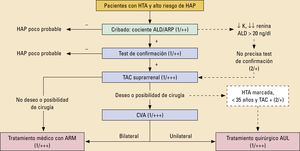
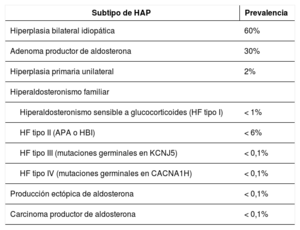
El hiperaldosteronismo y el hipoaldosteronismo responden a una secreción excesiva o insuficiente de aldosterona, respectivamente, por las glándulas suprarrenales. Las causas más frecuentes de hiperaldosteronismo primario incluyen la hiperplasia bilateral idiopática y el adenoma productor de aldosterona. El hipoaldosteronismo hiporreninémico es la causa más frecuente de hipoaldosteronismo aislado. El hiperaldosteronismo primario se caracteriza por hipertensión arterial, hipopotasemia y alcalosis metabólica y el hipoaldosteronismo por hiperpotasemia y acidosis metabólica. El cribado del hiperaldosteronismo primario consiste en la medición del cociente aldosterona/actividad de renina plasmática (ARP). Si resulta elevado, se recomiendan pruebas funcionales (sobrecarga salina intravenosa u oral, supresión con fludrocortisona o captopril). Una vez confirmado el diagnóstico, se debe realizar un estudio de imagen mediante tomografía computarizada (TC) abdominal y, en pacientes candidatos a cirugía, cateterismo de venas adrenales. En el hipoaldosteronismo se debe demostrar la incapacidad de secreción de renina y aldosterona tras pruebas funcionales estimuladoras (cambios posturales y depleción de volumen). En el hiperaldosteronismo primario por hiperplasia o adenoma unilateral, se recomienda adrenalectomía laparoscópica unilateral; cuando la afectación es bilateral y en pacientes desestimados para cirugía, se realizará tratamiento con antagonistas del receptor mineralocorticoide-espironolactona como primera elección. En el hipoaldosteronismo, restricción de potasio y terapia mineralocorticoide sustitutiva con fludrocortisona.

Palabras clave
Hiperaldosteronismo primario
Hipertensión arterial
Hipopotasemia
Hiperpotasemia
Hipoaldosternonismo
Abstract

Hyper- and hypoaldosteronism are caused by an excessive or insufficient adrenal secretion of aldosterone, respectively. Idiopathic bilateral hyperplasia and aldosterone-producing adenoma are the commonest causes of primary hyperaldosteronism. Primary hyperaldosteronism is characterized by hypertension, hypokalemia and metabolic alkalosis; in turn, hypoaldosteronism presents hyperkalemia and metabolic acidosis. The aldosterone/plasma renin activity ratio (ARR) is routinely used as a screening test of primary hyperaldosteronism. Functional tests are recommended if ARR is high (salt-loading, intravenous or oral, and fludrocortisone or captopril suppression). Once diagnostic is confirmed, imaging studies (abdominal computed tomography —CT—) and adrenal vein catheterization (in patients for surgery) have to be performed. Plasma levels of aldosterone and renin activity have to be determined by stimulatory functional tests (response to posture and volume depletion tests). Unilateral laparoscopic adrenalectomy is recommended in primary hyperaldosteronism caused by unilateral hyperplasia or adenoma; mineralocorticoid (spironolactone) receptor antagonists are the first-choice treatment for bilateral cases and in patients considered unfit for surgery. Potassium restriction and mineralocorticoid replacement therapy with fludrocortisone is the treatment of hypoaldosteronism.

Keywords
Primary hyperaldosteronism
Hypertension
Hypokalemia
Hyperkalemia
Hypoaldosteronism

Identifíquese

¿Aún no es suscriptor de la revista?

Comprar el acceso al artículo

Comprando el artículo el pdf del mismo podrá ser descargado

Teléfono para incidencias

De lunes a viernes de 9h a 18h (GMT+1) excepto los meses de julio y agosto que será de 9 a 15h

Llamadas desde España 932 415 960
Llamadas desde fuera de España +34 932 415 960
Bibliografía
[1]
J.W. Funder
202010180627527721
202010180627527722
, R.M. Carey, F. Mantero, M.H. Murad, M. Reincke, H. Shibata, et al.
The management of primary aldosteronism: Case detection, diagnosis, and treatment: An endocrine society clinical practice guideline.
J Clin Endocrinol Metab., (2016), 101 pp. 1889-1916
[2]
A. Hannemann
202010180627527723
202010180627527724
, H. Wallaschofski.
Prevalence of primary aldosteronism in patient's cohorts and in population-based studies-- a review of the current literature.
Horm Metab Res., (2012), 44 pp. 157-162
[3]
S. Douma
202010180627527725
, K. Petidis, M. Doumas, P. Papaefthimiou, A. Triantafyllou, N. Kartali, et al.
Prevalence of primary hyperaldosteronism in resistant hypertension: a retrospective observational study.
Lancet., (2008), 371 pp. 1921-1926
[4]
P. Mulatero
202010180627527726
, D. Tizzani, A. Viola, C. Bertello, S. Monticone, G. Mengozzi, et al.
Prevalence and characteristics of familial hyperaldosteronism: the PATOGEN study (Primary Aldosteronism in TOrino-GENetic forms).
Hypertension., (2011), 58 pp. 797-803
[5]
R.P. Lifton
202010180627527727
, R.G. Dluhy, M. Powers, G.M. Rich, M. Gutkin, F. Fallo, et al.
Hereditary hypertension caused by chimaeric gene duplications and ectopic expression of aldosterone synthase.
Nature Genetics., (1992), 2 pp. 66-74
[6]
W.R. Litchfield
202010180627527728
, C. Coolidge, P. Silva, R.P. Lifton, F. Fallo, G.H. Williams, et al.
Impaired potassium-stimulated aldosterone production: a possible explanation for normokalemic glucocorticoid-remediable aldosteronism.
J Clin Endocrinol Metab., (1997), 82 pp. 1507-1510
[7]
A. Pallauf
202010180627527729
, C. Schirpenbach, O. Zwermann, E. Fischer, M. Morak, E. Holinski-Feder, et al.
The prevalence of familial hyperaldosteronism in apparently sporadic primary aldosteronism in Germany: a single center experience.
Horm Metab Res., (2012), 44 pp. 215-220
[8]
M. Choi
2020101806275277210
, U.I. Scholl, P. Yue, P. Bjorklund, B. Zhao, C. Nelson-Williams, et al.
K+ channel mutations in adrenal aldosterone-producing adenomas and hereditary hypertension.
Science., (2011), 331 pp. 768-772
[9]
G. Daniil
2020101806275277211
, F.L. Fernandes-Rosa, J. Chemin, I. Blesneac, J. Beltrand, M. Polak, et al.
CACNA1H mutations are associated with different forms of primary aldosteronism.
EBioMedicine., (2016), 13 pp. 225-236
[10]
P. Milliez
2020101806275277212
, X. Girerd, P.-F. Plouin, J. Blacher, M.E. Safar, J.-J. Mourad.
Evidence for an increased rate of cardiovascular events in patients with primary aldosteronism.
J Am Coll Cardiol., (2005), 45 pp. 1243-1248
[11]
M. Stowasser
2020101806275277213
, J. Sharman, R. Leano, R.D. Gordon, G. Ward, D. Cowley, et al.
Evidence for abnormal left ventricular structure and function in normotensive individuals with familial hyperaldosteronism type I.
J Clin Endocrinol Metab., (2005), 90 pp. 5070-5076
[12]
A. Markou
2020101806275277214
, T. Pappa, G. Kaltsas, A. Gouli, K. Mitsakis, P. Tsounas, et al.
Evidence of primary aldosteronism in a predominantly female cohort of normotensive individuals: a very high odds ratio for progression into arterial hypertension.
J Clin Endocrinol Metab., (2013), 98 pp. 1409-1416
[13]
P. Mulatero
2020101806275277215
, M. Stowasser, K.-C. Loh, C.E. Fardella, R.D. Gordon, L. Mosso, et al.
Increased diagnosis of primary aldosteronism, including surgically correctable forms, in centers from five continents.
J Clin Endocrinol Metab., (2004), 89 pp. 1045-1050
[14]
G.P. Rossi
2020101806275277216
, G. Bernini, C. Caliumi, G. Desideri, B. Fabris, C. Ferri, et al.
A prospective study of the prevalence of primary aldosteronism in 1,125 hypertensive patients.
J Am Coll Cardiol., (2006), 48 pp. 2293-2300
[15]
S. Monticone
2020101806275277217
2020101806275277218
, F. D’Ascenzo, C. Moretti, T.A. Williams, F. Veglio, F. Gaita
2020101806275277219
, et al.
Cardiovascular events and target organ damage in primary aldosteronism compared with essential hypertension: a systematic review and meta-analysis.
Lancet Diabetes Endocrinol., (2018), 6 pp. 41-50
[16]
G. Hanslik
2020101806275277220
, H. Wallaschofski, A. Dietz, A. Riester, M. Reincke, B. Allolio, et al.
Increased prevalence of diabetes mellitus and the metabolic syndrome in patients with primary aldosteronism of the German Conn's Registry.
Eur J Endocrinol., (2015), 173 pp. 665-675
[17]
W. Arlt
2020101806275277221
, K. Lang, A.J. Sitch, A.S. Dietz, Y. Rhayem, I. Bancos, et al.
Steroid metabolome analysis reveals prevalent glucocorticoid excess in primary aldosteronism.
JCI Insight., (2017), 2 pp. e93136
[18]
W.F. Young
2020101806275277222
2020101806275277223
.
Diagnosis and treatment of primary aldosteronism: practical clinical perspectives.
J Intern Med., (2019), 285 pp. 126-148
[19]
W.F. Young
2020101806275277224
.
Primary aldosteronism: renaissance of a syndrome.
Clin Endocrinol., (2007), 66 pp. 607-618
[20]
L. Mosso
2020101806275277225
, C. Carvajal, A. González, A. Barraza, F. Ávila, J. Montero, et al.
Primary aldosteronism and hypertensive disease.
Hypertension., (2003), 42 pp. 161-165
[21]
T.A. Williams
2020101806275277226
2020101806275277227
, M. Reincke.
Management of endocrine disease: Diagnosis and management of primary aldosteronism: the Endocrine Society guideline 2016 revisited.
Eur J Endocrinol., (2018), 179 pp. R19-R29
[22]
J. Morera
2020101806275277228
, Y. Reznik.
Management of endocrine disease: The role of confirmatory tests in the diagnosis of primary aldosteronism.
Eur J Endocrinol., (2019), 180 pp. R45-R58
[23]
M. Stowasser
2020101806275277229
, A.H. Ahmed, D. Cowley, M. Wolley, Z. Guo, B.C. McWhinney, et al.
Comparison of seated with recumbent saline suppression testing for the diagnosis of primary aldosteronism.
J Clin Endocrinol Metab., (2018), 103 pp. 4113-4124
[24]
M.L.V. Lahera Vargas
2020101806275277230
.
Hiperaldosteronismo primario.
En: Manual de Endocrinología y Nutrición de la SEEN [Internet], (2015),
[25]
P. Mulatero
2020101806275277231
, C. Bertello, C. Garrone, D. Rossato, G. Mengozzi, A. Verhovez, et al.
Captopril test can give misleading results in patients with suspect primary aldosteronism.
Hypertension., (2007), 50 pp. e26-e27
[26]
C. Hambling
2020101806275277232
, R.T. Jung, A. Gunn, M.C. Browning, W.A. Bartlett.
Re-evaluation of the captopril test for the diagnosis of primary hyperaldosteronism.
Clin Endocrinol., (1992), 36 pp. 499-503
[27]
K. Nanba
2020101806275277233
, T. Tamanaha, K. Nakao, S.-T. Kawashima, T. Usui, T. Tagami, et al.
Confirmatory testing in primary aldosteronism.
J Clin Endocrinol Metab., (2012), 97 pp. 1688-1694
[28]
T. Nishikawa
2020101806275277234
, M. Omura, F. Satoh, H. Shibata, K. Takahashi, N. Tamura, et al.
Guidelines for the diagnosis and treatment of primary aldosteronism--the Japan Endocrine Society 2009.
Endocr J., (2011), 58 pp. 711-721
[29]
V. Lim
2020101806275277235
, Q. Guo, C.S. Grant, G.B. Thompson, M.L. Richards, D.R. Farley, et al.
Accuracy of adrenal imaging and adrenal venous sampling in predicting surgical cure of primary aldosteronism.
J Clin Endocrinol Metab., (2014), 99 pp. 2712-2719
[30]
M.J.E. Kempers
2020101806275277236
, J.W.M. Lenders, L. van Outheusden, G.J. van der Wilt, L.J. Schultze Kool, A.R.M.M. Hermus, et al.
Systematic review: diagnostic procedures to differentiate unilateral from bilateral adrenal abnormality in primary aldosteronism.
Ann Intern Med., (2009), 151 pp. 329-337
[31]
O. Vonend
2020101806275277237
, N. Ockenfels, X. Gao, B. Allolio, K. Lang, K. Mai, et al.
Adrenal venous sampling: evaluation of the German Conn's registry.
Hypertension., (2011), 57 pp. 990-995
[32]
A. Harvey
2020101806275277238
, G. Kline, J.L. Pasieka.
Adrenal venous sampling in primary hyperaldosteronism: comparison of radiographic with biochemical success and the clinical decision-making with “less than ideal” testing.
Surgery., (2006), 140 pp. 845-847
[33]
W.F. Young
2020101806275277239
, A.W. Stanson.
What are the keys to successful adrenal venous sampling (AVS) in patients with primary aldosteronism?.
Clin Endocrinol., (2009), 70 pp. 14-17
[34]
G. Kline
2020101806275277240
, D.T. Holmes.
Adrenal venous sampling for primary aldosteronism: laboratory medicine best practice.
J Clin Pathol., (2017), 70 pp. 911-916
[35]
I. Christakis
2020101806275277241
, J.A. Livesey, G.P. Sadler, R. Mihai.
Laparoscopic adrenalectomy for Conn's syndrome is beneficial to patients and is cost effective in England.
J Invest Surg., (2018), 31 pp. 300-306
[36]
M. Sywak
2020101806275277242
, J.L. Pasieka.
Long-term follow-up and cost benefit of adrenalectomy in patients with primary hyperaldosteronism.
Br J Surg., (2002), 89 pp. 1587-1593
[37]
B. Lechner
2020101806275277243
2020101806275277244
, K. Lechner, D. Heinrich, C. Adolf, F. Holler, H. Schneider, et al.
Therapy of endocrine disease: Medical treatment of primary aldosteronism.
Eur J Endocrinol., (2019), 181 pp. R147-R153
[38]
C. Wilczynski
2020101806275277245
, L. Shah, M.A. Emanuele, N. Emanuele, A. Mazhari.
Selective hypoaldosteronism: a review.
Endocr Practice., (2015), 21 pp. 957-965
[39]
L.A.P. Vilela
2020101806275277246
2020101806275277247
, M.Q. Almeida.
Diagnosis and management of primary aldosteronism.
Arch Endocrin Metab., (2017), 61 pp. 305-312
[40]
F.T. Lee
2020101806275277248
, D. Elaraj.
Evaluation and management of primary hyperaldosteronism.
Surg Clin N Am., (2019), 99 pp. 731-745