


Vol. 14. Núm. 19.
Páginas 1107-1115 (Octubre 2024)

Actualización
Estrategia terapéutica en el paciente diabético (I). Empoderamiento del paciente y educación. Objetivos terapéuticos. Estilo de vida, alimentación y control de los factores de riesgo cardiovascular. Sistemas de control glucémico

Treatment strategy for diabetic patients (I). Patient empowerment and education. Treatment goals. Lifestyle, diet, and control of cardiovascular risk factors. Glycemic control systems

A. Bayona CebadaabcdJ.B. Quiñones SilvabH.F. Escobar-MorrealebcL. Nattero Chávezabc
Doi : https://10.1016/j.med.2024.10.010
Opciones
Resumen

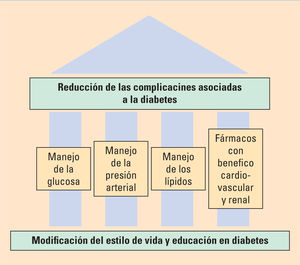
El manejo de la diabetes tipo 2 (DM2) requiere una aproximación multifactorial. La base del tratamiento es la modificación del estilo de vida y la educación en diabetes. Los pacientes deben participar en la toma de decisiones y recibir herramientas que ayuden al automanejo de su enfermedad. Los 4 pilares básicos en el manejo de la DM2 son: a) control glucémico; b) manejo de la presión arterial; c) manejo de los lípidos y d) uso de fármacos con beneficio cardiovascular y renal demostrado. En cuanto al estilo de vida, se recomienda combinar una alimentación que contribuya al mantenimiento del peso y el control glucémico, así como la incorporación de actividad física moderada rutinaria (al menos 150 minutos por semana). Los objetivos de colesterol y presión arterial deben ser individualizados para cada paciente con DM2 en función de la presencia de enfermedad cardiovascular o el riesgo cardiovascular. Se recomienda el cese del hábito tabáquico. Existen dos sistemas principales de control glucémico: la monitorización de glucosa sanguínea (glucemia capilar) y la monitorización continua de glucosa.

Palabras clave
Diabetes tipo 2
Factores de riesgo cardiovascular
Modificación del estilo de vida
Presión arterial
Lípidos
Control glucémico
Abstract

Managing type 2 diabetes (DM2) requires a multifactorial approach. The foundation of treatment is lifestyle modification and diabetes education. Patients must be involved in decision making and be given tools to help them manage their disease. The four basic pillars of DM2 management are: a) glycemic control; b) blood pressure management; c) lipid management; and d) use of drugs with proven cardiovascular and renal benefits. In terms of lifestyle, it is recommended to combine a diet that contributes to weight maintenance and glycemic control as well as the incorporation of regular moderate physical activity (at least 150minutes per week). Cholesterol and blood pressure targets should be individualized for each patient with DM2 based on the presence of cardiovascular disease or cardiovascular risk. Smoking cessation is recommended. There are two main glycemic control systems: blood glucose monitoring (capillary glycemia) and continuous glucose monitoring.

Keywords
Type 2 diabetes
Cardiovascular risk factors
Lifestyle modification
Blood pressure
Lipids
Blood glucose control

Identifíquese

¿Aún no es suscriptor de la revista?

Comprar el acceso al artículo

Comprando el artículo el pdf del mismo podrá ser descargado

Teléfono para incidencias

De lunes a viernes de 9h a 18h (GMT+1) excepto los meses de julio y agosto que será de 9 a 15h

Llamadas desde España 932 415 960
Llamadas desde fuera de España +34 932 415 960
Bibliografía
[1]
Wexler
202410150439593908
202410150439593909
DJ, Nathan DM, Rubinow K. Initial management of hyperglycemia in adults with type 2 diabetes mellitus. UpToDate [Internet]. 2024. [Última actualización 18 Mar 2024] Disponible en: www.uptodate.com.
[2]
American
2024101504395939010
2024101504395939011
Diabetes Association Professional Practice Committee.
5. facilitating positive health behaviors and well-being to improve health outcomes: Standards of care in diabetes-2024.
Diabetes Care., (2024), 47Suppl1 pp. S77-S110
[3]
D.G. Marrero
2024101504395939012
2024101504395939013
, J. Ard, A.M. Delamater, et al.
Twenty-first century behavioral medicine: a context for empowering clinicians and patients with diabetes: a consensus report.
Diabetes Care., (2013), 36 pp. 463-470
[4]
M.J. Davies
2024101504395939014
2024101504395939015
, V.R. Aroda, B.S. Collins, R.A. Gabbay, J. Green, N.M. Maruthur, et al.
Management of hyperglycemia in type 2 diabetes, 2022. A consensus report by the American Diabetes Association (ADA) and the European Association for the Study of Diabetes (EASD).
Diabetes Care., (2022), 45 pp. 2753-2786
[5]
K. Pal
2024101504395939016
2024101504395939017
, S.V. Eastwood, S. Michie, A.J. Farmer, M.L. Barnard, R. Peacock, et al.
Computer-based diabetes self-management interventions for adults with type 2 diabetes mellitus.
Cochrane Database Syst Rev., (2013), 2013 pp. CD008776
[6]
American
2024101504395939018
2024101504395939019
Diabetes Association Professional Practice Committee.
10. Cardiovascular disease and risk management: Standards of care in diabetes-2024.
Diabetes Care, (2024), 47Suppl1 pp. S179-S218
[7]
R.R. Holman
2024101504395939020
2024101504395939021
, S.K. Paul, M.A. Bethel, D.R. Matthews, H.A. Neil.
10-year follow-up of intensive glucose control in type 2 diabetes.
N Engl J Med., (2008), 359 pp. 1577-1589
[8]
R.A. Hayward
2024101504395939022
2024101504395939023
, P.D. Reaven, W.L. Wiitala, G.D. Bahn, D.J. Reda, L. Ge, et al.
VADT Investigators. Follow-up of glycemic control and cardiovascular outcomes in type 2 diabetes. N Engl J Med., (2015), 372 pp. 2197-2206
[9]
ADVANCE
2024101504395939024
2024101504395939025
Collaborative Group, A. Patel, S. MacMahon, J. Chalmers, B. Neal, L. Billot, M. Woodward, et al.
Intensive blood glucose control and vascular outcomes in patients with type 2 diabetes.
N Engl J Med., (2008), 358 pp. 2560-2572
[10]
Action
2024101504395939026
2024101504395939027
to control cardiovascular risk in Diabetes Study Group, H.C. Gerstein, M.E. Miller, R.P. Byington, D.C. Goff Jr., J.T. Bigger, J.B. Buse, et al.
Effects of intensive glucose lowering in type 2 diabetes.
N Engl J Med., (2008), 358 pp. 2545-2559
[11]
A. Rawshani
2024101504395939028
2024101504395939029
, A. Rawshani, S. Franzén, N. Sattar, B. Eliasson, A.M. Svensson, et al.
Risk factors, mortality, and cardiovascular outcomes in patients with type 2 diabetes.
N Engl J Med., (2018), 379 pp. 633-644
[12]
United
2024101504395939030
2024101504395939031
Kingdom Prospective Diabetes Study (UKPDS).
13: Relative efficacy of randomly allocated diet, sulphonylurea, insulin, or metformin in patients with newly diagnosed non-insulin dependent diabetes followedfor three years.
BMJ, (1995), 310 pp. 83-88
[13]
D. Umpierre
2024101504395939032
2024101504395939033
, P.A. Ribeiro, C.K. Kramer, C.B. Leitão, A.T. Zucatti, M.J. Azevedo, et al.
Physical activity advice only or structured exercise training and association with HbA1c levels in type 2 diabetes: a systematic review and meta-analysis.
JAMA., (2011), 305 pp. 1790-1799
[14]
A.M. Egan
2024101504395939034
2024101504395939035
, W.A. Mahmood, R. Fenton, N. Redziniak, T. Kyaw Tun, et al.
Barriers to exercise in obese patients with type 2 diabetes.
QJM., (2013), 106 pp. 635-638
[15]
Wexler
2024101504395939036
2024101504395939037
DJ, Nathan DM, Rubinow K. Overview of general medical care in nonpregnant adults with diabetes mellitus. UpToDate [Internet]. 2024. [Última actualización 22 May 2024]. Disponible en: www.uptodate.com.
[16]
P. Gaede
2024101504395939038
2024101504395939039
, P. Vedel, N. Larsen, G.V. Jensen, H.H. Parving, O. Pedersen.
Multifactorial intervention and cardiovascular disease in patients with type 2 diabetes.
N Engl J Med., (2003), 348 pp. 383-393
[17]
A.Z. Fan
2024101504395939040
2024101504395939041
, V. Rock, X. Zhang, Y. Li, L. Elam-Evans, L. Balluz.
Trends in cigarette smoking rates and quit attempts among adults with and without diagnosed diabetes, United States, 2001-2010.
Prev Chronic Dis., (2013), 10 pp. E160
[18]
E.J. Lewis
2024101504395939042
2024101504395939043
, L.G. Hunsicker, W.R. Clarke, T. Berl, M.A. Pohl, J.B. Lewis, et al.
Collaborative Study Group. Renoprotective effect of the angiotensin-receptor antagonist irbesartan in patients with nephropathy due to type 2 diabetes.
N Engl J Med., (2001), 345 pp. 851-860
[19]
B.M. Brenner
2024101504395939044
2024101504395939045
, M.E. Cooper, D. de Zeeuw, W.F. Keane, W.E. Mitch, H.H. Parving, et al.
RENAAL Study Investigators. Effects of losartan on renal and cardiovascular outcomes in patients with type 2 diabetes and nephropathy.
N Engl J Med., (2001), 345 pp. 861-869
[20]
M.A. Weber
2024101504395939046
2024101504395939047
, G.L. Bakris, K. Jamerson, M. Weir, S.E. Kjeldsen, R.B. Devereux, et al.
ACCOMPLISH Investigators. Cardiovascular events during differing hypertension therapies in patients with diabetes.
J Am Coll Cardiol, (2010), 56 pp. 77-85
[21]
American
2024101504395939048
2024101504395939049
Diabetes Association Professional Practice Committee.
7. Diabetes Technology: Standards of Care in Diabetes-2024.
Diabetes Care., (2024), 47Suppl1 pp. S126-S144
[22]
J. Rosenstock
2024101504395939050
2024101504395939051
, M. Davies, P.D. Home, J. Larsen, C. Koenen, G. Schernthaner.
A randomised, 52-week, treat-to-target trial comparing insulin detemir with insulin glargine when administered as add-on to glucose-lowering drugs in insulin-naive people with type 2 diabetes.
Diabetologia., (2008), 51 pp. 408-416
[23]
A. Farmer
2024101504395939052
2024101504395939053
, A. Wade, E. Goyder, P. Yudkin, D. French, A. Craven, et al.
Impact of self monitoring of blood glucose in the management of patients with non-insulin treated diabetes: open parallel group randomised trial.
[24]
M.J. O’Kane
2024101504395939054
2024101504395939055
, B. Bunting, M. Copeland, V.E. Coates, ESMON study group.
Efficacy of self monitoring of blood glucose in patients with newly diagnosed type 2 diabetes (ESMON study): randomised controlled trial.
BMJ., (2008), 336 pp. 1174-1177
[25]
L.A. Young
2024101504395939056
2024101504395939057
, J.B. Buse, M.A. Weaver, M.B. Vu, C.M. Mitchell, T. Blakeney, et al.
Monitor Trial Group. glucose self-monitoring in non-insulin-treated patients with type 2 diabetes in primary care settings: A randomized trial.
JAMA Intern Med., (2017), 177 pp. 920-929
[26]
W.H. Polonsky
2024101504395939058
2024101504395939059
, L. Fisher, C.H. Schikman, D.A. Hinnen, C.G. Parkin, Z. Jelsovsky, et al.
Structured self-monitoring of blood glucose significantly reduces A1C levels in poorly controlled, noninsulin-treated type 2 diabetes: results from the Structured Testing Program study.
Diabetes Care., (2011), 34 pp. 262-267
[27]
L.R. Willett
2024101504395939060
2024101504395939061
.
ACP Journal Club.
Meta-analysis: self-monitoring in non-insulin-treated type 2 diabetes improved HbA1c by 0.25%. Ann Intern Med., (2012), 156 pp. JC6-JC12
[28]
U.L. Malanda
2024101504395939062
2024101504395939063
, L.M. Welschen, I.I. Riphagen, J.M. Dekker, G. Nijpels, S.D. Bot.
Self-monitoring of blood glucose in patients with type 2 diabetes mellitus who are not using insulin.
Cochrane Database Syst Rev., (2012), 1 pp. CD005060
[29]
R.W. Beck
2024101504395939064
2024101504395939065
, T.D. Riddlesworth, K. Ruedy, A. Ahmann, S. Haller, D. Kruger, et al.
DIAMOND Study Group. Continuous glucose monitoring versus usual care in patients with type 2 diabetes receiving multiple daily insulin injections: A randomized trial.
Ann Intern Med., (2017), 167 pp. 365-374
[30]
N.M. Ehrhardt
2024101504395939066
2024101504395939067
, M. Chellappa, M.S. Walker, S.J. Fonda, R.A. Vigersky.
The effect of real-time continuous glucose monitoring on glycemic control in patients with type 2 diabetes mellitus.
J Diabetes Sci Technol., (2011), 5 pp. 668-675
[31]
H.J. Yoo
2024101504395939068
2024101504395939069
, H.G. An, S.Y. Park, O.H. Ryu, H.Y. Kim, J.A. Seo, et al.
Use of a real time continuous glucose monitoring system as a motivational device for poorly controlled type 2 diabetes.
Diabetes Res Clin Pract., (2008), 82 pp. 73-79
[32]
T. Martens
2024101504395939070
2024101504395939071
, R.W. Beck, R. Bailey, K.J. Ruedy, P. Calhoun, A.L. Peters, et al.
MOBILE Study Group. Effect of continuous glucose monitoring on glycemic control in patients with type 2 diabetes treated with basal insulin: A Randomized Clinical Trial.
JAMA., (2021), 325 pp. 2262-2272
[33]
D.A. Price
2024101504395939072
2024101504395939073
, Q. Deng, M. Kipnes, S.E. Beck.
Episodic Real-Time CGM Use in Adults with Type 2 Diabetes: Results of a pilot randomized controlled trial.
Diabetes Ther., (2021), 12 pp. 2089-2099
[34]
G. Aleppo
2024101504395939074
2024101504395939075
, R.W. Beck, R. Bailey, K.J. Ruedy, P. Calhoun, A.L. Peters, et al.
MOBILE Study Group; Type 2 diabetes basal insulin users: The Mobile Study (MOBILE) Study Group. The effect of discontinuing continuous glucose monitoring in adults with type 2 diabetes treated with basal insulin.
Diabetes Care., (2021), 44 pp. 2729-2737
[35]
T. Hakk
2024101504395939076
2024101504395939077
, H. Hanaire, R. Ajjan, N. Hermanns, J.P. Riveline, G. Rayman.
Use of flash glucose-sensing technology for 12 months as a replacement for blood glucose monitoring in insulin-treated type 2 diabetes.
Diabetes Ther., (2017), 8 pp. 573-586
[36]
M. Yaron
2024101504395939078
2024101504395939079
, E. Roitman, G. Aharon-Hananel, Z. Landau, T. Ganz, I. Yanuv, et al.
effect of flash glucose monitoring technology on glycemic control and treatment satisfaction in patients with type 2 diabetes.
Diabetes Care., (2019), 42 pp. 1178-1184
[37]
R. Aronson
2024101504395939080
2024101504395939081
, R.E. Brown, L. Chu, H.S. Bajaj, H. Khandwala, A. Abitbol, et al.
Impact of flash glucose monitoring in people with type 2 diabetes inadequately controlled with non-insulin antihyperglycaemic therapy (IMMEDIATE): A randomized controlled trial.
Diabetes Obes Metab., (2023), 25 pp. 1024-1031
[38]
E.E. Wright
2024101504395939082
2024101504395939083
Jr., M.S.D. Kerr, I.J. Reyes, Y. Nabutovsky, E. Miller.
Use of flash continuous glucose monitoring is associated with A1C reduction in people with type 2 diabetes treated with basal insulin or noninsulin therapy.
Diabetes Spectr., (2021), 34 pp. 184-189
[39]
T. Elliott
2024101504395939084
2024101504395939085
, S. Beca, R. Beharry, M.A. Tsoukas, A. Zarruk, A. Abitbol.
The impact of flash glucose monitoring on glycated hemoglobin in type 2 diabetes managed with basal insulin in Canada: A retrospective real-world chart review study.
Diab Vasc Dis Res., (2021), 18