

Vol. 13. Núm. 63.
Páginas 3730-3736 (Octubre 2022)

Síndromes de apnea e hipopnea del sueño

Sleep apnea and hypopnea syndromes

E. Ávalos Pérez-UrríaE. García CastilloG. IturricastilloP. Landete Rodríguez
Doi : https://10.1016/j.med.2022.09.004
Opciones
Resumen

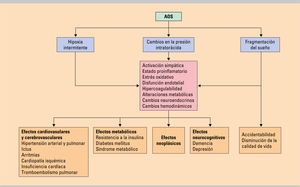
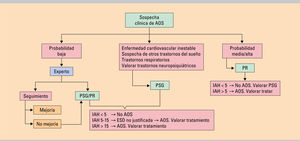
La apnea obstructiva del sueño (AOS) es uno de los trastornos más prevalentes, consistente en episodios repetidos de obstrucción de la vía aérea superior que producen una reducción del flujo respiratorio durante el sueño. La fragmentación del sueño, los cambios intermitentes en la presión intratorácica y la hipoxia intermitente producen un aumento de la actividad simpática y del estrés oxidativo y generan un estado proinflamatorio responsable del aumento del riesgo cardiovascular, de diabetes tipo 2, de determinadas neoplasias y de demencia. La sintomatología típica de la AOS consiste en la presencia de ronquidos, apneas observadas y excesiva somnolencia diurna. Las mujeres pueden tener presentaciones atípicas, por lo que es importante tener un nivel de sospecha alto para evitar el infradiagnóstico. Para su diagnóstico se precisa realizar una polisomnografía (PSG); en pacientes con probabilidad intermedia o alta se puede establecer el diagnóstico mediante poligrafía respiratoria (PR). Para su tratamiento es fundamental una adecuada higiene del sueño y tratar la obesidad. La ventilación no invasiva con presión continua en la vía aérea (CPAP) sigue siendo el tratamiento más efectivo, aunque existen en la actualidad otras medidas terapéuticas efectivas.

Palabras clave
Apnea
Hipopnea
Somnolencia
Hipoxia
Colapso
CPAP
Abstract

Obstructive sleep apnea (OSA) is one of the most prevalent disorders. It consists of repeated episodes of upper airway obstruction that produce a reduction in respiratory flow during sleep. Sleep fragmentation, intermittent changes in intrathoracic pressure, and intermittent hypoxia cause an increase in sympathetic activity and oxidative stress and generate a proinflammatory state responsible for an increase in cardiovascular risk, type 2 diabetes, certain neoplasms, and dementia. The typical symptoms of OSA include snoring, observed apneas, and excessive daytime drowsiness. Women may have atypical presentations; therefore, it is important to have a high degree of suspicion in order to avoid underdiagnosis. It is necessary to perform a polysomnogram (PSG) to diagnose it. In patients with an intermediate or high probability of having the disease, a diagnosis can be established through a respiratory polygraph (RP). Proper sleep hygiene and treating obesity are fundamental for its treatment. Continuous positive airway pressure (CPAP) non-invasive ventilation continues to be the most effective treatment, although there are other effective therapeutic measures available at present.

Keywords
Apnea
Hypopnea
Drowsiness
Hypoxia
Collapse
CPAP

Identifíquese

¿Aún no es suscriptor de la revista?

Comprar el acceso al artículo

Comprando el artículo el pdf del mismo podrá ser descargado

Teléfono para incidencias

De lunes a viernes de 9h a 18h (GMT+1) excepto los meses de julio y agosto que será de 9 a 15h

Llamadas desde España 932 415 960
Llamadas desde fuera de España +34 932 415 960
Bibliografía
[1]
O.
202209170531520098
202209170531520099
Mediano, N. González Mangado, J.M. Montserrat, M.L. Alonso-Álvarez, I. Almendros, et al.
el Spanish Sleep Network, International Consensus Document on Obstructive Sleep Apnea.
Arch Bronconeumol., (2022), 58 pp. 52-68
[2]
A.V.
2022091705315200910
Benjafield, N.T. Ayas, P.R. Eastwood, R. Heinzer, M.S.M. Ip, M.J. Morrell, et al.
Estimation of the global prevalence and burden of obstructive sleep apnoea: a literature-based analysis.
Lancet Respir Med., (2019), 7 pp. 687-698
[3]
J.M. Montserrat Canal, F.J. Puertas Cuesta.
Patología básica del sueño.
1ª ed., Elsevier, (2015),
[4]
N.G.
2022091705315200911
Mangado, C. Monasterio, N. Salord.
Documento internacional de consenso sobre apnea obstructiva del sueño. Anexo B: 2.1. La apnea obstructiva del sueño. Diagnóstico y exploración física.
Arch Bronconeumol., (2022), 58 pp. 52-68
[5]
E.
2022091705315200912
Chiner, J.M. Arriero, J. Signes-Costa, J. Marco, I. Fuentes.
Validación de la versión española del test de somnolencia Epworth en pacientes con síndrome de apnea de sueño.
Arch Bronconeumol Engl Ed [Internet] [Consultado 11 ene 2022], (1999), 35 pp. 422-427
[6]
N.C.
2022091705315200913
Netzer, R.A. Stoohs, C.M. Netzer, K. Clark, K.P. Strohl.
Using the Berlin Questionnaire to identify patients at risk for the sleep apnea syndrome.
Ann Intern Med., (1999), 131 pp. 485-491
[7]
C.L.
2022091705315200914
Chai-Coetzer, N.A. Antic, L.S. Rowland, P.G. Catcheside, A. Esterman, R.L. Reed, et al.
A simplified model of screening questionnaire and home monitoring for obstructive sleep apnoea in primary care.
Thorax., (2011), 66 pp. 213-219
[8]
H.
2022091705315200915
Marti-Soler, C. Hirotsu, P. Marques-Vidal, P. Vollenweider, G. Waeber, M. Preisig, et al.
The NoSAS score for screening of sleep-disordered breathing: a derivation and validation study.
Lancet Respir Med., (2016), 4 pp. 742-748
[9]
F.
2022091705315200916
Chung, R. Subramanyam, P. Liao, E. Sasaki, C. Shapiro, Y. Sun.
High STOP-Bang score indicates a high probability of obstructive sleep apnoea.
Br J Anaesth., (2012), 108 pp. 768-775
[10]
S.M.
2022091705315200917
2022091705315200918
Harding.
Complications and consequences of obstructive sleep apnea.
Curr Opin Pulm Med., (2000), 6 pp. 485-489
[11]
J.M.
2022091705315200919
2022091705315200920
Parish, V.K. Somers.
Obstructive sleep apnea and cardiovascular disease.
Mayo Clin Proc., (2004), 79 pp. 1036-1046
[12]
L.
2022091705315200921
Ferini-Strambi, G.E. Lombardi, S. Marelli, A. Galbiati.
Neurological deficits in obstructive sleep apnea.
Curr Treat Options Neurol., (2017), 19 pp. 16
[13]
E.
2022091705315200922
2022091705315200923
Esteller, M. Carrasco, Díaz-Herrera MÁ, J. Vila, G. Sampol, J. Juvanteny, et al.
Clinical Practice Guideline recommendations on examination of the upper airway for adults with suspected obstructive sleep apnoea-hypopnoea syndrome.
Acta Otorrinolaringol Esp (Engl Ed)., (2019), 70 pp. 364-372
[14]
V.K.
2022091705315200924
2022091705315200925
Kapur, D.H. Auckley, S. Chowdhuri, D.C. Kuhlmann, R. Mehra, K. Ramar, et al.
Clinical Practice Guideline for Diagnostic Testing for Adult Obstructive Sleep Apnea: An American Academy of Sleep Medicine Clinical Practice Guideline.
J Clin Sleep Med., (2017), 13 pp. 479-504