



Vol. 12. Núm. 4.
Páginas 159-167 (Febrero 2016)

Actualización
Síndrome de malabsorción

Malabsorption syndrome

S. Frago LarramonaS. García López
Doi : https://10.1016/j.med.2016.02.009
Opciones
Resumen
Concepto

El síndrome de malabsorción se define como una alteración en la asimilación de nutrientes que puede ser producida por malabsorción o maldigestión.

Puede producir una amplia variedad de signos y síntomas, así como diferentes alteraciones analíticas.

Etiopatogenia

Dependiendo del mecanismo patogénico responsable, se pueden producir déficits globales o específicos.

Manifestaciones clínicas

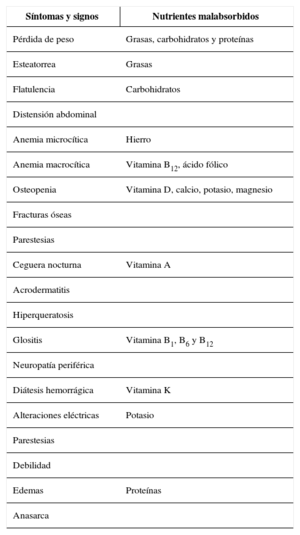
En la actualidad, el síndrome de malabsorción clásico, con esteatorrea, pérdida de peso, distensión abdominal y desnutrición no es la presentación habitual, siendo más frecuente la aparición de alteraciones analíticas aisladas o síntomas inespecíficos.

Estrategia diagnóstica

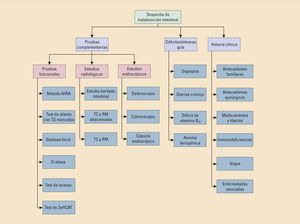
Aunque existen muchas pruebas diagnósticas disponibles, es fundamental realizar una historia clínica completa para enfocar la estrategia y pruebas diagnósticas. Conocer los fundamentos etiopatogénicos es muy útil para entender las pruebas funcionales y sus limitaciones.

Palabras clave
Malabsorción
Pruebas funcionales
Diarrea crónica
Anemia
Abstract
Concept

Malabsorption syndrome represents a disorder in nutrients assimilation which can be caused by malabsorption or maldigestión. It can bring about a variety of signs and symptoms as well as many different laboratory abnormalities.

Aetiopathogenesis

Depending on the responsible factor for the pathogenic mechanism, global or specific deficits may occur.

Clinical manifestations

Nowadays, the classic malabsorption syndrome with steatorrhea, weight loss, bloating and malnutrition is not the usual presentation. Instead, frequent occurrence of isolated laboratory abnormalities or nonspecific symptoms usually occur.

Diagnostic strategy

Although several diagnostic tests are available, it is essential to perform a complete medical history to guide diagnostic strategy and tests. Knowing the pathogenetic basis is useful to understanding the functional tests and their limitations.

Keywords
Malabsorption
Functional tests
Chronic diarrohea
Anemia

Identifíquese

¿Aún no es suscriptor de la revista?
Comprar el acceso al artículo

Comprando el artículo el pdf del mismo podrá ser descargado

Teléfono para incidencias

De lunes a viernes de 9h a 18h (GMT+1) excepto los meses de julio y agosto que será de 9 a 15h
Llamadas desde España 932 415 960
Llamadas desde fuera de España +34 932 415 960
Bibliografía
[1]
F. Gomollon.
Síndrome de malabsorción: fisiología y fisiopatología.
2ª ed., Jarpyo Editores, pp. 315-330
[2]
D.J. Rader, H.H. Hobbs.
Trastornos del metabolismo de las lipoproteínas.
18a ed., McGraw-Hill, pp. 3145-3161
[3]
J.J. Farrell.
Digestion and absorption of nutrients and vitamins.
Sleisenger and Fordtran's Gastro- intestinal and Liver Disease, 9th ed., Saunders, pp. 1695
[4]
P. Pezzilli.
Exocrine pancreas involvement in celiac disease: a review.
Recent Pat Inflamm Allergy Drug Discov, (2014), 8 pp. 167-172
[5]
K.E. Evans, J.S. Leeds, S. Morley, D.S. Sanders.
Pancreatic insufficiency in adult celiac disease: do patients require long-term enzyme supplementation?.
Dig Dis Sci, (2010), 55 pp. 2999-3004
[6]
J.L. Pérez Arellano.
Fisiopatología de la digestión y la absorción del tubo digestivo. Síndrome diarreico.
Manual de patología general, 6a ed., Masson, pp. 321-330
[7]
A.M. Kuzminski, E.J. del Giacco, R.H. Allen.
Effective treatment of cobalamin deficiency with oral cobalamin.
Blood, (1998), 92 pp. 1191-1198
[8]
P. Romero Cores, A. de los Santos Moreno, E. López Tinoco, J.A. Girón González.
Malabsorption syndrome.
Medicine, (2012), 11 pp. 197-205
[9]
C. Hogenauer, H. Hammer.
Maldigestion and malabsorption.
Sleisenger and Fordtran's gastrointestinal and liver disease, 9th ed., Saunders, pp. 1735-1767
[10]
Guía de práctica clínica: AGA Institute. AGA Institute medical position statement on the diagnosis and management of celiac disease, (2006), 131 pp. 1977-1980
[11]
A. Rubio-Tapia, M.L. Herman, J.F. Ludvigsson, D.G. Kelly, T.F. Mangan, T.T. Wu, et al.
Severe spruelike enteropathy associated with olmesartan.
Mayo Clin Proc, (2012), 87 pp. 732-738
[12]
N. Kamar, P. Faure, E. Dupuis, O. Cointault, K. Joseph-Hein, D. Durand, et al.
Villous atrophy induced by mycophenolate mofetil in renal-transplant patients.
Transpl Int, (2004), 17 pp. 463-467
[13]
J.E. Domínguez-Muñoz, J. Iglesias-García, M. Vilariño-Insua, M. Iglesias-Rey.
13C-mixed triglyceride breath test to assess oral enzyme substitution therapy in patients with chronic pancreatitis.
Clin Gastroenterol Hepatol, (2007), 5 pp. 484-488
[14]
J.E. Domínguez-Muñoz, C. Hieronymus, T. Sauerbruch, P. Malfertheiner.
Fecal elastase test: evaluation of a new noninvasive pancreatic function test.
Am J Gastroenterol, (1995), 90 pp. 1834-1837
[15]
M. Beatriz Di Carlo, F.N. López Mingorance, M. del Carmen Maselli, S. Ha-mamura, G. Otero, O.M. Tiscornia, et al.
Biochemical profile of the pan-creatic function: pancreolauril and oral glucose tolerance tests.
Acta Gastroenterol Latinoam, (2010), 40 pp. 128-133
[16]
Hovde, P.G. Farup.
A comparison of diagnostic tests for lactose malab-sorption-which one is the best?.
BMC Gastroenterol, (2009), 9 pp. 82
[17]
L. Sinha, R. Liston, H.J. Testa, K.J. Moriarty.
Idiopathic bile acid malabsorption: Qualitative and quantitative clinical features and response to cholestyramine.
Aliment Pharmacol Ther, (1998), 12 pp. 839-844
[18]
Thomas PD, Forbes A, Green J, Howdle P, Long R, Playford R, et al. Guidelines for the investigation of chronic diarrhoea. 2nd ed. Gut. 2003; 52Suppl5:v1-15.
[19]
American Gastroenterological Association medical position statement: guidelines for the evaluation and management of chronic, diarrhea.
Gastroenterology, (1999), 116 pp. 1461
[20]
F. Bermejo San José, S. García López.
Anemia de origen digestivo.
Tratamiento de las enfermedades gastroenterológicas. Manual de la Asociación Española de Gastroenterología, 3a ed, Elsevier Doyma, pp. 537-551
[21]
A.F. Goddard, A.S. McIntyre, B.B. Scott.
Guidelines for the management of iron deficiency anaemia.
Gut, (2000), 46 pp. 1-5