

Vol. 13. Núm. 49.
Páginas 2887-2890 (Febrero 2022)

Protocolo terapéutico empírico del cuadro febril agudo de probable etiología infecciosa

Empirical therapy protocol for acute fever likely of an infectious etiology

A. Ramos-MartínezabcJ. Calderón-ParraabcS. de la Fuente Moralabc
Doi : https://10.1016/j.med.2022.02.015
Opciones
Resumen

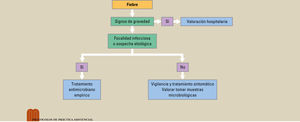
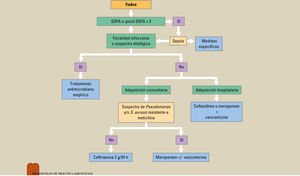
La fiebre consiste en la elevación de la temperatura corporal hasta un valor igual o superior a 38°C. La presencia de síntomas o signos de gravedad como confusión, taquipnea o hipotensión condicionan la atención hospitalaria y la administración con celeridad de un tratamiento antimicrobiano empírico. En el caso de que se sospeche una infección bacteriana de manejo extrahospitalario, el tratamiento antibiótico debe basarse en el foco infeccioso y patógenos más probables, manteniendo un control clínico estricto. En los casos de fiebre por infección comunitaria que requiere ingreso se debe emplear una cefalosporina de tercera generación o amoxicilina/clavulánico. Cuando la infección se ha originado mientras el paciente está ingresado, hay que procurar la cobertura frente a P. aeruginosa mediante cefalosporina antipseudomónicas o carbapenemas y frente a SARM con vancomicina o daptomicina. Es necesario evaluar los mecanismos de resistencia de gramnegativos más prevalentes en el entorno del paciente.

Palabras clave
Fiebre
Hipertermia
Agentes antibacterianos
Sepsis
Abstract

Fever consists of the elevation of body temperature to a value equal to or greater than 38° C. The presence of signs or symptoms of severity such as confusion, tachypnea, or hypotension requires hospital care and rapid administration of empirical antimicrobial therapy. In the event bacterial infection managed on an outpatient basis is suspected, antibiotic treatment must be based on the source of the infection and most likely pathogens, maintaining strict clinical control. In cases of fever due to community infection that require admission, a third-generation cephalosporin or amoxicillin/clavulanic acid must be used. When the infection occurs while the patient was hospitalized, coverage must be provided for P. aeruginosa through antipseudonomal cephalosporin or carbapenems and against MRSA with vancomycin or daptomycin. The mechanisms of gram-negative resistance that are most prevalent in the patient's surroundings must be evaluated.

Keywords
Fever
Hyperthermia
Antibacterial agents
Sepsis

Identifíquese

¿Aún no es suscriptor de la revista?

Comprar el acceso al artículo

Comprando el artículo el pdf del mismo podrá ser descargado

Teléfono para incidencias

De lunes a viernes de 9h a 18h (GMT+1) excepto los meses de julio y agosto que será de 9 a 15h

Llamadas desde España 932 415 960
Llamadas desde fuera de España +34 932 415 960
Bibliografía
[1]
T.L.J.
202202220910544868
202202220910544869
Lee-Chiong, J.T. Stitt.
Disorders of temperature regulation.
Compr Ther., (1995), 21 pp. 697-704
[2]
D.J.
2022022209105448610
Niven, J.E. Gaudet, K.B. Laupland, K.J. Mrklas, D.J. Roberts, H.T. Stelfox.
Accuracy of peripheral thermometers for estimating temperature: a systematic review and meta-analysis.
Ann Intern Med., (2015), 163 pp. 768-777
[3]
R.D.
2022022209105448611
Savage, R.A. Fowler, A.H. Rishu, S.M. Bagshaw, D. Cook, P. Dodek, et al.
Pathogens and antimicrobial susceptibility profiles in critically ill patients with bloodstream infections: a descriptive study.
C open., (2016), 4 pp. E569-E577
[4]
K.B.
2022022209105448612
Pouwels, S. Hopkins, M.J. Llewelyn, A.S. Walker, C.A. McNulty, J.V. Robotham.
Duration of antibiotic treatment for common infections in English primary care: cross sectional analysis and comparison with guidelines.
BMJ., (2019), 364 pp. l440
[5]
M.C.
2022022209105448613
2022022209105448614
García-Cáceres, R. Regueira-González, S. Díaz-Herranz, J.L. Martín-Rodrigo.
Fiebre en Atención Primaria.
Semer - Med Fam [Internet]., (2008), 34 pp. 149-152
[6]
P.
2022022209105448615
2022022209105448616
Cameron.
Infectious diseases emergencies.
Textbook of adult emergency medicine, 5ª ed., Elsevier, pp. 390-395
[7]
J.F. Timsit, E. Azoulay, C. Schwebel, P.E. Charles, M. Cornet, B. Souweine, et al.
Empirical micafungin treatment and survival without invasive fungal infection in adults with ICU-acquired sepsis, candida colonization, and multiple organ failure: The EMPIRICUS Randomized Clinical Trial.
JAMA., (2016), 316 pp. 1555-1564
[8]
R.J.
2022022209105448617
Flower, J.R. Vane.
Inhibition of prostaglandin synthetase in brain explains the anti-pyretic activity of paracetamol (4-acetamidophenol).
Nature., (1972), 240 pp. 410-411
[9]
J.M.
2022022209105448618
Bailey.
New mechanisms for effects of anti-inflammatory glucocorticoids.
Biofactors., (1991), 3 pp. 97-102