

Vol. 13. Núm. 49.
Páginas 2895-2898 (Febrero 2022)

Protocolo terapéutico empírico de la sepsis

Empirical therapy protocol for sepsis

V. Moreno-Torres ConchaabcI. Pintos-PascualabcJ. Calderón Parraabc
Doi : https://10.1016/j.med.2022.02.017
Opciones
Resumen

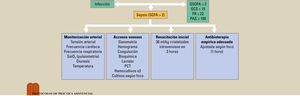
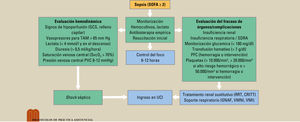
Un grupo de medidas ha demostrado ser muy eficaces en la reducción de la elevada mortalidad de la sepsis. Las actuaciones de primera línea se refieren al abordaje prácticamente inmediato del paciente séptico, incluyendo la monitorización, la evaluación del foco, la extracción de hemocultivos, la antibioterapia empírica adecuada en la primera hora y la infusión de al menos 30ml/kg de cristaloides intravenosos dentro de las 3 primeras horas, al tiempo que se realiza la determinación de lactato, procalcitonina y otros parámetros analíticos de cara a cuantificar el daño orgánico. Tras el abordaje inicial, también se deben priorizar las actuaciones de segunda línea, en las que se debe plantear el control del foco de la infección si es necesario, reevaluar la presencia de shock séptico (necesidad de vasopresores y aclaramiento de lactato) y considerar la idoneidad de técnicas (reemplazo renal o soporte respiratorio) que a su vez determinarán el ingreso en la UCI.

Palabras clave
Resucitación inicial
Antibioterapia precoz
Control del foco
Aclaramiento de lactato
Abstract

A group of measures has demonstrated to be very effective in reducing the high mortality of sepsis. First-line actions involve a practically immediate approach to a septic patient and include monitoring, evaluation of the source, extraction of blood cultures, adequate empirical antibiotic therapy in the first hour, and infusion of at least 30ml/kg of intravenous crystalloid fluids within the first three hours at the same time that determination of lactate, procalcitonin, and other analytical parameters is performed in order to quantifying organ damage. After the initial approach are second-line actions, in which control of the source of the infection must be proposed if necessary, reevaluating the presence of septic shock (need for vasopressors and lactate clearance), and considering the suitability of certain techniques (renal replacement therapy or ventilatory support) which in turn will determine ICU admission.

Keywords
Initial resuscitation
Early antibiotic therapy
Control of the source
Lactate clearance

Identifíquese

¿Aún no es suscriptor de la revista?

Comprar el acceso al artículo

Comprando el artículo el pdf del mismo podrá ser descargado

Teléfono para incidencias

De lunes a viernes de 9h a 18h (GMT+1) excepto los meses de julio y agosto que será de 9 a 15h

Llamadas desde España 932 415 960
Llamadas desde fuera de España +34 932 415 960
Bibliografía
[1]
M.
202202220911020698
202202220911020699
Cecconi, L. Evans, M. Levy, A. Rhodes.
Sepsis and septic shock.
[2]
M.
2022022209110206910
2022022209110206911
Singer, C.S. Deutschman, C.W. Seymour, M. Shankar-Hari, D. Annane, M. Bauer, et al.
The Third International Consensus Definitions for Sepsis and Septic Shock (Sepsis-3).
JAMA., (2016), 315 pp. 801-810
[3]
A.
2022022209110206912
2022022209110206913
Rhodes, L.E. Evans, W. Alhazzani, M.M. Levy, M. Antonelli, R. Ferrer, et al.
Surviving sepsis campaign: International guidelines for management of sepsis and septic shock: 2016.
Intensive Care Med., (2016), 43 pp. 304-377
[4]
Y.
2022022209110206914
Wirz, M.A. Meier, L. Bouadma, C.E. Luyt, M. Wolff, J. Chastre, et al.
Effect of procalcitonin-guided antibiotic treatment on clinical outcomes in intensive care unit patients with infection and sepsis patients: a patient-level meta-analysis of randomized trials.
Crit Care., (2018), 22 pp. 191
[5]
W.J.
2022022209110206915
Gu, Z. Zhang, J. Bakker.
Early lactate clearance-guided therapy in patients with sepsis: a meta-analysis with trial sequential analysis of randomized controlled trials.
Intensive Care Med., (2015), 41 pp. 1862-1863
[6]
T.
2022022209110206916
Cardoso, A.H. Carneiro, O. Ribeiro, A. Teixeira-Pinto, A. Costa-Pereira.
Reducing mortality in severe sepsis with the implementation of a core 6-hour bundle: results from the Portuguese community-acquired sepsis study (SACiUCI study).
Crit Care., (2010), 14 pp. R83
[7]
M.M.
2022022209110206917
Levy, A. Rhodes, G.S. Phillips, S.R. Townsend, C.A. Schorr, R. Beale.
Surviving sepsis campaign: association between performance metrics and outcomes in a 7.5-year study.
Crit Care Med., (2015), 43 pp. 3-12
[8]
R.
2022022209110206918
Ferrer, I. Martin-Loeches, G. Phillips, T.M. Osborn, S. Townsend, R.P. Dellinger, et al.
Empiric antibiotic treatment reduces mortality in severe sepsis and septic shock from the first hour: results from a guideline-based performance improvement program.
Crit Care Med., (2014), 42 pp. 1749-1755
[9]
F.
2022022209110206919
Bloos, D. Thomas-Rüddel, H. Rüddel, C. Engel, D. Schwarzkopf, J.C. Marshall, et al.
MEDUSA Study Group. Impact of compliance with infection management guidelines on outcome in patients with severe sepsis: a prospective observational multi-center study.
Crit Care., (2014), 18 pp. R42
[10]
T.
2022022209110206920
Avni, A. Lador, S. Lev, L. Leibovici, M. Paul, A. Grossman.
Vasopressors for the Treatment of Septic Shock: Systematic Review and Meta-Analysis.
PLoS One., (2015), 10 pp. e0129305