

Vol. 14. Núm. 17.
Páginas 1026-1029 (Octubre 2024)

Protocolos de práctica asistencial
Protocolo diagnóstico de la poliuria

Diagnostic protocol for polyuria

A. Rivas MontenegroL. González FernándezA. López GuerraO. González Albarrán
Doi : https://10.1016/j.med.2024.09.005
Opciones
Resumen

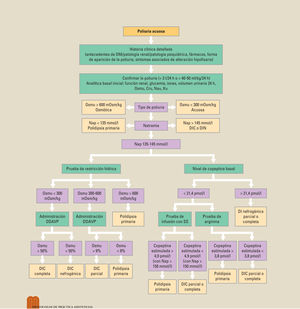
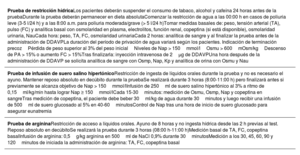
La poliuria se define como un volumen de excreción urinaria > 3 l/24h o > 40-50ml/kg/24h. Es imprescindible diferenciarlo de síntomas como nicturia y polaquiuria que se relacionan con patología urológica. Para orientar el diagnóstico es importante diferenciar si se trata de una poliuria osmótica o acuosa. La causa más frecuente de diuresis osmótica es la diabetes mellitus descompensada. Las causas principales de poliuria acuosa son polidipsia primaria (PP), deficiencia de vasopresina (AVP-D) y resistencia a la vasopresina (AVP-R). Para el enfoque diagnóstico de poliuria acuosa la realización de un diagnóstico preciso sobre las diferentes causas de poliuria es fundamental, debido a que el plan terapéutico varía. Una vez confirmada la poliuria acuosa se debe establecer la causa del síndrome poliuria-polidipsia. Actualmente, se recomienda iniciar el estudio con una medición de copeptina basal para diferenciar AVP-D de AVP-R y para distinguir AVP-D de PP medir la copeptina estimulada tras la infusión de arginina o suero hipertónico.

Palabras clave
Poliuria
Deficiencia de vasopresina
Resistencia a la vasopresina
Copeptina
Abstract

Polyuria is defined as a urinary excretion volume > 3 l/24h or > 40-50ml/kg/24h. It is essential to differentiate it from symptoms such as nocturia and pollakiuria that are related to urologic pathology. To guide the diagnosis it is important to differentiate whether it is an osmotic or aqueous polyuria. The most frequent cause of osmotic diuresis is decompensated diabetes mellitus. The main causes of aqueous polyuria are primary polydipsia (PP), vasopressin deficiency (AVP-D) and vasopressin resistance (AVP-R). Making an accurate diagnosis of the different causes of polyuria is essential because the therapeutic plan varies. Once aqueous polyuria is confirmed, the cause of the polyuria-polydipsia syndrome must be established. Currently, it is recommended to start the study with a basal copeptin measurement to differentiate AVP-D from AVP-R and to differentiate AVP-D from PP to measure stimulated copeptin after infusion of arginine or hypertonic saline.

Keywords
Polyuria
Vasopressin deficiency
Vasopressin resistance
Copeptin

Identifíquese

¿Aún no es suscriptor de la revista?

Comprar el acceso al artículo

Comprando el artículo el pdf del mismo podrá ser descargado

Teléfono para incidencias

De lunes a viernes de 9h a 18h (GMT+1) excepto los meses de julio y agosto que será de 9 a 15h

Llamadas desde España 932 415 960
Llamadas desde fuera de España +34 932 415 960
Bibliografía
[1]
M. Christ-Crain
202409250617330058
202409250617330059
.
Diabetes insipidus: New concepts for diagnosis.
Neuroendocrinology., (2020), 110 pp. 859-867
[2]
M. Christ-Crain
2024092506173300510
, B. Winzeler, J. Refardt.
Diagnosis and management of diabetes insipidus for the internist: an update.
J Intern Med., (2021), 290 pp. 73-87
[3]
Hui
2024092506173300511
C, Khan M, Khan Suheb MZ RJ. arginine vasopressin disorder (diabetes insipidus). (StatPearls IS [Internet]. TI (FL):, ed. Treasure Island (FL): StatPearls Publishing; 2024.
[4]
N. Nigro
2024092506173300512
, M. Grossmann, C. Chiang, W.J. Inder.
Polyuria-polydipsia syndrome: a diagnostic challenge.
Intern Med J., (2018), 48 pp. 244-253
[5]
M. Tomkins
2024092506173300513
2024092506173300514
, S. Lawless, J. Martin-Grace, M. Sherlock, C.J. Thompson.
Diagnosis and management of central diabetes insipidus in adults.
J Clin Endocrinol Metab., (2022), 107 pp. 2701-2715
[6]
H. Rondon-Berrios
2024092506173300515
, S. Tandukar, M.K. Mor, E.C. Ray, F.H. Bender, T.R.W.S. Kleyman.
Urea for the treatment of hyponatremia.
Clin J Am Soc Nephrol., (2018), 13 pp. 1627-1632
[7]
M.H. Gault
2024092506173300516
, M.E. Dixon, M. Doyle, W.M. Cohen.
Hypernatremia, azotemia, and dehydration ue to high-protein tube feeding.
Ann Intern Med., (1968), 68 pp. 778-791
[8]
M.R. Weir
2024092506173300517
, A. Januszewicz, R.E. Gilbert, U. Vijapurkar, I. Kline, A. Fung, et al.
Effect of canagliflozin on blood pressure and adverse events related to osmotic diuresis and reduced intravascular volume in patients with type 2 diabetes mellitus.
J Clin Hypertens., (2014), 16 pp. 875-882
[9]
M. Christ-Crain
2024092506173300518
, D.G. Bichet, W.K. Fenske, M.B. Goldman, S. Rittig, J.G. Verbalis, et al.
Diabetes insipidus.
Nat Rev Dis Primers., (2019), 5 pp. 54
[10]
J. Sands
2024092506173300519
, D. Bichet.
Nephrogenic diabetes insipidus.
Ann Intern Med., (2006), 144 pp. 186-194
[11]
K. Timper
2024092506173300520
2024092506173300521
, W. Fenske, F. Kühn, N. Frech, B. Arici, J. Rutishauser, et al.
Diagnostic accuracy of copeptin in the differential diagnosis of the polyuria-polydipsia syndrome: A prospective multicenter study.
J Clin Endocrinol Metab., (2015), 100 pp. 2268-2274
[12]
W. Fenske
2024092506173300522
2024092506173300523
, J. Refardt, I. Chifu, I. Schnyder, B. Winzeler, J. Drummond, et al.
A copeptin-based approach in the diagnosis of diabetes insipidus.
N Engl J Med., (2018), 379 pp. 428-439
[13]
B. Winzeler
2024092506173300524
2024092506173300525
, N. Cesana-Nigro, J. Refardt, D.R. Vogt, C. Imber, B. Morin, et al.
Arginine-stimulated copeptin measurements in the differential diagnosis of diabetes insipidus: a prospective diagnostic study.
Lancet., (2019), 394 pp. 587-595