

Vol. 12. Núm. 42.
Páginas 2521-2525 (Octubre 2017)

Protocolos de práctica asistencial
Protocolo de tratamiento de la dislipidemia

Treatment protocol for dyslipidaemia

S. Santamaría FernándezM. Vázquez MárquezV. Bonaiuto
Doi : https://10.1016/j.med.2017.10.007
Opciones
Resumen
Introducción

Las enfermedades cardiovasculares causan en Europa más de 4 millones de muertes anuales y constituyen la primera causa de morbimortalidad global, tanto en hombres como en mujeres. La concentración elevada de colesterol LDL (c-LDL) constituye un factor de riesgo cardiovascular (RCV) mayor y su reducción es uno de los objetivos fundamentales en la prevención cardiovascular.

Tratamiento

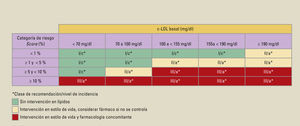
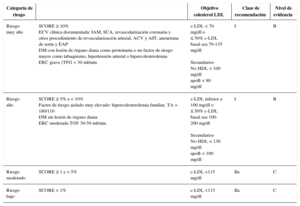
El tratamiento de las dislipidemias ha sufrido en los últimos años, en un intento de simplificación, un importante cambio de paradigma. Se sigue manteniendo el c-LDL como diana terapéutica principal; sin embargo, se ha abandonado su empleo como objetivo explícito y se ha modificado por una estrategia individualizada basada en una estratificación de RCV absoluto, de manera que el abordaje terapéutico debe realizarse en tres pasos: conocer el RCV del sujeto; marcar un objetivo individual de c-LDL y establecer un plan terapéutico.

Palabras clave
Colesterol LDL
Modelos de cálculo de riesgo
Categorías de riesgo cardiovascular
Estatinas
Abstract
Introduction

Cardiovascular disease causes more than 4 million deaths annually in Europe and are the primary cause of global morbidity and mortality in both men and women. High levels of LDL (CLDL) cholesterol constitute a major cardiovascular risk (CVR) factor; one of the fundamental objectives of cardiovascular prevention is to lower these levels.

Treatment

In recent years, in an attempt at simplification, there has been a paradigm shift in the treatment of dyslipidaemia. LDL cholesterol remains the main therapeutic target; however it is no longer used as an explicit objective and has been changed for an individualised strategy based on absolute CVR stratification. Therefore, there are three stages to the therapeutic approach: establishing the patient's CVR, setting an individual c-LDL objective, and putting together a therapeutic plan.

Keywords
LDL cholesterol
Risk calculation models
Cardiovascular risk categories
Statins

Identifíquese

¿Aún no es suscriptor de la revista?

Comprar el acceso al artículo

Comprando el artículo el pdf del mismo podrá ser descargado

Teléfono para incidencias

De lunes a viernes de 9h a 18h (GMT+1) excepto los meses de julio y agosto que será de 9 a 15h

Llamadas desde España 932 415 960
Llamadas desde fuera de España +34 932 415 960
Bibliografía
[1]
201710191208323978
N. Townsend, M. Nichols, P. Scarborough, M. Rayner.
Cardiovascular disease in Europe—epidemiological update 2015.
Eur Heart J., (2015), 36 pp. 2696-2705
[2]
201710191208323979
R.M. Conroy, K. Pyorala, A.P. Fitzgerald, S. Sans, A. Menotti, G. De Backer, et al.
Estimation of ten-year risk of fatal cardiovascular disease in Europe: the SCORE project.
EurHeart J., (2003), 24 pp. 987-1003
[3]
2017101912083239710
A.L. Catapano, I. Graham, G. De Backer, O. Wiklund, M.J. Chapman, H. Drexel, et al.
2016 ESC/EAS Guidelines for the Management of Dyslipidaemias.
Eur Heart J., (2016), 37 pp. 2999-3058
[4]
2017101912083239711
N.J. Stone, J.G. Robinson, A.H. Lichtenstein, C.N. Bairey Merz, C.B. Blum, R.H. Eckel, et al.
2013 ACC/AHA guideline on the treatment of blood cholesterol to reduce atherosclerotic cardiovascular risk in adults: a report of the American College of Cardiology/American Heart Association Task Force on Practice Guidelines.
Circulation., (2014), 129(25) pp. S1-S45
[5]
2017101912083239712
P.S. Jellinger, Y. Handelsman, P.D. Rosenblit, Z.T. Bloomgarden, V.A. Fonseca, A.J. Garber, et al.
American Association of Clinical Endocrinologist and American College of Endocrinology guidelines for management of dyslipemia and prevention of cardiovascular disease.
Endocr Pract., (2017), 23Suppl2 pp. 1-87
[6]
2017101912083239713
Expert Panel on Detection, Evaluation, and Treatment of High Blood Cholesterol in Adults: Executive Summary of the Third Report of the National Cholesterol Education Program (NCEP) Expert Panel on Detection, Evaluation, and Treatment of High Blood Cholesterol in Adults (Adult Treatment Panel III).
JAMA., (2001), 285 pp. 2486-2497
[7]
2017101912083239714
Cholesterol Treatment Trialists’ (CTT) Collaboration, Baigent C, Blackwell L, Emberson J, Holland LE, Reith C, Bhala N, et al. Efficacy and safety of more intensive lowering of LDL cholesterol: a meta-analysis of data from 170,000 participants in 26 randomised trials. Lancet. 2010; 376:1670-81.
[8]
2017101912083239715
C.P. Cannon, M.A. Blazing, R.P. Giugliano, A. McCagg, J.A. White, P. Theroux, et al.
Ezetimibe added to statin therapy after acute coronary syndromes.
N Engl J Med., (2015), 372 pp. 2387-2397
[9]
2017101912083239716
M.S. Sabatine, R.P. Giugliano, S.D. Wiviott, F.J. Raal, D.J. Blom, J. Robinson, et al.
Efficacy and safety of evolocumab in reducing lipids and cardiovascular events.
N Engl J Med., (2015), 727 pp. 1500-1509
[10]
2017101912083239717
M.S. Sabatine, R.P. Giugliano, A.C. Keech, N. Honarpour, S.D. Wiviott, S.A. Murphy, et al.
Evolocumab and Clinical Outcomes in Patients with Cardiovascular Disease.
N Engl J Med., (2017), 376 pp. 1713-1722