


Vol. 13. Núm. 87.
Páginas 5146-5154 (Octubre 2023)

Actualización
Patología vascular aguda, isquemia arterial aguda y síndrome aórtico agudo

Acute vascular pathology, acute limb ischemia, and acute aortic syndrome

Á. Moreno CuervoE. Martín MoralesJ. Río GómezF. García Boyano
Doi : https://10.1016/j.med.2023.09.004
Opciones
Resumen

La patología vascular aguda y concretamente la isquemia arterial aguda y el síndrome aórtico agudo (SAA) tienen una elevada morbimortalidad, siendo necesario realizar en un corto plazo de tiempo un correcto diagnóstico y tratamiento para reducirla.

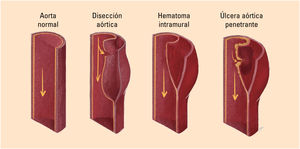
La isquemia arterial aguda es el resultado de la disminución brusca del aporte sanguíneo a las extremidades y cursa con datos de hipoperfusión, dolor e impotencia funcional de la extremidad afecta. El SAA incluye 3 entidades clínicas: la disección, el hematoma intramural y la úlcera aterosclerótica penetrante que cursan con dolor torácico súbito y lancinante asociado a hipertensión arterial.

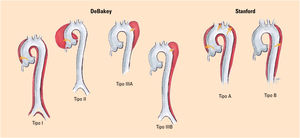
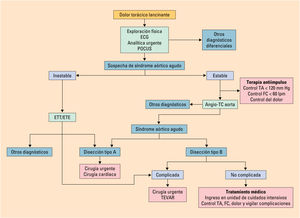
En relación con la isquemia arterial aguda, la sospecha clínica es esencial y, aunque no es imprescindible, los estudios de imagen confirman el diagnóstico y nos son de utilidad en la planificación quirúrgica. En el caso de SAA, la angiografía por TC es la prueba de elección para el diagnóstico. La anticoagulación sistémica es el tratamiento inicial de la isquemia arterial aguda, siendo en muchos casos necesario asociar cirugía de revascularización. En los casos de SAA tipo A, el tratamiento es la cirugía urgente, en el tipo B el tratamiento inicial es médico con monitorización y control tensional.

Palabras clave
Isquemia aguda de las extremidades
Trombosis aguda
Síndrome aórtico agudo
Disección de aorta
Abstract

Acute vascular pathology, and specifically acute limb ischemia and acute aortic syndrome (AAS), have a high morbidity and mortality. It is necessary to make a correct diagnosis and provide treatment to reduce it in a short period of time.

Acute limb ischemia is the result of a sudden decrease in blood supply to the limbs. It progresses with signs of hypoperfusion, pain, and functional weakness in the affected limb. AAS includes three clinical entities: dissection, intramural hematoma, and penetrating atherosclerotic ulcer. They progress with sudden, piercing pain associated with hypertension.

In regard to acute limb ischemia, clinical suspicion is essential and, although they are not indispensable, imaging studies can confirm the diagnosis and are useful in surgical planning. In the case of AAS, an angio-CT scan is the diagnostic test of choice. Systemic anticoagulation is the initial treatment for acute limb ischemia. In many cases, revascularization surgery is also necessary. In cases of type A AAS, the treatment is emergency surgery. For type B, the initial treatment is medical, with monitoring and blood pressure control.

Keywords
Acute limb isquemia
Acute thrombosis
Acute aortic syndrome
Aortic dissection

Identifíquese

¿Aún no es suscriptor de la revista?
Comprar el acceso al artículo

Comprando el artículo el pdf del mismo podrá ser descargado

Teléfono para incidencias

De lunes a viernes de 9h a 18h (GMT+1) excepto los meses de julio y agosto que será de 9 a 15h
Llamadas desde España 932 415 960
Llamadas desde fuera de España +34 932 415 960
Bibliografía
[1]
M. Björck
202310091552432568
202310091552432569
, J.J. Earnshaw, S. Acosta, F. Bastos Gonçalves, F. Cochennec, E.S. Debus, et al.
Editor's Choice - European Society for Vascular Surgery (ESVS) 2020 Clinical Practice Guidelines on the Management of Acute Limb Ischaemia.
Eur J Vasc Endovasc Surg., (2020), 59 pp. 173-218
[2]
J.R. Santistevan
2023100915524325610
2023100915524325611
.
Acute limb ischemia: An emergency medicine approach.
Emerg Med Clin North Am., (2017), 35 pp. 889-909
[3]
R.D. Acar
2023100915524325612
, M. Sahin, C. Kirma.
One of the most urgent vascular circumstances: Acute limb ischemia.
[4]
F. Fluck
2023100915524325613
, A.M. Augustin, T. Bley, R. Kickuth.
Current treatment options in acute limb ischemia.
RöFo - Fortschritte auf dem Gebiet der Röntgenstrahlen und der bildgebenden Verfahren., (2019), 192 pp. 319-326
[5]
J.J. Earnshaw
2023100915524325614
, R.J. Hinchliffe, C.J. Bailey, M.L. Shames.
Acute limb ischemia..
Rutherford's vascular surgery and endovascular therapy, 10ª ed, Elsevier, pp. 1353-1397
[6]
N. Gunawansa
2023100915524325615
.
Atraumatic acute limb ischemia: Clinical presentation, classification, assessment and management-a review.
J Vasc Surg Med., (2017), 1 pp. 10-15
[7]
M.A. Creager
2023100915524325616
2023100915524325617
, J.A. Kaufman, M.S. Conte.
Clinical practice. Acute limb ischemia.
N Engl J Med., (2012), 366 pp. 2198-2206
[8]
E. Bossone
2023100915524325618
2023100915524325619
, T. LaBounty, K. Eagle.
Acute aortic syndromes: diagnosis and management, an update.
Eur Heart J., (2018), 39 pp. 739-749
[9]
K.M. Harris
2023100915524325620
, C.E. Strauss, K.A. Eagle, A.T. Hirsch, E.M. Isselbacher, T.T. Tsai, et al.
International Registry of Acute Aortic Dissection (IRAD) Investigators. Correlates of delayed recognition and treatment of acute type A aortic dissection: the International Registry of Acute Aortic Dissection (IRAD).
Circulation., (2011), 124 pp. 1911-1918
[10]
T.T. Tsai
2023100915524325621
, C.A. Nienaber, K.A. Eagle.
Acute aortic syndromes.
Circulation., (2005), 112 pp. 3802-3813
[11]
C.A. Nienaber
2023100915524325622
2023100915524325623
, R.E. Clough.
Management of acute aortic dissection.
Lancet., (2015), 385 pp. 800-811
[12]
A. Evangelista
2023100915524325624
, E.M. Isselbacher, E. Bossone, T.G. Gleason, M. Di Eusanio, U. Sechtem, et al.
Insights from the international registry of acute aortic dissection: A 20-year experience of collaborative clinical research.
Circulation., (2018), 137 pp. 1846-1860
[13]
C. Ferrera
2023100915524325625
, I. Vilacosta, B. Cabeza, J. Cobiella, I. Martínez, M.S.P. Sanz, et al.
Diagnosing aortic intramural hematoma: Current perspectives.
Vasc Health Risk Manag., (2020), 16 pp. 203-213
[14]
I. Akin
2023100915524325626
, S. Kische, H. Ince, C. Nienaber.
Penetrating aortic ulcer, intramural hematoma, acute aortic syndrome: when to do what.
J Cardiovasc Surg (Torino)., (2012), 53 pp. 83-90
[15]
A. Julián-Jiménez
2023100915524325627
, R. Juárez González, R. Rubio Díaz, Nieto Rojas.
Manual de protocolos y actuación en urgencias.
5ª ed, SANED, (2021),
[16]
B. Williams
2023100915524325628
, G. Mancia, W. Spiering, E. Agabiti Rosei, M. Azizi, M. Burnier, et al.
ESC Scientific Document Group. 2018 ESC/ESH Guidelines for the management of arterial hypertension.
Eur Heart J., (2018), 39 pp. 3021-3104
[17]
C.A. Nienaber
2023100915524325629
, R.E. Clough.
Management of acute aortic dissection.
Lancet., (2015), 385 pp. 800-811
[18]
J.V. Lombardi
2023100915524325630
2023100915524325631
, G.C. Hughes, J.J. Appoo, J.E. Bavaria, A.W. Beck, R.P. Cambria, et al.
Society for Vascular Surgery (SVS) and Society of Thoracic Surgeons (STS) reporting standards for type B aortic dissections.
J Vasc Surg., (2020), 71 pp. 723-747
[19]
S.C. Malaisrie
2023100915524325632
, C.K. Mehta.
Updates on Indications for TEVAR in Type B Aortic Dissection.
Innovations., (2020), 15 pp. 495-501
[20]
X. Yugueros
2023100915524325633
, G. Mestres, C. García-Madrid, V. Riambau.
Actualización sobre las características pronósticas y el manejo terapéutico de la úlcera aórtica penetrante.
Angiología., (2016), 68 pp. 304-310
[21]
G.S. Oderich
2023100915524325634
, J.M. Kärkkäinen, N.R. Reed, E.R. Tenorio, G.A. Sandri.
Penetrating aortic ulcer and intramural hematoma.
Cardiovasc Intervent Radiol., (2019), 42 pp. 321-334
[22]
R. Maraj
2023100915524325635
, P. Rerkpattanapipat, L.E. Jacobs, P. Makornwattana, M.N. Kotler.
Meta-analysis of 143 reported cases of aortic intramural hematoma.
Am J Cardiol., (2000), 86 pp. 664-668