

Vol. 13. Núm. 34.
Páginas 1975-1984 (Mayo 2021)

Actualización
Enfermedad de Behçet

Behçet's disease

G. EspinosaaM. Rodríguez Carballeirab
Doi : https://10.1016/j.med.2021.05.010
Opciones
Resumen

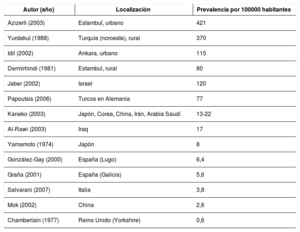
La enfermedad de Behçet es un trastorno inflamatorio crónico recidivante que cursa con brotes y cuya etiología es incierta. Su prevalencia varía según el área geográfica y la etnia, incrementándose desde el Mediterráneo hacia el Este Asiático a lo largo de la antigua «ruta de la seda». La manifestación clínica más característica son las úlceras orales y genitales, seguidas de otras lesiones cutáneas (eritema nudoso, papulopústuas, etc.) y uveítis. Con menos frecuencia se presenta con artritis, afectación gastrointestinal, vascular (arterial y venosa) y del sistema nervioso central. Tras los primeros años desde la presentación, suele evolucionar de forma favorable, pero la clínica vascular y neurológica, aunque menos común, puede ser fatal. La afectación ocular es la principal responsable de daño residual en forma de disminución de la agudeza visual. Suele comenzar en torno a la tercera década de la vida y no muestra un predominio claro de sexo, pero suele ser más grave en el masculino. El tratamiento tiene como objetivo suprimir las exacerbaciones inflamatorias y recurrencias que pueden causar daño orgánico irreversible. Debe individualizarse según el fenotipo y la gravedad de la enfermedad. Se fundamenta en la colchicina para la afectación cutaneomucosa, corticoides, otros inmunosupresores y anticuerpos monoclonales para la clínica más grave.

Palabras clave
Enfermedad de Behçet
Síndromes autoinflamatorios
Vasculitis
Revisión
Abstract

Behçet's disease is a chronic relapsing inflammatory disorder that flares and is of uncertain aetiology. Its prevalence varies by geographic area and ethnicity, increasing from the Mediterranean to East Asia along the ancient «Silk Route». Oral and genital ulcers are the most characteristic clinical manifestations, followed by other skin lesions (erythema nodosum, papulopustular lesions, etc.) and uveitis. Less frequently it presents with arthritis, gastrointestinal, vascular (arterial and venous) and central nervous system involvement. After the first few years from onset, the disease usually progresses favourably, but vascular and neurological symptoms, although less common, can be fatal. Eye involvement is primarily responsible for residual damage in the form of decreased visual acuity. It usually starts around the third decade of life and shows no clear gender predominancy, but is usually more severe in males. The aim of treatment is to suppress inflammatory flare-ups and recurrence that can cause irreversible organ damage. It should be tailored to the phenotype and severity of the disease. It is based on colchicine for involvement of the skin and mucosa, corticosteroids, other immunosuppressants and monoclonal antibodies for more severe disease.

Keywords
Behçet's disease
Autoinflammatory syndromes
Vasculitis
Revision

Identifíquese

¿Aún no es suscriptor de la revista?

Comprar el acceso al artículo

Comprando el artículo el pdf del mismo podrá ser descargado

Teléfono para incidencias

De lunes a viernes de 9h a 18h (GMT+1) excepto los meses de julio y agosto que será de 9 a 15h

Llamadas desde España 932 415 960
Llamadas desde fuera de España +34 932 415 960
Bibliografía
[1]
A. Greco, A. De Virgilio, M. Ralli, A. Ciofalo, P. Mancini, G. Attanasio, et al.
Behçet's disease: New insights into pathophysiology, clinical features and treatment options.
Autoimmun Rev., (2017), 17 pp. 567-575
[2]
C.C. Zouboulis, P. Kakdamanis.
Early descriptions of Adamantiades-Behcet's disease.
Ann Rheum Dis., (2003), 62 pp. 691-692
[3]
H. Direskeneli.
Autoimmunity versus autoinflammation in Behçet's disease: do we oversimplify a complex disorder?.
Rheumatology., (2006), 45 pp. 1461-1465
[4]
D. McGonagle, M.F. McDermott.
A proposed classification of the immunological diseases.
[5]
M. Pineton de Chambrun, B. Wechsler, G. Geri, P. Cacoub, D. Saadoun.
New insights into the pathogenesis of Behcet's disease.
Autoimmun Rev., (2012), 11 pp. 687-698
[6]
J.C. Jennette
202106080541545698
, R.J. Falk, P.A. Bacon, N. Basu, M.C. Cid, F. Ferrario, et al.
2012 revised International Chapel Hill Consensus Conference Nomenclature of Vasculitides.
Arthritis Rheum., (2013), 65 pp. 1-11
[7]
M. Melikoglu, E. Kural-Seyahi, K. Tascilar, H. Yazici.
The unique features of vasculitis in Behçet's syndrome.
Clin Rev Allergy Immunol., (2008), 35 pp. 40-46
[8]
M. Giza, D. Koftori, L. Chen, P. Bowness.
Is Behçet's disease a “class 1-opathy”? The role of HLA-B*51 in the pathogenesis of Behçet's disease.
Clin Exp Immunol., (2017), 191 pp. 11-18
[9]
C. Maldini, M.P. LaValley, M. Cheminant, M. de Menthon, A. Mahr.
Relationships of HLA-B51 or B5 genotype with Behçet's disease clinical characteristics: systematic review and meta-analyses of observational studies.
Rheumatology., (2012), 51 pp. 887-900
[10]
M. de Menthon
202106080541545699
, M.P. Lavalley, C. Maldini, L. Guillevin, A. Mahr.
HLA-B51/B5 and the risk of Behcet's disease: a systematic review and meta-analysis of case-control genetic association studies.
Arthritis Rheum., (2009), 61 pp. 1287-1296
[11]
G. Hatemi
2021060805415456910
, E. Seyahi, I. Fresko, R. Talarico, V. Hamuryudan.
One year in review 2020: Behçet's syndrome.
Clin Exp Rheumatol., (2020), 38 pp. 3-10
[12]
H. Yazici, E. Seyahi, G. Hatemi, Y. Yazici.
Behçet syndrome: a contemporary view.
Nat Rev Rheumatol., (2018), 14 pp. 107-119
[13]
M.A. Islam, S.S. Alam, S. Kundu, Prodhan AHMSU, S.S. Khandker, T. Reshetnyak, et al.
Prevalence of antiphospholipid antibodies in Behçet's disease: A systematic review and meta-analysis.
PLoS One., (2020), 15 pp. e0227836
[14]
M. Rodríguez-Carballeira
2021060805415456911
, M.A. Alba, R. Solans-Laqué, M.J. Castillo, R. Ríos-Fernández, J.R. Larrañaga, et al.
Registry of the Spanish network of Behçet's disease: a descriptive analysis of 496 patients.
Clin Exp Rheumatol., (2014), 32 pp. S33-S39
[15]
I. Tugal-Tutkun, S. Onal, R. Altan-Yaycioglu, H. Huseyin Altunbas, M. Urgancioglu.
Uveitis in Behcet disease: an analysis of 880 patients.
Am J Ophthalmol., (2004), 138 pp. 373-380
[16]
G. Akman-Demir, P. Serdaroglu, B. Tasçi.
Clinical patterns of neurological involvement in Behçet's disease: evaluation of 200 patients.
Brain., (1999), 122 pp. 2171-2182
[17]
K.T. Calamia, M. Schirmer, M. Melikoglu.
Major vessel involvement in Behcet's disease: an update.
Curr Opin Rheumatol., (2011), 23 pp. 24-31
[18]
M. Rodríguez-Carballeira, R. Solans, J.R. Larrañaga, F.J. García-Hernández, R. Rios-Fernández, J. Nieto, et al.
REGEB investigators, Autoimmune Diseases Study Group (GEAS). Venous thrombosis and relapses in patients with Behçet's disease. Descriptive analysis from Spanish network of Behçet's disease (REGEB cohort).
Clin Exp Rheumatol., (2018), 36 pp. 40-44
[19]
W. Skef
2021060805415456912
.
Gastrointestinal Behçet's disease: a review.
World J Gastroenterol., (2015), 21 pp. 3801
[20]
C. Posarelli, M.N. Maglionico, R. Talarico, G. Covello, M. Figus.
Behçet's syndrome and ocular involvement: changes over time.
Clin Exp Rheumatol., (2020), 38 pp. 86-93
[21]
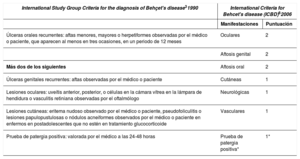
Criteria for diagnosis of Behçet's disease.
International Study Group for Behçet's Disease.
Lancet, (1990), 335 pp. 1078-1080
[22]
International Team for the Revision of the International Criteria for Behçet's Disease (ITR-ICBD).
The International Criteria for Behçet's Disease (ICBD): a collaborative study of 27 countries on the sensitivity and specificity of the new criteria.
J Eur Acad Dermatol Venereol., (2014), 28 pp. 338-347
[23]
P. Leccese, Y. Ozguler, R. Christensen, S.N. Esatoglu, D. Bang, B. Bodaghi, et al.
Management of skin, mucosa and joint involvement of Behçet's syndrome: A systematic review for update of the EULAR recommendations for the management of Behçet's syndrome.
Semin Arthritis Rheum., (2019), 48 pp. 752-762
[24]
Y. Ozguler, P. Leccese, R. Christensen, S.N. Esatoglu, D. Bang, B. Bodaghi, et al.
Management of major organ involvement of Behçet's syndrome: a systematic review for update of the EULAR recommendations.
Rheumatology (Oxford)., (2018), 57 pp. 2200-2212
[25]
E.D. Deeks
2021060805415456913
.
Apremilast: a review in oral ulcers of Behçet's disease.
Drugs., (2020), 80 pp. 181-188
[26]
E. Seyahi, H. Yazici.
To anticoagulate or not to anticoagulate vascular thrombosis in Behçet's disease: an enduring question.
Clin Exp Rheumatol., (2016), 34 pp. S3-S4
[27]
P. Uke, R. Gorodkin, N. Beare.
Biologic therapy for Behçet's uveitis: a systematic review.
Br J Ophthalmol., (2020), 104 pp. 1045-1051
[28]
E. Dincses, S.N. Esatoglu, I. Fresko, M. Melikoglu, E. Seyahi.
Outcome of invasive procedures for venous thrombosis in Behçet's syndrome: case series and systematic literature review.
Clin Exp Rheumatol., (2019), 37 pp. 125-131
[29]
M. Akiyama, Y. Kaneko, T. Takeuchi.
Effectiveness of tocilizumab in Behcet's disease: A systematic literature review.
Semin Arthritis Rheum., (2020), 50 pp. 797-804
[30]
M. Mesquida, B. Molins, V. Llorenç, M.V. Hernández, G. Espinosa, A.D. Dick, et al.
Current and future treatments for Behçet's uveitis: road to remission.
Int Ophthalmo.l, (2014), 34 pp. 365-381
[31]
D. Saadoun, B. Wechsler, K. Desseaux, D. Le Thi Huong, Z. Amoura, M. Resche-Rigon, et al.
Mortality in Behcet's disease.
Arthritis Rheum., (2010), 62 pp. 2806-2812
[32]
E. Kural-Seyahi
2021060805415456914
, I. Fresko, N. Seyahi, I. Ozyazgan, C. Mat, V. Hamuryudan, et al.
The long-term mortality and morbidity of Behçet syndrome: a 2-decade outcome survey of 387 patients followed at a dedicated center.