

Vol. 13. Núm. 21.
Páginas 1169-1177 (Noviembre 2020)

Actualización
Clasificación de las enfermedades del hematíe. Síndrome anémico y poliglobúlico. Concepto y clasificación

Classification of red blood cell disorders. Anemic and polycythemic syndrome. Concept and classification

P. Villafuerte GutiérrezP. García Ramírez
Doi : https://10.1016/j.med.2020.11.010
Opciones
Resumen

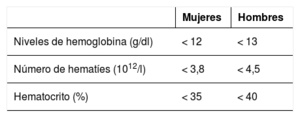
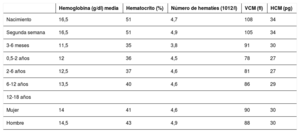
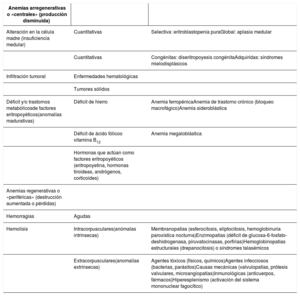
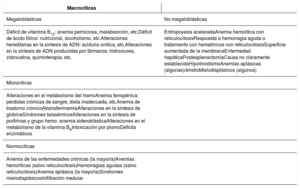
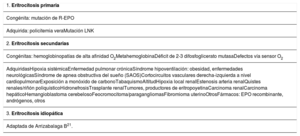
La anemia es la disminución de la masa eritrocitaria normal de una persona, siendo insuficiente para un transporte óptimo de oxígeno a los tejidos. El síndrome anémico es el conjunto de signos y síntomas derivados de este hecho y de los mecanismos compensadores según la gravedad y duración de la hipoxia. La poliglobulia se refiere a un aumento de la concentración de hemoglobina y/o hematocrito en sangre periférica. El diagnóstico de la causa específica de poliglobulia es importante para el manejo adecuado del paciente. La anemia es el resultado de una o más combinaciones de tres mecanismos básicos: pérdida de sangre, disminución de la producción de hematíes o aumento de la destrucción de hematíes (hemolisis). Según la clasificación etiopatogénica, las anemias son regenerativas («periféricas») o arregenerativas («centrales»). El diagnóstico de anemia en la práctica clínica se realiza con la cifra de hemoglobina por debajo de los valores de referencia establecidos por la OMS y otros parámetros eritrocitarios disponibles en un hemograma. Una historia clínica completa con anamnesis y exploración física exhaustiva, junto con pruebas de laboratorio además del hemograma, como el frotis de sangre periférica, reticulocitos, prueba de Coombs y patrón férrico, entre otros, nos permitirán establecer el diagnóstico diferencial inicial de la anemia basándonos en criterios morfológicos (microcítica, normocítica o macrocítica) y etiopatogénicos (regenerativas o arregenerativas).

Palabras clave
Anemia
Síndrome anémico
Eritropoyesis
Abstract

Anemia is a decrease in a person's normal red cell mass, making it insufficient for the optimal transportation of oxygen to tissues. Anemic syndrome is the set of signs and symptoms arising from this phenomenon and the compensatory mechanisms according to the severity and duration of the hypoxia. Polycythemia refers to an increase in the hemoglobin and/or hematocrit concentration in peripheral blood. The diagnosis of the specific cause of polycythemia is important for proper management of the patient. Anemia is the result of one or more combinations of three basic mechanisms: blood loss, a decrease in red blood cell production, or an increase in red blood cell destruction (hemolysis). According to the etiopathogenic classification, anemias are regenerative («peripheral») or non-regenerative («central»). A diagnosis of anemia is made in clinical practice with a hemoglobin figure below the reference values established by the WHO and other red blood cell parameters available on a complete blood count. A complete medical record with a comprehensive anamnesis and physical examination along with a complete blood count and laboratory tests, such as a peripheral blood and reticulocyte smear, Coombs test, and pattern of iron, among others, will allow us to establish an initial differential diagnosis of the anemia based on morphological (microcytic, normocytic, or macrocytic) and etiopathogenic (regenerative or non-regenerative) criteria.

Keywords
Anemia
Anemic syndrome
Erythropoiesis

Identifíquese

¿Aún no es suscriptor de la revista?

Comprar el acceso al artículo

Comprando el artículo el pdf del mismo podrá ser descargado

Teléfono para incidencias

De lunes a viernes de 9h a 18h (GMT+1) excepto los meses de julio y agosto que será de 9 a 15h

Llamadas desde España 932 415 960
Llamadas desde fuera de España +34 932 415 960
Bibliografía
[1]
202012220642551298
202012220642551299
Anemia: concepto, clínica y clasificación. En: Moraleda, J.M., Sánchez Godoy, P., Sánchez Salinas, A., editores., Pregrado de, hematología., 4ª, ed., Madrid: Luzán, 2017.
[2]
2020122206425512910
2020122206425512911
Leung LK. Approach to the adult with anemia. UpToDate 2020. Disponible en: www.uptodate.com.
[3]
2020122206425512912
2020122206425512913
E. Beutler, J. Waalen.
The definition of anemia: what is the lower limit of normal of the blood hemoglobin concentration?.
Blood., (2006), 107 pp. 1747-1750
[4]
2020122206425512914
2020122206425512915
World Health Organization. Nutritional anaemias: Report of a WHO scientific group. Geneva, Switzertland: World Health Organization. 1968.
[5]
2020122206425512916
2020122206425512917
A. Sánchez Salinas, A.M. García Hernández, A. Martínez Marín, V. Cabañas Perianes.
Síndrome anémico.
Medicine., (2016), 12 pp. 1127-1135
[6]
2020122206425512918
2020122206425512919
J. Sans Sabrafen, C. Besses, J.L. Vives-Corrons.
Hematología clínica. La anemia. Aspectos generales del diagnóstico.
5ª ed., Elsevier, (2006), pp. 107-126
[7]
2020122206425512920
2020122206425512921
J.W. Fisher.
Erythropoietin: physiology and pharmacology update.
Exp Biol Med Maywood NJ., (2003), 228 pp. 1-14
[8]
2020122206425512922
S. Toda, K. Segawa, S. Nagata.
MerTK-mediated engulfment of pyrenocytes by central macrophages in erythroblastic islands.
Blood., (2014), 123 pp. 3963-3971
[9]
2020122206425512923
S.M. Hattangadi, S. Martínez-Morilla, H.C. Patterson, J. Shi, K. Burke, A. Avila-Figueroa, et al.
Histones to the cytosol: exportin 7 is essential for normal terminal erythroid nuclear maturation.
Blood., (2014), 124 pp. 1931-1940
[10]
2020122206425512924
R.S. Hillman, K.A. Ault, M. Leporrier, H.M. Rinder.
Hematology in clinical practice.
Mc Graw-Hill, (2001),
[11]
2020122206425512925
S. Tartakover-Matalon, H. Shoham-Kessary, V. Foltyn, H. Gershon.
Receptors involved in the phagocytosis of senescent and diamide-oxidized human RBCs.
Transfusion (Paris)., (2000), 40 pp. 1494-1502
[12]
2020122206425512926
S.A. Landaw.
Factors that accelerate or retard red blood cell senescence.
Blood Cells., (1988), 14 pp. 47-67
[13]
Williams hematology, 5a ed., McGraw-Hill,
[14]
2020122206425512928
2020122206425512929
J.A. Lozano.
Síndrome anémico.
Offarm., (2002), 21 pp. 88-95
[15]
2020122206425512930
D.A. Nardone, K.M. Roth, D.J. Mazur, J.H. McAfee.
Usefulness of physical examination in detecting the presence or absence of anemia.
Arch Intern Med., (1990), 150 pp. 201-204
[16]
2020122206425512931
T. Gjørup, P.M. Bugge, C. Hendriksen, A.M. Jensen.
A critical evaluation of the clinical diagnosis of anemia.
Am J Epidemiol., (1986), 124 pp. 657-665
[17]
2020122206425512932
M.A. Sanz, E. Carreras.
Manual práctico de hematología clínica.
6a ed., Editorial Antares, (2019),
[18]
2020122206425512933
G.B. Weiss, J.D. Bessman.
Spurious automated red cell values in warm autoimmune hemolytic anemia.
Am J Hematol., (1984), 17 pp. 433-435
[19]
2020122206425512934
S. Woessner Casas, L. Florensa Brichs.
La citología óptica en el diagnóstico hematológico.
5a ed., Acción Médica, (2006),
[20]
2020122206425512935
2020122206425512936
WHO Classification of tumours of haematopoietic and lymphoid tissues, revised 4th ed. Swerdlow SH, Campo E, Harris NL, et al., editors. International Agency for Research on Cancer (IARC), Lyon 2017.
[21]
B. Arrizabalaga.
Eritrocitosis secundarias adquiridas. Eritrocitosis idiopática. Eritropatologia.
Ambos Marketing, (2017), pp. 501-513
[22]
Wintrobe's Atlas of clinical hematology, 1a ed., Wolters Kluwer,
[23]
Atlas del Grupo Español de Citología y Hematología (GECHEM). Disponible en: www.atlas.gechem.org/es/.