
Vol. 14. Núm. 46.
Páginas 2743-2755 (Diciembre 2025)

Actualización
Actualización práctica en el diagnóstico y tratamiento del insomnio

Practical update on the diagnosis and treatment of insomnia

E. AmeyugoaM. León TéllezbA. BajocM.A. Álvarez-Mondef
Doi : https://10.1016/j.med.2025.11.020
Opciones
Resumen

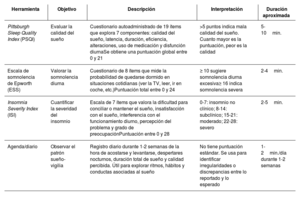
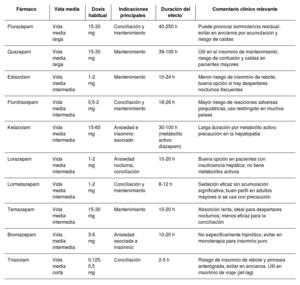
El insomnio es uno de los trastornos del sueño más frecuentes y se asocia con deterioro funcional, aumento del riesgo de comorbilidades médicas y psiquiátricas y mayores costes sanitarios. Su prevalencia alcanza el 30%-35% de la población general, aunque solo un 10%-15% cumple criterios de insomnio crónico. El diagnóstico es clínico y debe valorar factores predisponentes, precipitantes y perpetuantes, descartando causas secundarias. Herramientas como el Insomnia Severity Index (ISI), el Pittsburgh Sleep Quality Index (PSQI) y el diario de sueño pueden complementar la evaluación. El abordaje terapéutico recomendado es integral, con la terapia cognitivo-conductual para el insomnio (TCC-I) como primera elección. Sus componentes incluyen control de estímulos, restricción del tiempo en la cama, reestructuración cognitiva, técnicas de relajación y psicoeducación. La higiene del sueño no es eficaz como intervención aislada. El tratamiento farmacológico se reserva para casos seleccionados, preferiblemente a corto plazo, y comprende benzodiacepinas, fármacos Z, antidepresivos sedantes, melatonina, agonistas melatoninérgicos, antihistamínicos y neuromoduladores. En pediatría, el enfoque principal es conductual. Entre los avances recientes destaca el daridorexant, un antagonista dual de receptores de orexina aprobado en Europa.

Palabras clave
Insomnio
Diagnóstico
Tratamiento
Terapia cognitivo-conductual
Abstract

Insomnia is one of the most common sleep disorders. It is associated with functional impairment, increased risk of medical and psychiatric comorbidities, and higher healthcare costs. Its prevalence is as high as 30%-35% in the general population, although only 10%-15% meet criteria for chronic insomnia. The diagnosis is clinical and predisposing, precipitating, and perpetuating factors must be evaluated, ruling out secondary causes. Tools such as the Insomnia Severity Index (ISI), the Pittsburgh Sleep Quality Index (PSQI), and a sleep diary can complement the assessment. The recommended therapeutic approach is comprehensive, with cognitive-behavioral therapy for insomnia (CBT-I) as the first choice. Its components include stimulus control, bedtime restriction, cognitive restructuring, relaxation techniques, and psychological education. Sleep hygiene is not effective as an isolated intervention. Pharmacological treatment is reserved for selected cases and is preferably short-term. It includes benzodiazepines, Z-drugs, sedative antidepressants, melatonin, melatonergic agonists, antihistamines and neuromodulators. In pediatrics, the main approach is behavioral. Recent advances include daridorexant, a dual orexin receptor antagonist approved in Europe.

Keywords
Insomnia
Diagnosis
Treatment
Cognitive-behavioral therapy

Identifíquese

¿Aún no es suscriptor de la revista?
Comprar el acceso al artículo

Comprando el artículo el pdf del mismo podrá ser descargado

Teléfono para incidencias

De lunes a viernes de 9h a 18h (GMT+1) excepto los meses de julio y agosto que será de 9 a 15h
Llamadas desde España 932 415 960
Llamadas desde fuera de España +34 932 415 960
Bibliografía
[1]
E. Aserinsky
202512110530279808
202512110530279809
, N. Kleitman.
Regularly occurring periods of eye motility, and concomitant phenomena, during sleep.
Science., (1953), 118 pp. 273-274
[2]
O. Le Bon
2025121105302798010
2025121105302798011
.
Relationships between REM and NREM in the NREM-REM sleep cycle: a review on competing concepts.
Sleep Med., (2020), 70 pp. 6-16
[3]
M. Hirshkowitz
2025121105302798012
2025121105302798013
, K. Whiton, S.M. Albert, C. Alessi, O. Bruni, L. DonCarlos, et al.
National Sleep Foundation's sleep time duration recommendations: methodology and results summary.
Sleep Health., (2015), 1 pp. 40-43
[4]
American
2025121105302798014
2025121105302798015
Academy of Sleep Medicine.
International Classification of Sleep Disorders.
3rd ed., ICSD-3-TR, (2023),
[5]
E. Aernout
2025121105302798016
2025121105302798017
, I. Benradia, J.B. Hazo, A. Sy, F. Askevis-Leherpeux, D. Sebbane, et al.
International study of the prevalence and factors associated with insomnia in the general population.
Sleep Med., (2021), 82 pp. 186-192
[6]
L. Zhang
2025121105302798018
2025121105302798019
, Z.X. Zhao.
Objective and subjective measures for sleep disorders.
Neurosci Bull., (2007), 23 pp. 236-240
[7]
American
2025121105302798020
2025121105302798021
Psychiatric Association. Diagnostic and Statistical Manual of Mental Disorders. 2013. [Consultado 28 Sept 2025]. Disponible en: https://www.appi.org/products/dsm.
[8]
D.J. Buysse
2025121105302798022
2025121105302798023
, S. Ancoli-Israel, J.D. Edinger, K.L. Lichstein, C.M. Morin.
Recommendations for a standard research assessment of insomnia.
Sleep., (2006), 29 pp. 1155-1173
[9]
S. Schutte-Rodin
2025121105302798024
2025121105302798025
, L. Broch, D. Buysse, C. Dorsey, M. Sateia.
Clinical guideline for the evaluation and management of chronic insomnia in adults.
J Clin Sleep Med., (2008), 4 pp. 487-504
[10]
S. Paul
2025121105302798026
2025121105302798027
, K. Vidusha, S. Thilagar, D.K. Lakshmanan, G. Ravichandran, A. Arunachalam.
Advancement in the contemporary clinical diagnosis and treatment strategies of insomnia disorder.
Sleep Med., (2022), 91 pp. 124-140
[11]
E. Hertenstein
2025121105302798028
2025121105302798029
, B. Feige, T. Gmeiner, C. Kienzler, K. Spiegelhalder, A. Johann, et al.
Insomnia as a predictor of mental disorders: A systematic review and meta-analysis.
Sleep Med Rev., (2019), 43 pp. 96-105
[12]
J. Backhaus
2025121105302798030
2025121105302798031
, K. Junghanns, A. Broocks, D. Riemann, F. Hohagen.
Test-retest reliability and validity of the Pittsburgh Sleep Quality Index in primary insomnia.
J Psychosom Res., (2002), 53 pp. 737-740
[13]
D.J. Buysse
2025121105302798032
2025121105302798033
, C.F. Reynolds, T.H. Monk, S.R. Berman, D.J. Kupfer.
The Pittsburgh Sleep Quality Index: a new instrument for psychiatric practice and research.
Psychiatry Res., (1989), 28 pp. 193-213
[14]
C.H. Bastien
2025121105302798034
2025121105302798035
, A. Vallières, C.M. Morin.
Validation of the Insomnia Severity Index as an outcome measure for insomnia research.
Sleep Med., (2001), 2 pp. 297-307
[15]
C.E. Carney
2025121105302798036
2025121105302798037
, D.J. Buysse, S. Ancoli-Israel, J.D. Edinger, A.D. Krystal, K.L. Lichstein, et al.
The consensus sleep diary: standardizing prospective sleep self-monitoring.
Sleep., (2012), 35 pp. 287-302
[16]
M.J. Sateia
2025121105302798038
2025121105302798039
, D.J. Buysse, A.D. Krystal, D.N. Neubauer, J.L. Heald.
Clinical practice guideline for the pharmacologic treatment of chronic insomnia in adults: An American Academy of Sleep medicine clinical practice guideline.
J Clin Sleep Med., (2017), 13 pp. 307-349
[17]
D. Riemann
2025121105302798040
2025121105302798041
, C.A. Espie, E. Altena, E.S. Arnardottir, C. Baglioni, C.L.A. Bassetti, et al.
The European Insomnia Guideline: An update on the diagnosis and treatment of insomnia 2023.
J Sleep Res., (2023), 32 pp. e14035
[18]
C.M. Morin
2025121105302798042
2025121105302798043
, J.D. Edinger, S. Beaulieu-Bonneau, H. Ivers, A.D. Krystal, B. Guay, et al.
Effectiveness of sequential psychological and medication therapies for insomnia disorder: A randomized clinical trial.
JAMA Psychiatry, (2020), 77 pp. 1107-1115
[19]
C. Álamo
2025121105302798044
2025121105302798045
, J. Sáiz Ruiz, C.Z. Arnáez.
Orexinergic receptor antagonists as a new therapeutic target to overcome limitations of current pharmacological treatment of insomnia disorder.
Actas Esp Psiquiatr., (2024), 52 pp. 172-182
[20]
E. Hertenstein
2025121105302798046
2025121105302798047
, E. Trinca, M. Wunderlin, C.L. Schneider, M.A. Züst, K.D. Fehér, T. Su, et al.
Cognitive behavioral therapy for insomnia in patients with mental disorders and comorbid insomnia: A systematic review and meta-analysis.
Sleep Med Rev., (2022), 62 pp. 101597
[21]
L. Steinmetz
2025121105302798048
2025121105302798049
, L. Simon, B. Feige, D. Riemann, A.F. Johann, J. Ell, et al.
Network meta-analysis examining efficacy of components of cognitive behavioural therapy for insomnia.
Clin Psychol Rev., (2024), 114 pp. 102507
[22]
S. Paul
2025121105302798050
2025121105302798051
, K. Vidusha, S. Thilagar, D.K. Lakshmanan, G. Ravichandran, A. Arunachalam.
Advancement in the contemporary clinical diagnosis and treatment strategies of insomnia disorder.
Sleep Med., (2022), 91 pp. 124-140
[23]
H. Everitt
2025121105302798052
2025121105302798053
, D.S. Baldwin, B. Stuart, G. Lipinska, A. Mayers, A.L. Malizia, et al.
Antidepressants for insomnia in adults.
Cochrane Database Syst Rev., (2018), 5 pp. CD010753
[24]
J. Dewald-Kaufmann
2025121105302798054
2025121105302798055
, E. de Bruin, G. Michael.
Cognitive Behavioral Therapy for Insomnia (CBT-i) in school-aged children and adolescents.
Sleep Med Clin., (2019), 14 pp. 155-165
[25]
L.J. Meltzer
2025121105302798056
2025121105302798057
, J.A. Mindell.
Systematic review and meta-analysis of behavioral interventions for pediatric insomnia.
J Pediatr Psychol., (2014), 39 pp. 932-948
[26]
J.A. Owens
2025121105302798058
2025121105302798059
, S. Moturi.
Pharmacologic treatment of pediatric insomnia.
Child Adolesc Psychiatr Clin N Am., (2009), 18 pp. 1001-1016
[27]
M.A. Katzman
2025121105302798060
2025121105302798061
, M.P. Katzman.
Neurobiology of the orexin system and its potential role in the regulation of hedonic tone.
Brain Sci., (2022), 12 pp. 150
[28]
M.P. Mogavero
2025121105302798062
2025121105302798063
, A. Silvani, G. Lanza, R. Ferri, L.M. Delrosso, L. Ferini-Strambi.
Targeting orexin receptors for the treatment of insomnia: From physiological mechanisms to current clinical evidence and recommendations.
Nat Sci Sleep., (2023), 15 pp. 17-38
[29]
C. Roch
2025121105302798064
2025121105302798065
, G. Bergamini, M.A. Steiner, M. Clozel.
Nonclinical pharmacology of daridorexant: a new dual orexin receptor antagonist for the treatment of insomnia.
Psychopharmacology (Berl)., (2021), 238 pp. 2693L 708
[30]
E. Mignot
2025121105302798066
2025121105302798067
, D. Mayleben, I. Fietze, D. Leger, G. Zammit, C.L.A. Bassetti, et al.
investigators. Safety and efficacy of daridorexant in patients with insomnia disorder: results from two multicentre, randomised, double-blind, placebo-controlled, phase 3 trials.
Lancet Neurol., (2022), 21 pp. 125-139
[31]
D. Kunz
2025121105302798068
2025121105302798069
, Y. Dauvilliers, H. Benes, D. García-Borreguero, G. Plazzi, D. Seboek Kinter, et al.
Long-term safety and tolerability of daridorexant in patients with insomnia disorder.
CNS Drugs., (2023), 37 pp. 93-106
[32]
M. Fernandes
2025121105302798070
2025121105302798071
, F. Placidi, N.B. Mercuri, C. Liguori.
Daridorexant treatment for chronic insomnia: a real-world retrospective single-center study.
Neurol Sci., (2024), 45 pp. 3443-3448