
Vol. 12. Núm. 46.
Páginas 2731-2742 (Diciembre 2017)

Actualización
Tratamiento de la depresión

Depression treatment

M.A. Álvarez-MonV. PereiraF. Ortuño
Doi : https://10.1016/j.med.2017.12.001
Opciones
Resumen
Introducción

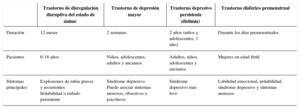
El trastorno depresivo mayor es el principal de los trastornos depresivos recogidos en el DSM-5. Afecta a poblaciones de cualquier edad y sexo, y se manifiesta con síntomas cognitivos, conductuales y afectivos. El riesgo suicida es elevado.

Tratamientos farmacológicos

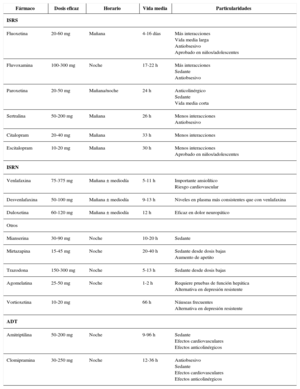
Existen numerosos fármacos eficaces en los trastornos depresivos que se clasifican según su mecanismo de acción. Destacan los inhibidores selectivos de la recaptación de la serotonina (ISRS) por su eficacia y seguridad.

Tratamientos no farmacológicos

Entre los tratamientos de neuromodulación, la terapia electroconvulsiva (TEC) es una alternativa eficaz en casos resistentes al tratamiento farmacológico. Por otra parte, cambios en el estilo de vida y algunas intervenciones psicoterapéuticas pueden resultar de utilidad en muchos pacientes.

Protocolo de tratamiento

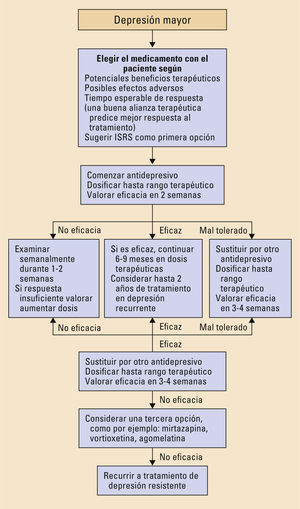
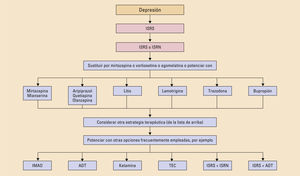
Los ISRS son la primera línea en la depresión mayor, pudiendo utilizarse otros fármacos como sustitutos o coadyuvantes en líneas posteriores de tratamiento. La TEC debe considerarse en depresión resistente en adultos y en mujeres embarazadas.

Palabras clave
Trastorno depresivo mayor
Inhibidores selectivos de recaptación de serotonina
Psicoterapia
Terapia electroconvulsiva
Abstract
Introduction

Major depressive disorder is the main depressive disorder included in DSM-5. It affects people of all ages and both sexes, and manifests with cognitive, behavioural and affective changes. The risk of suicide is high.

Drug treatment

There are several effective drugs for depressive disorders that are classified according to their mechanism of action. The selective serotonin reuptake inhibitors (SSRI) are at the forefront in terms of efficacy and safety.

Non-drug treatment

Of the neuromodulation techniques, electroconvulsive therapy (ECT) is an effective alternative for cases that are refractory to drug treatment. Moreover, lifestyle changes and some psychotherapeutic interventions can be useful for many patients.

Treatment protocol

SSRI are the first-line treatment for major treatment, and other drugs can be used as substitutes or adjuvants in subsequent treatment lines. ECT should be considered for treatment-refractory depression in adults and pregnant women.

Keywords
Major depressive disorder
Selective serotonin reuptake inhibitors
Psychotherapy
Electroconvulsive therapy

Identifíquese

¿Aún no es suscriptor de la revista?

Comprar el acceso al artículo

Comprando el artículo el pdf del mismo podrá ser descargado

Teléfono para incidencias

De lunes a viernes de 9h a 18h (GMT+1) excepto los meses de julio y agosto que será de 9 a 15h

Llamadas desde España 932 415 960
Llamadas desde fuera de España +34 932 415 960
Bibliografía
[1]
201712220518202728
R.C. Kessler, E.J. Bromet.
The epidemiology of depression across cultures.
Annu Rev Public Health., (2013), 34 pp. 119-138
[2]
201712220518202729
G.V. Polanczyk, G.A. Salum, L.S. Sugaya, A. Caye, L.A. Rohde.
Annual research review: A meta-analysis of the worldwide prevalence of mental disorders in children and adolescents.
J Child Psychol Psychiatry., (2015), 56 pp. 345-365
[3]
2017122205182027210
M.K. Nock, G. Borges, E.J. Bromet, C.B. Cha, R.C. Kessler, S. Lee.
Suicide and suicidal behavior.
Epidemiol Rev., (2008), 30 pp. 133-154
[4]
American Psychiatric, Association..
Manual diagnóstico y estadístico de los trastornos, mentales..
5ª, ed., Editorial Médica Panamericana, (2014),
[5]
2017122205182027211
J. Dean, M. Keshavan.
The neurobiology of depression: an integrated view.
Asian J Psychiatr., (2017), 27 pp. 101-111
[6]
2017122205182027212
M.B. Powers, R.A. de Kleine, J.A.J. Smits.
Core mechanisms of cognitive behavioral therapy for anxiety and depression: a review.
Psychiatr Clin North Am., (2017), 40 pp. 611-623
[7]
2017122205182027213
B. Liu, J. Liu, M. Wang, Y. Zhang, L. Li.
From serotonin to neuroplasticity: evolvement of theories for major depressive disorder.
Front Cell Neurosci., (2017), 11 pp. 305
[8]
2017122205182027214
T.M. Hillhouse, J.H. Porter.
A brief history of the development of antidepressant drugs: from monoamines to glutamate.
Exp Clin Psychopharmacol., (2015), 23 pp. 1-21
[9]
2017122205182027215
2017122205182027216
A. Cipriani, T.A. Furukawa, G. Salanti, J.R. Geddes, J.P. Higgins, R. Churchill, et al.
Comparative efficacy and acceptability of 12 new-generation antidepressants: a multiple-treatments meta-analysis.
Lancet., (2009), 373 pp. 746-758
[10]
2017122205182027217
2017122205182027218
A. Cipriani, X. Zhou, C. Del Giovane, S.E. Hetrick, B. Qin, C. Whittington, et al.
Comparative efficacy and tolerability of antidepressants for major depressive disorder in children and adolescents: a network meta-analysis.
Lancet., (2016), 388 pp. 881-890
[11]
2017122205182027219
S.M. Stahl.
Psicofarmacología esencial de Stahl.
Aula Médica, (2013),
[12]
2017122205182027220
K. Cahill, S. Stevens, R. Perera, T. Lancaster.
Pharmacological interventions for smoking cessation: an overview and network meta-analysis.
Cochrane Database Syst Rev., (2013), pp. CD009329
[13]
2017122205182027221
M. Solas, F.I. Milagro, D. Martínez-Urbistondo, M.J. Ramírez, J.A. Martínez.
Precision obesity treatments including pharmacogenetic and nutrigenetic approaches.
Trends Pharmacol Sci., (2016), 37 pp. 575-593
[14]
2017122205182027222
2017122205182027223
P. Sienaert.
Mechanisms of ECT: Reviewing the science and dismissing the myths.
[15]
2017122205182027224
M. Fink.
Celebrating 80 years of inducing brain seizures as psychiatric treatment.
[16]
2017122205182027225
M.M. Husain, A.J. Rush, M. Fink, R. Knapp, G. Petrides, T. Rummans, et al.
Speed of response and remission in major depressive disorder with acute electroconvulsive therapy (ECT): A consortium for research in ECT (CORE) report.
J Clin Psychiatry., (2004), 65 pp. 485-491
[17]
2017122205182027226
M.T. Berlim, F. van den Eynde, S. Tovar-Perdomo, Z.J. Daskalakis.
Response, remission and drop-out rates following high-frequency repetitive transcranial magnetic stimulation (rTMS) for treating major depression: a systematic review and meta-analysis of randomized, double-blind and sham-controlled trials.
Psychol Med., (2014), 44 pp. 225-239
[18]
2017122205182027227
J.J. Chen, L.B. Zhao, Y.Y. Liu, S.H. Fan, P. Xie.
Comparative efficacy and acceptability of electroconvulsive therapy versus repetitive transcranial magnetic stimulation for major depression: A systematic review and multiple-treatments meta-analysis.
Behav Brain Res., (2017), 320 pp. 30-36
[19]
2017122205182027228
C.L. Cimpianu, W. Strube, P. Falkai, U. Palm, A. Hasan.
Vagus nerve stimulation in psychiatry: a systematic review of the available evidence.
J Neural Transm (Vienna)., (2017), 124 pp. 145-158
[20]
2017122205182027229
T. Morishita, S.M. Fayad, M.A. Higuchi, K.A. Nestor, K.D. Foote.
Deep brain stimulation for treatment-resistant depression: systematic review of clinical outcomes.
Neurotherapeutics., (2014), 11 pp. 475-484
[21]
2017122205182027230
P. Molero, M.A. Martínez-González, M. Ruiz-Canela, F. Lahortiga, A. Sánchez-Villegas, A. Pérez-Cornago, et al.
Cardiovascular risk and incidence of depression in young and older adults: evidence from the SUN cohort study.
World Psychiatry., (2017), 16 pp. 111
[22]
2017122205182027231
2017122205182027232
L.H. Lemmens, A. Arntz, F. Peeters, S.D. Hollon, A. Roefs, M.J. Huibers.
Clinical effectiveness of cognitive therapy v. interpersonal psychotherapy for depression: results of a randomized controlled trial.
Psychol Med., (2015), 45 pp. 2095-2110
[23]
2017122205182027233
2017122205182027234
S.H. Kennedy, R.W. Lam, R.S. McIntyre, S.V. Tourjman, V. Bhat, P. Blier, et al.
CANMAT Depression Work Group Canadian Network for Mood and Anxiety Treatments (CANMAT) 2016 Clinical Guidelines for the Management of Adults with Major Depressive Disorder: Section 3. Pharmacological Treatments.
Can J Psychiatry., (2016), 61 pp. 540-560
[24]
2017122205182027235
2017122205182027236
D. Taylor, C. Paton, S. Kapur.
The Maudsley prescribing guidelines in psychiatry.
12th ed., Wiley Blackwell, (2015),
[25]
2017122205182027237
2017122205182027238
B.N. Gaynes, S.B. Dusetzina, A.R. Ellis, R.A. Hansen, J.F. Farley, W.C. Miller, et al.
Treating depression after initial treatment failure: directly comparing switch and augmenting strategies in STAR*D.
J Clin Psychopharmacol., (2012), 32 pp. 114-119
[26]
2017122205182027239
National Collaborating Centre for Mental Health. Depression in children and young people: identification and management in primary, community and secondary care (NICE guideline CG28). Leicester and London (UK): British Psychological Society and The Royal College of Psychiatrists; 2005.
[27]
2017122205182027240
Grupo de Trabajo de la Guía de Práctica Clínica sobre la Depresión Mayor en la Infancia y en la Adolescencia. Guía de Práctica Clínica sobre la Depresión Mayor en la Infancia y en la Adolescencia. Plan de Calidad para el Sistema Nacional de Salud del Ministerio de Sanidad y Política Social. Axencia de Avaliación de Tecnoloxías Sanitarias de Galicia (avalia-t); 2009.
[28]
Guía esencial de psicofarmacología del niño y el adolescente., Editorial Médica Panamericana S.A,
[29]
2017122205182027242
2017122205182027243
C. Locher, H. Koechlin, S.R. Zion, C. Werner, D.S. Pine, I. Kirsch, et al.
Efficacy and safety of selective serotonin reuptake inhibitors, serotonin-norepinephrine reuptake inhibitors, and placebo for common psychiatric disorders among children and adolescents: a systematic review and meta-analysis. JAMA Psychiatry.
, (2017), 74 pp. 1011-1020
[30]
2017122205182027244
M. Goldsmith, M. Singh, K. Chang.
Antidepressants and psychostimulants in pediatric populations: is there an association with mania?.
Paediatr Drugs., (2011), 13 pp. 225-243
[31]
2017122205182027245
2017122205182027246
A. Jarde, M. Morais, D. Kingston, R. Giallo, G.M. MacQueen, L. Giglia, et al.
Neonatal outcomes in women with untreated antenatal depression compared with women without depression: A systematic review and meta-analysis.
JAMA Psychiatry., (2016), 73 pp. 826-837
[32]
2017122205182027247
A. Ornoy, G. Koren.
Selective serotonin reuptake Inhibitors during pregnancy: do we have now more definite answers related to prenatal exposure?.
Birth Defects Res., (2017), 109 pp. 898-908
[33]
2017122205182027248
National Collaborating Centre for Mental Health. Antenatal and postnatal mental health: clinical management and service guidance (CG192). 2014. Leicester and London (UK): British Psychological Society and The Royal College of Psychiatrists; 2014.
[34]
2017122205182027249
J.O. Berle, O. Spigset.
Antidepressant Use during breastfeeding.
Curr Womens Health Rev., (2011), 7 pp. 28-34
[35]
2017122205182027250
2017122205182027251
R.M. Kok, C.F. Reynolds III.
Management of depression in older adults. A review.
JAMA., (2017), 317 pp. 2114-2122