

Vol. 14. Núm. 40.
Páginas 2464-2467 (Octubre 2025)

Protocolos de práctica asistencial
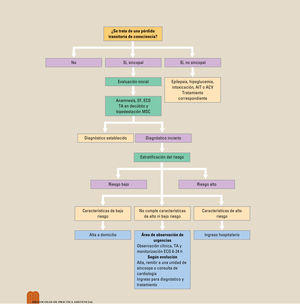
Protocolo diagnóstico del síncope en urgencias

Diagnostic protocol for syncope in the emergency department

L. Goñi BlancoabN. Pérez CastellanoabJ.J. González FerrerabJ. Pérez Villacastínab
Doi : https://10.1016/j.med.2025.09.007
Opciones
Resumen

El síncope es un motivo de consulta frecuente en los servicios de urgencias y representa un desafío diagnóstico debido a la amplia variedad de causas potenciales, desde cuadros benignos hasta condiciones potencialmente mortales. Este documento ofrece una guía práctica para la evaluación, estratificación de riesgo y manejo adecuado del paciente con síncope.

Palabras clave
Síncope
Diagnóstico
Anamnesis
Evaluación inicial
Urgencias
Abstract

Syncope is a frequent reason for consultation in the emergency department. It represents a diagnostic challenge due to the wide variety of potential causes, which range from benign to potentially life-threatening conditions. This document provides a practical guide for the assessment, risk stratification, and appropriate management of patients with syncope.

Keywords
Syncope
Diagnosis
Anamnesis
Initial evaluation
Emergency department

Identifíquese

¿Aún no es suscriptor de la revista?

Comprar el acceso al artículo

Comprando el artículo el pdf del mismo podrá ser descargado

Teléfono para incidencias

De lunes a viernes de 9h a 18h (GMT+1) excepto los meses de julio y agosto que será de 9 a 15h

Llamadas desde España 932 415 960
Llamadas desde fuera de España +34 932 415 960
Bibliografía recomendada
[1]
F. Ammirati
202510090734035968
202510090734035969
, F. Colivicchi, M. Santini.
Diagnosing syncope in clinical practice. Implementation of a simplified diagnostic algorithm in a multicentre prospective trial – the OESIL 2 study (Osservatorio Epidemiologico della Sincope nel Lazio).
Eur Heart J., (2000), 21 pp. 935-940
[2]
G. Baron-Esquivias
2025100907340359610
2025100907340359611
, J. Martínez-Alday, A. Martín, A. Moya, R. García-Civera, M. Paz López-Chicharro, et al.
Epidemiological characteristics and diagnostic approach in patients admitted to the emergency room for transient loss of consciousness: Group for Syncope Study in the Emergency Room (GESINUR) study.
Europace., (2010), 12 pp. 869-876
[3]
M. Brignole
2025100907340359612
2025100907340359613
, A. Moya, F.J. de Lange, J.C. Deharo, P.M. Elliott, A. Fanciulli, et al.
ESC Scientific Document Group. 2018 ESC Guidelines for the diagnosis and management of syncope.
Eur Heart J., (2018), 39 pp. 1883-1948
[4]
F. McCarthy
2025100907340359614
2025100907340359615
, C.G. McMahon, U. Geary, P.K. Plunkett, R.A. Kenny, C.J. Cunningham, European Society of Cardiology.
Management of syncope in the Emergency Department: a single hospital observational case series based on the application of European Society of Cardiology Guidelines.
Europace., (2009), 11 pp. 216-224
[5]
J. Pérez Villacastín
2025100907340359616
.
Sociedad Española de Cardiología, (2016),
[6]
W.K. Shen
2025100907340359617
2025100907340359618
, W.W. Decker, P.A. Smars, D.G. Goyal, A.E. Walker, D.O. Hodge, et al.
Syncope Evaluation in the Emergency Department Study (SEEDS): a multidisciplinary approach to syncope management.
Circulation., (2004), 110 pp. 3636-3645
[7]
E.S. Soteriades
2025100907340359619
2025100907340359620
, J.C. Evans, M.G. Larson, M.H. Chen, L. Chen, E.J. Benjamin, et al.
Incidence and prognosis of syncope.
N Engl J Med., (2002), 347 pp. 878-885