

Vol. 13. Núm. 65.
Páginas 3829-3837 (Octubre 2022)

Actualización
Asma bronquial

Bronchial asthma

B. Molina GarcíaO. Navarrete IsidoroA. Ruiz PeñaJ.M. Rodríguez González-Moro
Doi : https://10.1016/j.med.2022.10.003
Opciones
Resumen

El asma es una enfermedad inflamatoria crónica de las vías respiratorias con múltiples factores de riesgo implicados en su patogenia y que se caracteriza clínicamente por disnea, tos y sibilancias.

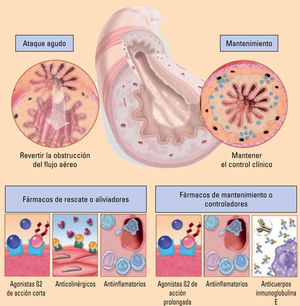
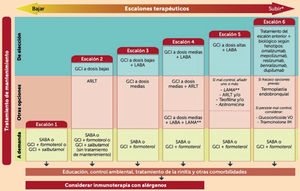
Para su diagnóstico, la clínica y la función respiratoria son las herramientas clave (espirometría con obstrucción, reversibilidad, variabilidad, óxido nítrico en aire espirado —FENO— y provocación bronquial). El tratamiento del asma tiene como finalidad el control de la enfermedad, manteniendo estables síntomas y exacerbaciones. Para implantar un adecuado tratamiento, el asma se clasifica según su gravedad y, en función de esta, se sigue el algoritmo terapéutico de 6 escalones publicado en la guía española GEMA. El pilar terapéutico fundamental son los corticoides inhalados presentes en cada uno de los escalones, asociados a otros fármacos para el control de la enfermedad (agonistas beta 2, antimuscarínicos, antagonistas de los leucotrienos). En estos últimos años, destaca la incorporación al arsenal terapéutico de los anticuerpos monoclonales para el tratamiento del asma grave alérgica y eosinofílica.

Palabras clave
Asma
Inflamación
Corticoides inhalados
Abstract

Asthma is a chronic inflammatory disease of the respiratory tract with multiple risk factors involved in its pathogenesis. It is clinically characterized by dyspnea, cough, and wheezing.

Symptoms and respiratory function are the key tools for diagnosing it (spirometry with obstruction, reversibility, variability, fractional exhaled nitric oxide —FENO—, bronchial provocation). The goals of asthma treatment are disease control and maintaining symptoms and exacerbations stable. In order to implement a suitable treatment, asthma is classified according to its severity and based on that, the six-step treatment algorithm indicated in the Spanish GEMA guidelines is followed. The fundamental pillar of therapy is inhaled corticosteroids, which is present in each of the steps, and other drugs are associated for disease control (beta2-agonists, muscarinic receptor antagonists, leukotriene receptor antagonists). In recent years, the incorporation of monoclonal antibodies into the treatment arsenal for severe allergic and eosinophilic asthma is noteworthy.

Keywords
Asthma
Inflammation
Inhaled corticosteroids

Identifíquese

¿Aún no es suscriptor de la revista?

Comprar el acceso al artículo

Comprando el artículo el pdf del mismo podrá ser descargado

Teléfono para incidencias

De lunes a viernes de 9h a 18h (GMT+1) excepto los meses de julio y agosto que será de 9 a 15h

Llamadas desde España 932 415 960
Llamadas desde fuera de España +34 932 415 960
Bibliografía
[1]
Guía
202210150552016098
202210150552016099
Española para el Manejo del ASMA (GEMA 5.1). [Consultado Feb 2022]. Disponible en: https://www.gemasma.com.
[2]
L.P. Boulet
2022101505520160910
2022101505520160911
, J.M. FitzGerald, M.L. Levy, A.A. Cruz, S. Pendersen, T. Haahtela, et al.
A guide to the translation of the global initiative for Asthma (GINA) strategy into improved care.
Eur Respir J., (2012), 39 pp. 1220-1229
[3]
M.S.S. Franken
2022101505520160912
2022101505520160913
, O.A.M. Garcia, B.D. Pabón.
Actualización del asma.
Revista Médica Sinergia., (2021), 6 pp. e717
[4]
GBD
2022101505520160914
2022101505520160915
2015 Chronic Respiratory Disease Collaborators.
Global, regional, and national deaths, prevalence, disability-adjusted life years, and years lived with disability for chronic obstructive pulmonary disease and asthma, 1990-2015: a systematic analysis for the Global Burden of Disease Study 2015.
Lancet Respir Med., (2017), 5 pp. 691-706
[5]
B. Lundbäck
2022101505520160916
2022101505520160917
, H. Backman, J. Lötvall, E. Rönmark.
Is asthma prevalence still increasing?.
Expert Rev Respir Med., (2016), 10 pp. 39-51
[6]
N. Álvarez
2022101505520160918
2022101505520160919
, F. Guillén, I. Aguinaga, J. Hermoso de Mendoza, B. Marín, I. Serrano, et al.
Estudio de prevalencia y asociación entre síntomas de asma y obesidad en la población pediátrica de Pamplona.
Nutr Hosp., (2014), 30 pp. 519-525
[7]
I. Elizalde
2022101505520160920
2022101505520160921
, F. Guillén, I. Aguinaga.
Factores asociados al asma en los niños y adolescentes de la zona rural de Navarra (España).
Aten Primaria., (2018), 50 pp. 332-339
[8]
P. López
2022101505520160922
2022101505520160923
, A.M. Gandarilla, L. Díez, M. Ordobás.
Evolución de la prevalencia de asma y factores demográficos y de salud asociados en población de 18-64 años de la Comunidad de Madrid (1996-2013).
Rev Esp Salud Pública., (2017), 91 pp. e1-e14
[9]
R. Vila-Rigat
2022101505520160924
2022101505520160925
, R. Panadès, E. Hernández, J. Sivecas, X. Blanché, L. Muñoz-Ortiz, et al.
Prevalence of work-related asthma and its impact in Primary Health Care.
Arch Bronconeumol., (2015), 51 pp. 449-455
[10]
S.F. Thomsen
2022101505520160926
2022101505520160927
.
Genetics of asthma: an introduction for the clinician.
Eur Clin Respir J., (2015), 2
[11]
World
2022101505520160928
2022101505520160929
Health Organization.
Ambient air pollution: a global assessment of exposure and burden of disease.
World Health Organization, (2016),
[12]
Health
2022101505520160930
2022101505520160931
Effects Institute.
State of Global Air 2019: Special Report on global exposure to air pollution and its disease burden.
Health Effects Institute, (2019),
[13]
S.J. Levine
2022101505520160932
2022101505520160933
, S.E. Wenzel.
Narrative review: the role of Th2 immune pathway modulation in the treatment of severe asthma and its phenotypes.
Ann Intern Med., (2010), 152 pp. 232-237
[14]
P.J. Barnes
2022101505520160934
2022101505520160935
.
Pathophysiology of allergic inflammation.
Immunol Rev., (2011), 242 pp. 31-50
[15]
S. Al-Muhsen
2022101505520160936
2022101505520160937
, J.R. Johnson, Q. Hamid.
Remodeling in asthma.
J Allergy Clin Immunol., (2011), 128 pp. 451-462
[16]
GINA
2022101505520160938
2022101505520160939
Report, Global Strategy for Asthma Management and Prevention 2021 update. [Consultado Feb 2022]. Disponible en: https://ginasthma.org/wp-content/uploads/2021/05/GINA-Main-Report-2021-V2-WMS.pdf.
[17]
NAEPP-EP
2022101505520160940
2022101505520160941
2007.
Nacional Asthma Education and Prevention Program. Expert Panel Report Guidelines for the diagnosis and management of asthma.
National Institutes of Health, National Heart, Lung, and Blood Institute, (2007),
[18]
D.W. Cockcroft
2022101505520160942
2022101505520160943
, V.A. Swystun.
Asthma control versus asthma severity.
J Allergy Clin Immunol., (1996), 98 pp. 1016-1018
[19]
S.W. Stoloff
2022101505520160944
2022101505520160945
, H.A. Boushey.
Severity, control, and responsiveness in asthma.
J Allergy Clin Immunol., (2006), 117 pp. 544-548
[20]
D.R. Taylor
2022101505520160946
2022101505520160947
, E.D. Bateman, L.P. Boulet, H.A. Boushey, W.W. Busse, T.B. Casale, et al.
A new perspective on concepts of asthma severity and control.
Eur Respir J., (2008), 32 pp. 545-554
[21]
D. Dusser
2022101505520160948
2022101505520160949
, D. Montani, P. Chanez.
Mild asthma: an expert review on epidemiology, clinical characteristics and treatment recommendations.
[22]
N. Shahidi
2022101505520160950
2022101505520160951
, J.M. FitzGerald.
Current recommendations for the treatment of mild asthma.
J Asthma Allergy., (2010), 3 pp. 169-176
[23]
H.K. Reddel
2022101505520160952
2022101505520160953
, J.M. FitzGerald, E.D. Bateman, L.B. Bacharier, A. Becker, G. Brusselle, et al.
GINA 2019: a fundamental change in asthma management Treatment of asthma with short-acting bronchodilators alone is no longer recommended for adults and adolescents.
Eur Respir J., (2019), 53 pp. 1901046
[24]
J. Muneswarao
2022101505520160954
2022101505520160955
, M.Z. Hassali, B. Ibrahim, B. Saini, I.A. Hyder, A.K. Verma.
It is time to change the way we manage mild asthma: an update in GINA 2019.
Respir Res., (2019), 20 pp. 183
[25]
R. Pellegrino
2022101505520160956
2022101505520160957
, G. Viegi, V. Brusasco, R.O. Crapo, F. Burgos, R. Casaburi, et al.
Interpretative strategies for lung function tests.
Eur Respir J., (2005), 26 pp. 948-968
[26]
B.T. Kitch
2022101505520160958
2022101505520160959
, A.D. Paitiel, K.M. Kuntz, D.W. Dockery, J.P. Schouten, S.T. Weiss, et al.
A single measure of FEV1 is associated with risk of asthma attacks in long-term follow-up.
Chest., (2004), 126 pp. 1875-1882
[27]
F.W. Dekker
2022101505520160960
2022101505520160961
, A.C. Schrier, P.J. Sterk, J.H. Dijkman.
Validity of peak expiratory flow measurement in assessing reversibility of airflow obstruction.
Thorax., (1992), 47 pp. 162-166
[28]
L.P. Boulet
2022101505520160962
2022101505520160963
, A. Becker, D. Berubé, R. Beveridge, P. Ernst, on behalf of the Canadian Asthma Consensus Group.
Summary of recommendations from the Canadian Asthma Consensus report 1999.
CMAJ., (1999), 161 pp. S1-S12
[29]
P.G. Gibson
2022101505520160964
2022101505520160965
, H. Powell, F.M. Ducharme.
Differential effects of maintenance long-acting beta-agonist and inhaled corticosteroid on asthma control and asthma exacerbations.
J Allergy ClinImmunol., (2007), 119 pp. 344-350
[30]
J.D. Blakey
2022101505520160966
2022101505520160967
, K. Woolnough, J. Fellows, S. Walker, M. Thomas, I.D. Pavord.
Assessing the risk of attack in the management of asthma: a review and proposal for revision of the current control-centred paradigm.
Prim Care Respir J., (2013), 22 pp. 344-352
[31]
SEPAR
2022101505520160968
2022101505520160969
Manual del Médico Residente en Neumología. 4ª ed. Madrid: EIOSalud; 2021.
[32]
R.A. Pauwels
2022101505520160970
2022101505520160971
, S. Pedersen, W.W. Busse, W.C. Tan, Y.Z. Chen, OhlssonSV, et al.
START Investigators Group. Early intervention with budesonide in mild persistent asthma: a randomised, double-blind trial.
Lancet, (2003), 361 pp. 1071-1076
[33]
A. Woolcock
2022101505520160972
2022101505520160973
, B. Lundback, N. Ringdal, L.A. Jacques.
Comparison of addition of salmeterol to inhaled steroids with doubling of the dose of inhaled steroids.
Am J RespirCrit Care Med., (1996), 153 pp. 1481-1488
[34]
M. Masoli
2022101505520160974
2022101505520160975
, M. Weatherall, S. Holt, R. Beasley.
Moderate dose inhaled corticosteroids plus salmeterol versus higher doses of inhaled corticosteroids corticosteroids in symptomatic asthma.
Thorax., (2005), 60 pp. 730-734
[35]
P.J. Barnes
2022101505520160976
2022101505520160977
, G. Nicolini, A. Bizzi, M. Spinola, D. Singh.
Do inhaled corticosteroid/long-acting beta2-agonist fixed combinations provide superior clinical benefits compared with separate inhalers?. A literature reappraisal.
Allergy Asthma Proc., (2012), 33 pp. 140-144
[36]
S.R. Salpeter
2022101505520160978
2022101505520160979
, N.S. Buckley, T.M. Ormiston, E.E. Salpeter.
Meta-analysis: effect of long-acting beta-agonists on severe asthma exacerbations and asthma-related deaths.
Ann Intern Med., (2006), 144 pp. 904-912
[37]
M. Weatherall
2022101505520160980
2022101505520160981
, M. Wijesinghe, K. Perrin, M. Harwood, R. Beasley.
Metaanalysis of the risk of mortality with salmeterol and the effect of concomitant inhaled corticosteroid therapy.
Thorax., (2010), 65 pp. 39-43
[38]
R.A. Pauwels
2022101505520160982
2022101505520160983
, C.G. Löfdahl, D.S. Postma, A.E. Tattersfield, P. O’Byrne, P.J. Barnes, et al.
Effect of inhaled formoterol and budesonide on exacerbations of asthma. Formoterol and Corticosteroids Establishing Therapy (FACET) International Study Group.
N Engl J Med., (1997), 337 pp. 1405-1411
[39]
E.D. Bateman
2022101505520160984
2022101505520160985
, H.A. Boushey, J. Bousquet, W.W. Busse, T.J. Clark, R.A. Pauwels, et al.
GOAL Investigators Group. Can guideline-defined asthma control be achieved? The Gaining Optimal Asthma ControL study.
Am J Respir Crit Care Med., (2004), 170 pp. 836-844
[40]
M. Tonelli
2022101505520160986
2022101505520160987
, M. Zingoni, E. Bacci, F.L. Dente, A. Di Franco, D. Giannini, et al.
Short-term effect of the addition of leukotriene receptor antagonists to the current therapy in severe asthmatics.
Pulm Pharmacol Ther., (2003), 16 pp. 237-240
[41]
J.C. Virchow
2022101505520160988
2022101505520160989
Jr., A. Prasse, I. Naya, L. Summerton, A. Harris.
Zafirlukast improves asthma control in patients receiving high-dose inhaled corticosteroids.
Am J RespirCrit Care Med., (2000), 162 pp. 578-585
[42]
G.G. Brusselle
2022101505520160990
2022101505520160991
, C. Vanderstichele, P. Jordens, R. Deman, H. Slabbynck, V. Rin-goet, et al.
Azithromycin for prevention of exacerbations in severe asthma (AZISAST): a multicentre randomised double-blind placebo-controlled trial.
[43]
E.H. Wong
2022101505520160992
2022101505520160993
, J.D. Porter, M.R. Edwards, S.L. Johnston.
The role of macrolides in asthma: current evidence and future directions.
Lancet Respir Med., (2014), 2 pp. 657-670
[44]
M. Castro
2022101505520160994
2022101505520160995
, J. Corren, I.D. Pavord, J. Maspero, S. Wenzel, K.F. Rabe, et al.
Dupilumab efficacy and safety in moderate-to-severe uncontrolled asthma.
N Engl J Med., (2018), 378 pp. 2486-2496
[45]
J.D. Rabe
2022101505520160996
2022101505520160997
, B.N. Swanson, A. Khan, J. Chao, H. Staudinger, G. Pirozzi, et al.
Efficacy and safety of dupilumab in glucocorticoid-dependent severe asthma.
N Engl J Med., (2018), 378 pp. 2475-2485
[46]
A. Torrego
2022101505520160998
2022101505520160999
, I. Solà, A.M. Munoz, I. Roqué, M. Figuls, J.J. Yepes-Nuñez, et al.
Bronchial thermoplasty for moderate or severe persistent asthma in adults.
Cochrane Database Syst Rev. 2014, (2014), pp. CD009910
[47]
F.D. Martínez
20221015055201609100
20221015055201609101
, A.L. Wright, L.M. Taussig, C.J. Holberg, M. Halonen, W.J. Morgan.
Asthma and wheezing in the first six years of life. The Group Health Medical Associates.
N Engl J Med., (1995), 332 pp. 133-138
[48]
R.A. Nathan
20221015055201609102
20221015055201609103
, C.A. Sorkness, M. Kosinski, M. Schatz, J.T. Li, P. Marcus, et al.
Development of the asthma control test: a survey for assessing asthma control test.
J Allergy Clin Immunol., (2004), 113 pp. 59-65
[49]
J.M. Vega
20221015055201609104
20221015055201609105
, X. Badia, C. Badiola, A. López-Viña, J.M. Olaguíbel, C. Picado, et al.
Covalair Investigator Group. Validation of the Spanish version of the Asthma Control Test (ACT).
J Asthma., (2007), 44 pp. 867-872
[50]
E.F. Juniper
20221015055201609106
20221015055201609107
, P.M. O’Byrne, G.H. Guyatt, P.J. Ferrie, D.R. King.
Development and validation of a questionnaire to measure asthma control.
Eur Respir J., (1999), 14 pp. 902-907
[51]
C. Picado
20221015055201609108
20221015055201609109
, C. Badiola, N. Perulero, J. Sastre, J.M. Olaguíbel, A. López, et al.
Covalair Investigator Group. Validation of the Spanish version of the Asthma Control Questionnaire.
Clin Ther., (2008), 30 pp. 1918-1931
[52]
C.E. Jia
20221015055201609110
20221015055201609111
, H.P. Zhang, Y. Lv, R. Liang, Y.Q. Jiang, H. Powell, et al.
The Asthma Control Test and Asthma Control Questionnaire for assessing asthma control: Systematic review and meta-analysis.
J Allergy Clin Immunol., (2013), 131 pp. 695-703