

Vol. 14. Núm. 1.
Páginas 28-36 (Enero 2024)

Actualización
Alteraciones de la motilidad esofágica

Esophageal motility disorders

Á. Flandes IparraguirreA. Barbero VillaresR. Benabdallah Sebbagh
Doi : https://10.1016/j.med.2024.01.007
Opciones
Resumen

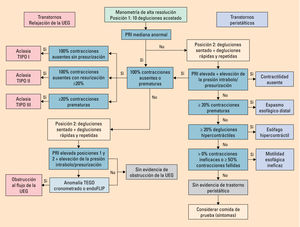
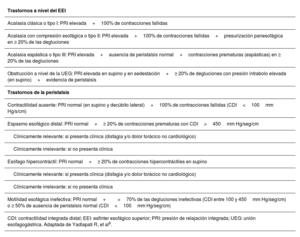
Los trastornos motores esofágicos (TME) se manifiestan clínicamente con la presencia de disfagia y/o dolor torácico en relación con la deglución. Para el diagnóstico es preciso descartar inicialmente causas orgánicas que justifiquen estos síntomas. El desarrollo en las últimas décadas de la manometría de alta resolución y su aplicación en la práctica clínica habitual ha permitido una mejor caracterización de los trastornos motores esofágicos. En los últimos años se han actualizado los criterios diagnósticos en la clasificación de Chicago 4.0, que establece dos grandes grupos de alteraciones motoras: las que presentan obstrucción a nivel de la unión esofagogástrica (OUEG) y, por otro, las que cursan con una alteración de la contractilidad del cuerpo esofágico. El tratamiento de los TME con OUEG (la acalasia en sus distintas presentaciones y la obstrucción al flujo de la unión esofagogástrica) va dirigido a disminuir la presión basal a este nivel, para lo que se dispone de distintas técnicas como la dilatación neumática con balón, la miotomía endoscópica (POEM) y quirúrgica (miotomía de Heller), y menos frecuentemente la utilización de fármacos orales y la inyección de toxina botulínica. En el caso de los trastornos de la peristalsis esofágica, el objetivo del tratamiento es controlar la sintomatología. Para ello se utilizan inhibidores de la bomba de protones (IBP) en pacientes con enfermedad por reflujo gastroesofágico (ERGE) asociado y, en el caso de trastornos asociados a hipercontractilidad, pueden utilizarse otros fármacos como nitratos o antagonistas del calcio y, en ocasiones, antidepresivos tricíclicos en dosis bajas.

Palabras clave
Disfagia
Dolor torácico
Manometría esofágica
Acalasia
Contractilidad
Abstract

Esophageal motility disorders (EMD) manifest clinically with the presence of dysphagia and/or chest pain related to swallowing. In order to diagnose it, it is necessary to first rule out organic causes that would explain these symptoms. In recent decades, the development of high-resolution manometry and its use in routine clinical practice has allowed for better characterization of esophageal motility disorders. The diagnostic criteria have been updated in recent years in the Chicago Classification v4.0, which establishes two large groups of motor disorders: those with esophagogastric junction outflow obstruction (EGJOO) and those with abnormal esophageal body contractility. The treatment of EMDs with EGJOO (the various presentations of achalasia and esophagogastric junction outflow obstruction) is aimed at reducing the baseline pressure in this area. Various techniques are available for this, such as pneumatic balloon dilatation, endoscopic (POEM) and surgical myotomy (Heller myotomy), and, less frequently, the use of oral drugs and botulinum toxin injection. In the case of esophageal peristalsis disorders, the goal of treatment is to control symptoms. To do so, proton pump inhibitors (PPIs) are used in patients with associated gastroesophageal reflux disease (GERD) and, in the case of disorders associated with hypercontractility, other drugs such as nitrates or calcium channel blockers and, occasionally, low-dose tricyclic antidepressants may be used.

Keywords
Dysphagia
Chest pain
Esophageal manometry
Achalasia
Contractility

Identifíquese

¿Aún no es suscriptor de la revista?

Comprar el acceso al artículo

Comprando el artículo el pdf del mismo podrá ser descargado

Teléfono para incidencias

De lunes a viernes de 9h a 18h (GMT+1) excepto los meses de julio y agosto que será de 9 a 15h

Llamadas desde España 932 415 960
Llamadas desde fuera de España +34 932 415 960
Bibliografía
[1]
G.W. Meyer, R.M. Austin, C.E. Brady III, D.O. Castell.
Muscle anatomy of the human esophagus.
J Clin Gastroenterol [Internet]., (1986), 8 pp. 131-134
[2]
B. Higgs, F.W. Kerr, F.H. Ellis Jr..
The experimental production of esophageal achalasia by electrolytic lesions in the medulla.
J Thorac Cardiovasc Surg [Internet]., (1965), 50 pp. 613-625
[3]
J. Gonella, J.P. Niel, C. Roman.
Mechanism of the noradrenergic motor control on the lower oesophageal sphincter in the cat.
J Physiol., (1980), 306 pp. 251-260
[4]
I. Hirano, P.J. Kahrilas.
Disfagia.
Harrison Principios de Medicina Interna, 21ª ed, McGraw-Hill,
[5]
M. Feldman, L.S. Friedman, L.J. Brandt.
Función neuromuscular del esófago y trastornos de la motilidad esofágica.
Capítulo 43. En: Sleisenger y Fordtran Enfermedades digestivas y hepáticas, 11ª ed, Elsevier, (2021),
[6]
R. Yadlapati
202401250545016938
, P.J. Kahrilas, M.R. Fox, A.J. Bredenoord, C. Prakash Gyawali, S. Roman, et al.
Esophageal motility disorders on high-resolution manometry: Chicago classification version 4.0©.
Neurogastroenterol Motil., (2021), 33 pp. e14058
[7]
M.A. Khashab
202401250545016939
2024012505450169310
, M.F. Vela, N. Thosani, D. Agrawal, J.L. Buxbaum, S.M. Abbas Fehmi, et al.
ASGE guideline on the management of achalasia.
Gastrointest Endosc., (2020), 91 pp. 213-227
[8]
D.C. Sadowski, F. Ackah, B. Jiang, L.W. Svenson.
Achalasia: incidence, prevalence and survival. A population-based study.
Neurogastroenterol Motil., (2010), 22 pp. e256-e261
[9]
X. Jia, S. Chen, Q. Zhuang, N. Tan, M. Zhang, Y. Cui, et al.
Achalasia: The current clinical dilemma and possible pathogenesis.
J Neurogastroenterol Motil., (2023), 29 pp. 145-155
[10]
F.B. van Hoeij, A.J. Smout, A.J. Bredenoord.
Characterization of idiopathic esophagogastric junction outflow obstruction.
Neurogastroenterol Motil., (2015), 27 pp. 1310-1316
[11]
J.A. Murray, A. Ledlow, J. Launspach, D. Evans, M. Loveday, J.L. Conklin.
The effects of recombinant human hemoglobin on esophageal motor functions in humans.
Gastroenterology., (1995), 109 pp. 1241-1248
[12]
S. Yamato, S.J. Spechler, R.K. Goyal.
Role of nitric oxide in esophageal peristalsis in the opossum.
Gastroenterology., (1992), 103 pp. 197-204
[13]
H. Korsapati, V. Bhargava, R.K. Mittal.
Reversal of asynchrony between circular and longitudinal muscle contraction in nutcracker esophagus by atropine.
Gastroenterology., (2008), 135 pp. 796-802
[14]
P.J. Howard, L. Maher, A. Pryde, E.W. Cameron, R.C. Heading.
Five year prospective study of the incidence, clinical features, and diagnosis of achalasia in Edinburgh.
Gut., (1992), 33 pp. 1011-1015
[15]
V.F. Eckardt, B. Stauf, G. Bernhard.
Chest pain in achalasia: patient characteristics and clinical course.
Gastroenterology., (1999), 116 pp. 1300-1304
[16]
V. Martín-Domínguez, M.T. Pérez-Fernández, A. Marinero, V. Jusué-Irurita, M. Caldas, C. Santander.
Hypercontractile esophagus: Clinical context and motors findings in high resolution manometry.
Rev Esp Enferm Dig., (2015), 107 pp. 274-279
[17]
A. Săftoiu
2024012505450169311
, C. Hassan, M. Areia, M.S. Bhutani, R. Bisschops, E. Bories, et al.
Role of gastrointestinal endoscopy in the screening of digestive tract cancers in Europe: European Society of Gastrointestinal Endoscopy (ESGE) Position Statement.
Endoscopy., (2020 Apr), 52 pp. 293-304
[18]
D.A. Carlson, A.B. Gluskin, B. Mogni, J. Koo, R. Sood, Z. Lin, et al.
Esophageal diverticula are associated with propagating peristalsis: a study utilizing high-resolution manometry.
Neurogastroenterol Motil., (2016), 28 pp. 392-398
[19]
L. Huang, M. Pimentel, A. Rezaie.
Do Jackhammer contractions lead to achalasia?. A longitudinal study.
Neurogastroenterol Motil., (2017), 29
[20]
M. Sánchez-Carpintero, G. Villar.
Estudios telemandados con control fluoroscópico del tracto digestivo superior: Técnicas e indicaciones.
Radiología., (2017), 59 pp. 343-354
[21]
S. Roman
2024012505450169312
.
Trastornos motores esofágicos.
EMC - Tratado de medicina., (2023), 27 pp. 1-9
[22]
C. Santander Vaquero, A. Ruiz de León.
Manometría de alta resolución. En: Lacima Vidal G, director.
Tratado de neurogastroenterología y motilidad digestiva, Editorial Médica Panamericana, (2015), pp. 56-66
[23]
J. Flández, H. Monrroy.
Clasificación de Chicago para trastornos de la motilidad esofágica versión 3.0.
Gastroenterol Latinoam., (2016), 27 pp. 54-61
[24]
Donnan EN, Pandolfino JE. EndoFLIP in the esophagus: Assessing sphincter function, wall stiffness, and motility to guide treatment. Gastroenterol Clin North Am [Internet]. 2020;49(3):427-35. Disponible en: https://doi.org/10.1016/j.gtc.2020.04.002.
[25]
E. Savarino, M. di Pietro, A.J. Bredenoord, D.A. Carlson, J.O. Clarke, A. Khan, et al.
Use of the functional lumen imaging probe in clinical esophagology.
Am J Gastroenterol., (2020), 115 pp. 1786-1796
[26]
L.R. Valdovinos, M.F. Vela.
Utilidad de la sonda de imagen luminal funcional (EndoFLIP) en las enfermedades esofágicas.
Acta Gastroenterol Latinoam., (2020), pp. 79-87
[27]
M.F. Vaezi
2024012505450169313
2024012505450169314
, J.E. Pandolfino, R.H. Yadlapati, K.B. Greer, R.T. Kavitt.
ACG clinical guidelines: Diagnosis and management of achalasia: Diagnosis and management of achalasia.
Am J Gastroenterol [Internet]., (2020), 115 pp. 1393-1411
[28]
R.A. Nijhuis
2024012505450169315
2024012505450169316
, G. Zaninotto, S. Roman.
European Guideline on Achalasia - UEG and ESNM recommendations.
United European Gastroenterol J., (2020), 8 pp. 13-34
[29]
J.E. Leyden
2024012505450169317
, A.C. Moss, P. MacMathuna.
Endoscopic pneumatic dilation versus botulinum toxin injection in the management of primary achalasia.
Cochrane Database Syst Rev., (2014), 2014 pp. CD005046
[30]
H. Inoue, H. Minami, Y. Kobayashi, Y. Sato, M. Kaga, M. Suzuki, et al.
Peroral endoscopic myotomy (POEM) for esophageal achalasia.
Endoscopy., (2010), 42 pp. 265-271
[31]
F. Schlottmann
2024012505450169318
, D.J. Luckett, J. Fine, N.J. Shaheen, M.G. Patti.
Laparoscopic Heller myotomy versus peroral endoscopic myotomy (POEM) for achalasia: A systematic review and meta-analysis.
Ann Surg., (2018), 267 pp. 451-460
[32]
G.E. Boeckxstaens, V. Annese, S.B. des Varannes, S. Chaussade, M. Costantini, A. Cuttitta, et al.
Pneumatic dilation versus laparoscopic Heller's myotomy for idiopathic achalasia.
N Engl J Med., (2011), 364 pp. 1807-1816
[33]
D. Biasutto, F. Mion, A. Garros, S. Roman.
Rapid drink challenge test during esophageal high resolution manometry in patients with esophago-gastric junction outflow obstruction.
Neurogastroenterol Motil., (2018 Jun), 30 pp. e13293
[34]
J. Koerselman, K.G. Pursnani, P. Peghini, M.A. Mohiuddin, D. Katzka, L.M. Akkermans, et al.
Different effects of an oral anticholinergic drug on gastroesophageal reflux in upright and supine position in normal, ambulant subjects: a pilot study.
Am J Gastroenterol., (1999), 94 pp. 925-930
[35]
E.L. Cattau Jr., D.O. Castell, D.A. Johnson, T.J. Spurling, R. Hirszel, S.J. Chobanian, et al.
Diltiazem therapy for symptoms associated with nutcracker esophagus.
Am J Gastroenterol., (1991), 86 pp. 272-276