

Vol. 12. Núm. 42.
Páginas 2477-2484 (Octubre 2017)

Actualización
Riesgo cardiovascular

Cardiovascular risk

F. Salgado OrdóñezJ. Sanz CánovasR. Pacheco Yepes
Doi : https://10.1016/j.med.2017.10.001
Opciones
Resumen
Concepto

La arteriosclerosis es una enfermedad sistémica, progresiva y silente que se asocia a condiciones y hábitos de vida potencialmente modificables que se conocen como factores de riesgo vascular (FRV).

Clasificación

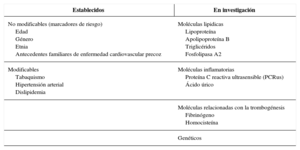
Se han identificado seis principales FRV: tabaquismo, obesidad, diabetes, sedentarismo, aumento de la presión arterial y lípidos plasmáticos. Aunque se está investigando el papel de otras variables, genéticas y moleculares, para que expliquen por qué algunos sujetos desarrollan enfermedad cardiovascular a pesar de tener los FRV mencionados bajo control.

Epidemiología

La morbimortalidad cardiovascular está aumentando por el incremento de la diabetes y la obesidad y por la escasa implementación de medidas de control de esta pandemia.

Factores pronósticos

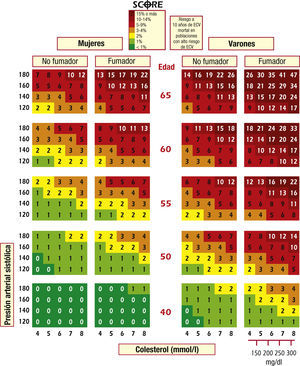
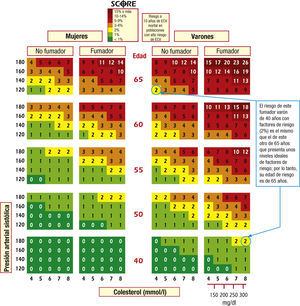
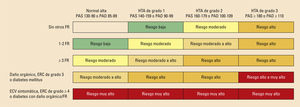
Debemos aprender a estimar el riesgo vascular (RV) de forma global. El modelo más empleado para su cálculo es el SCORE.

Estrategias de prevención

Una vez establecido el RV, se deben marcar los objetivos terapéuticos, para controlar todos los FRV de forma sinérgica y adecuada. Los pacientes con mayor riesgo deben recibir una intervención más precoz e intensiva, pero también debemos proceder a la detección de aterosclerosis subclínica con técnicas no invasivas en personas con un RV próximo al umbral de decisión.

Palabras clave
Factor de riesgo
Riesgo vascular
Prevención cardiovascular
Estrategias de prevención cardiovascular
Abstract
Concept

Arteriosclerosis is a systemic, progressive and silent disease that is associated with potentially modifiable life habits and conditions, which are known as cardiovascular risk factors (CRFs).

Classification

We have identified 6 main CRFs: nicotine addiction, obesity, diabetes, physical inactivity, increased blood pressure and increased plasma lipid concentrations. However, the role of other variables (genetic and molecular) is being investigated to explain why some patients develop cardiovascular disease despite having the abovementioned CRFs under control.

Epidemiology

Cardiovascular morbidity and mortality is increasing due to the increase in diabetes and obesity and to the scarce implementation of control measures for this pandemic.

Prognostic factors

It is important to learn to estimate the overall cardiovascular risk. The most widely used model for this calculation is the Systematic Coronary Risk Evaluation (SCORE).

Prevention strategies

Once the cardiovascular risk has been established, the therapeutic objectives need to be established to control all CRFs synergistically and appropriately. Patients with a higher risk should undergo earlier and more intensive interventions; however, we should also proceed to detect subclinical atherosclerosis with noninvasive techniques in individuals with vascular risk near the decision threshold.

Keywords
Risk factor
Vascular risk
Cardiovascular prevention
Strategies for cardiovascular prevention

Identifíquese

¿Aún no es suscriptor de la revista?

Comprar el acceso al artículo

Comprando el artículo el pdf del mismo podrá ser descargado

Teléfono para incidencias

De lunes a viernes de 9h a 18h (GMT+1) excepto los meses de julio y agosto que será de 9 a 15h

Llamadas desde España 932 415 960
Llamadas desde fuera de España +34 932 415 960
Bibliografía
[1]
201710191205020598
201710191205020599
Organización Mundial de la Salud. Global action plan for the prevention and control of noncommunicable diseases 2013-2020. Disponible en: http://www.who.int/nmh/publications/ncd-action-plan/en/ [consultado el 11 de abril de 2016].
[2]
2017101912050205910
2017101912050205911
J.M. Lobos, M.A. Royo-Bordonada, C. Brotons, L. Álvarez-Sala, P. Armario, A. Maiques, et al.
European Guidelines on Cardiovascular Disease Prevention in Clinical Practice. CEIPC 2008 Spanish adaptation.
Rev Clin Esp., (2009), 209 pp. 279-302
[3]
2017101912050205912
2017101912050205913
T.R. Dawer, G.F. Meadors, F.E. Moore.
Epidemiological approaches to heart disease: the Framingham Study.
Am J Public Health Nations Health., (1951), 41 pp. 279-286
[4]
2017101912050205914
2017101912050205915
S. Yusuf, S. Hawken, S. Ounpuu, T. Dans, A. Avezum, F. Lanas, et al.
Effect of potentially modifiable risk factors associated with myocardial infarction in 52 countries (the INTERHEART study): case-control study.
Lancet., (2004), 364 pp. 937-952
[5]
2017101912050205916
2017101912050205917
R.M. Conroy, K. Pyörälä, A.P. Fitzgerald, S. Sans, A. Menotti, G. De Backer, et al.
Estimation of ten-year risk of fatal cardiovascular disease in Europe: the SCORE project.
Eur Heart J., (2003), 24 pp. 987-1003
[6]
2017101912050205918
2017101912050205919
J.C. Fruchart, F. Sacks, M.P. Hermans, G. Assmann, W.V. Brown, R. Ceska, et al.
The Residual Risk Reduction Initiative: a call to action to reduce residual vascular risk in patients with dyslipidemia.
Am J Cardiol., (2008), 102 pp. 1K-34K
[7]
2017101912050205920
2017101912050205921
V.J. Dzau, E.M. Antman, H.R. Black, D.L. Hayes, J.E. Manson, J. Plutzky, et al.
The cardiovascular disease continuum validated: clinical evidence of improved patient outcomes: part II: Clinical trial evidence (acute coronary syndromes through renal disease) and future directions.
Circulation., (2006), 114 pp. 2871-2891
[8]
2017101912050205922
2017101912050205923
M. Grau, R. Elosua, A. Cabrera de León, M.J. Guembe, J.M. Baena-Díez, T. Vega Alonso, et al.
Cardiovascular risk factors in Spain in the first decade of the 21st Century, a pooled analysis with individual data from11 population-based studies: the DARIOS study.
Rev Esp Cardiol., (2011), 64 pp. 295-304
[9]
2017101912050205924
2017101912050205925
P. Guallar-Castillón, M. Gil-Montero, L.M. León-Muñoz, A. Graciani, A. Bayán-Bravo, J.M. Taboada, et al.
Magnitude and management of hypercholesterolemia in the adult population of Spain, 2008-2010: The ENRICA Study.
Rev Esp Cardiol., (2012), 65 pp. 551-558
[10]
2017101912050205926
2017101912050205927
J.R. Banegas, E. López-García, J. Dallongeville, E. Guallar, J.P. Halcox, C. Borghi, et al.
Achievement of treatment goals for primary prevention of cardiovascular disease in clinical practice across Europe: the EURIKA study.
Eur Heart J., (2011), 32 pp. 2143-2152
[11]
2017101912050205928
2017101912050205929
P. Magnus, R. Beaglehole.
The real contribution of the major risk factors to the coronary epidemics: time to end the “only-50%” myth.
Arch Intern Med., (2001), 161 pp. 2657-2660
[12]
2017101912050205930
2017101912050205931
J.G. Canto, A.E. Iskandrian.
Major risk factors for cardiovascular disease: debunking the only 50% myth.
JAMA., (2003), 290 pp. 947-949
[13]
2017101912050205932
2017101912050205933
D.G. Hackam, S.S. Anand.
Emerging risk factors for atherosclerotic vascular disease: a critical review of the evidence.
JAMA., (2003), 290 pp. 932-940
[14]
2017101912050205934
2017101912050205935
M.T. Cooney, E. Vartiainen, T. Laatikainen, D. De Bacquer, C. McGorrian, A. Dudina, et al.
Cardiovascular risk age: concepts and practicalities.
[15]
2017101912050205936
2017101912050205937
J.S. Kutner, P.J. Blatchford, D.H. Taylor Jr., C.S. Ritchie, J.H. Bull, D.L. Fairclough, et al.
Safety and benefit of discontinuing statin therapy in the setting of advanced, life-limiting illness: a randomized clinical trial.
JAMA Intern Med., (2015), 175 pp. 691-700
[16]
2017101912050205938
2017101912050205939
L. Mosca, E.J. Benjamin, K. Berra, J.L. Bezanson, R.J. Dolor, D.M. Lloyd-Jones, et al.
Effectiveness-based guidelines for the prevention of cardiovascular disease in women—2011 update: a guideline from the American Heart Association.
Circulation., (2011), 123 pp. 1243-1262
[17]
2017101912050205940
2017101912050205941
S. Nielsen, L. Björck, J. Berg, K.W. Giang, T. Zverkova Sandström, K. Falk, et al.
Sex-specific trends in 4-year survival in 37 276 men and women with acute myocardial infarction before the age of 55 years in Sweden, 1987-2006: a register-based cohort study.
BMJ Open., (2014), 4 pp. e004598
[18]
2017101912050205942
2017101912050205943
J.S. Berger, L. Elliott, D. Gallup, M. Roe, C.B. Granger, P.W. Armstrong, et al.
Sex differences in mortality following acute coronary syndromes.
JAMA., (2009), 302 pp. 874-882
[19]
2017101912050205944
2017101912050205945
A.A. Van Oeffelen, I. Vaartjes, K. Stronks, M.L. Bots, C. Agyemang.
Incidence of acute myocardial infarction in first and second generation minority groups: does the second generation converge towards the majority population?.
Int J Cardiol., (2013), 168 pp. 5422-5429
[20]
2017101912050205946
2017101912050205947
G. Mancia, F. Fagard, K. Narkiewicz, J. Redon, A. Zanchetti, M. Böhm, et al.
Guía de práctica clínica de la ESH/ESC para el manejo de la hipertensión arterial (2013).
Hipertens Riesgo Vasc., (2013), 30 pp. 4-91
[21]
2017101912050205948
2017101912050205949
P.M. Okin, D.A. Hille, S.E. Kjeldsen, B. Dahlof, R.B. Devereux.
Impact of lower achieved blood pressure on outcomes in hypertensive patients.
J Hypertens., (2012), 30 pp. 802-810
[22]
2017101912050205950
2017101912050205951
J. Marrugat, J. Vila, J.M. Baena-Díez, M. Gram, J. Sala, R. Ramos, et al.
Validez relativa de la estimación del riesgo cardiovascular a los 10 años en una cohorte poblacional del estudio REGICOR.
Rev Esp Cardiol., (2011), 64 pp. 385-394
[23]
2017101912050205952
2017101912050205953
B.G. Nordestgaard, M.J. Chapman, K. Ray, J. Boren, F. Andreotti, G.F. Watts, et al.
Lipoprotein(a) as a cardiovascular risk factor: current status.
Eur Heart J., (2010), 31 pp. 2844-2853
[24]
2017101912050205954
2017101912050205955
C.J.L. Murray, A.D. López.
Global Health Statistics. Global Burden of Disease and Injury Series.
Harvard School of Public Health, (1996),
[25]
2017101912050205956
2017101912050205957
S.J. Olshansky, D.J. Passaro, R.C. Hershow, J. Layden, B.A. Carnes, J. Brody, et al.
A potential decline in life expectancy in the United States in the 21st century.
N Engl J Med., (2005), 352 pp. 1138-1145
[26]
2017101912050205958
2017101912050205959
C.L. Ogden, M.D. Carroll, H.G. Lawman, C.D. Fryar, D. Kruszon-Moran, B.K. Kit, et al.
Trends in obesity prevalence among children and adolescents in the United States, 1988-1994 Through 2013-2014.
JAMA., (2016), 315 pp. 2292-2299
[27]
2017101912050205960
2017101912050205961
H. Mistry, S. Morris, M. Dyer, K. Kotseva, D. Wood, M. Buxton, EUROACTION study group.
Cost-effectiveness of a European preventive cardiology programme in primary care: a Markov modelling approach.
pii: e001029
[28]
2017101912050205962
2017101912050205963
F. Agüero, I.R. Dégano, I. Subirana, M. Grau, A. Zamora, J. Sala, et al.
Impact of a partial smoke-free legislation on myocardial infarction incidence, mortality and case-fatality in a population-based registry: the REGICOR Study.
[29]
2017101912050205964
2017101912050205965
H. Niinikoski, H. Lagström, E. Jokinen, M. Siltala, T. Rönnemaa, J. Viikari, et al.
Impact of repeated dietary counseling between infancy and 14 years of age on dietary intakes and serum lipids and lipoproteins: the STRIP study.
Circulation., (2007), 116 pp. 1032-1040
[30]
2017101912050205966
2017101912050205967
M. Collins, H. Mason, M. O’Flaherty, M. Guzman-Castillo, J. Critchley, S. Capewell.
An economic evaluation of salt reduction policies to reduce coronary heart disease in England: a policy modeling study.
Value Health., (2014), 17 pp. 517-524
[31]
2017101912050205968
2017101912050205969
H. Mason, A. Shoaibi, R. Ghandour, M. O’Flaherty, S. Capewell, R. Khatib, et al.
MedCHAMPS project team. A cost effectiveness analysis of salt reduction policies to reduce coronary heart disease in four Eastern Mediterranean countries.
[32]
2017101912050205970
2017101912050205971
M. Lalonde.
Lalonde: time to change talk to action.
Hosp Adm Can., (1977), 19 pp. 20-21
[33]
2017101912050205972
2017101912050205973
R.B. D’Agostino Sr., R.S. Vasan, M.J. Pencina, P.A. Wolf, M. Cobain, J.M. Massaro, et al.
General cardiovascular risk profile for use in primary care: the Framingham Heart Study.
Circulation., (2008), 117 pp. 743-753
[34]
2017101912050205974
2017101912050205975
M.Á. Royo-Bordonada, J.M. Lobos, C. Brotons, F. Villar, C. de Pablo, P. Armario, et al.
Estado de la prevención cardiovascular en España.
Med Clin (Barc)., (2014), 142 pp. 7-14
[35]
2017101912050205976
2017101912050205977
J. Marrugat, I. Subirana, E. Comín, C. Cabezas, J. Vila, R. Elosua, et al.
Validity of an adaptation of the Framingham cardiovascular risk function: the VERIFICA Study.
J Epidemiol Community Health., (2007), 61 pp. 40-47
[36]
2017101912050205978
2017101912050205979
M.F. Piepoli, A.W. Hoes, S. Agewall, C. Albus, C. Brotons, A.L. Catapano, et al.
Guía ESC 2016 sobre prevención de la enfermedad cardiovascular en la práctica clínica.
Rev Esp Cardiol., (2016), 69 pp. 939.e1-939.e87
[37]
2017101912050205980
2017101912050205981
S. Silber.
Comparison of spiral and electron beam tomography in the evaluation of coronary calcification in asymptomatic persons.
Int J Cardiol., (2002), 82 pp. 297-298
[38]
2017101912050205982
2017101912050205983
M.W. Lorenz, J.F. Polak, M. Kavousi, E.B. Mathiesen, H. Völzke, T.P. Tuomainen, PROG-IMT Study Group, et al.
Carotid intima-media thickness progression to predict cardiovascular events in the general population (the PROG-IMT collaborative project): a meta-analysis of individual participant data.
Lancet., (2012), 379 pp. 2053-2062
[39]
2017101912050205984
2017101912050205985
I. Tzoulaki, K.C. Siontis, E. Evangelou, J.P. Ioannidis.
Bias in associations of emerging biomarkers with cardiovascular disease.
JAMA Intern Med., (2013), 173 pp. 664-671
[40]
2017101912050205986
2017101912050205987
F.G. Fowkes, G.D. Murray, I. Butcher, C.L. Heald, R.J. Lee, L.E. Chambless, Ankle Brachial Index Collaboration, et al.
Ankle brachial index combined with Framingham Risk Score to predict cardiovascular events and mortality: a meta-analysis.
JAMA., (2008), 300 pp. 197-208