

Vol. 12. Núm. 33.
Páginas 1980-1989 (Mayo 2017)

Actualización
Melanoma

Melanoma

B. Martínez-Amores MartínezaF.J. Vicente MartínbM. Durán PovedacR. Molina Villaverded
Doi : https://10.1016/j.med.2017.04.022
Opciones
Resumen
Introducción

El melanoma es un tumor maligno procedente de los melanocitos que se localiza a nivel cutáneo en el 95% de los casos. A pesar de su elevada incidencia, la mortalidad se ha estabilizado en los últimos años gracias a las campañas de detección temprana, precocidad quirúrgica y a la mejoría de la supervivencia con los nuevos tratamientos en fase metastásica.

Epidemiología

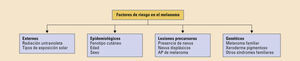
El riesgo de aparición del melanoma está relacionado de forma directa con la exposición solar, pero también influyen factores personales como el tipo de piel, epidemiológicos, lesiones precursoras y aspectos genéticos.

Diagnóstico

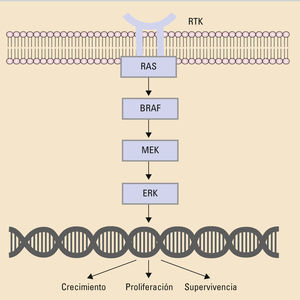
Aunque se han reconocido múltiples factores pronósticos de melanoma hasta la fecha, el único predictivo de respuesta al tratamiento es la presencia de la mutación BRAF V600E en el ADN de las células tumorales, determinación mandatoria en todos los casos de melanoma metastásico.

Tratamiento

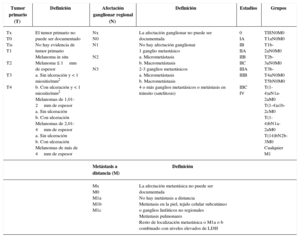
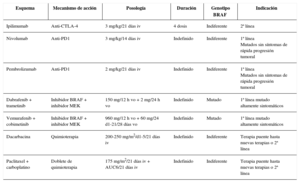
El tratamiento de un melanoma localizado debe ser siempre su extirpación quirúrgica con márgenes amplios y la linfadenectomía regional reglada en casos de afectación ganglionar clínica o biopsia selectiva de ganglio centinela con presencia de células tumorales en pacientes sin sospecha de afectación ganglionar previa. El tratamiento del melanoma metastásico debe ser sistémico, basado en tres pilares fundamentales: inmunoterapia, inhibidores BRAF y quimioterapia.

Palabras clave
Melanoma
Mutación BRAF
Inmunoterapia
Biopsia selectiva ganglio centinela
Abstract
Introduction

Melanoma is a malignant tumour starting in the melanocytes that is located at skin level in 95% of cases. Despite its high incidence, mortality has stabilised in recent years thanks to early detection campaigns, prompt surgery and improved survival with new treatments in the metastatic stage.

Epidemiology

The risk of developing a melanoma is directly associated with exposure to the sun. However, personal factors also have an impact, such as skin type, epidemiological factors, precursor lesions, and genetic aspects.

Diagnosis

Although to date, many prognostic factors for melanoma have been identified, the only predictor for treatment response is the presence of BRAF V600E mutation in the DNA of the tumour cells, which it is compulsory to determine in all cases of metastatic melanoma.

Treatment

Local melanoma should always be surgically removed with wide margins, and formal regional lymphadenectomy in cases of clinical lymph node involvement, or selective biopsy of the sentinel gland in the presence of tumour cells in patients with no previous suspicion of lymph node involvement. Metastatic melanoma should be treated systemically, based on the three essential pillars: immunotherapy, BRAF inhibitors and chemotherapy.

Keywords
Melanoma
BRAF mutation
Immunotherapy
Selective biopsy of the sentinel gland

Identifíquese

¿Aún no es suscriptor de la revista?

Comprar el acceso al artículo

Comprando el artículo el pdf del mismo podrá ser descargado

Teléfono para incidencias

De lunes a viernes de 9h a 18h (GMT+1) excepto los meses de julio y agosto que será de 9 a 15h

Llamadas desde España 932 415 960
Llamadas desde fuera de España +34 932 415 960
Bibliografía
[1]
201705120937555418
J. Ferlay, I. Soerjomataram, R. Dikshit, S. Eser, C. Mathers, M. Rebelo, et al.
Cancer incidence and mortality worldwide: sources, methods and major patterns in GLOBOCAN 2012.
Int J Cancer., (2014), 136
E359-86
[2]
201705120937555419
S.Q. Wang, R. Setlow, M. Berwick, D. Polsky, A.A. Marghoob, A.W. Kopf, et al.
Ultraviolet A and melanoma: a review.
J Am Acad Dermatol., (2001), 44
837-46
[3]
2017051209375554110
J.A. Lee.
The relationship between malignant melanoma of skin and exposure tu sunlight.
Photochem Photobiol., (1989), 50
493-96
[4]
2017051209375554111
G.B. Ivry, C.A. Ogle, E.K. Shim.
Role of sun exposure in melanoma.
Dermatol Surg., (2006), 32
481-92
[5]
2017051209375554112
R.L. Siegel, K.D. Miller, A. Jemal.
Cancer statistics 2016.
CA Cancer J Clin., (2016), 66 pp. 7-30
[6]
2017051209375554113
C.G. Watts, M. Dieng, R.L. Morton, G.J. Mann, S.W. Menzies, A.E. Cust.
Clinical practice guidelines for identification, screening and follow-up of individuals at high risk of primary cutaneous melanoma: a systematic review.
Br J Dermatol., (2015), 172 pp. 33-47
[7]
2017051209375554114
S. Kang, R.L. Barnhill, M.C. Mihm, T.B. Fitzpatrick, A.J. Sober.
Melanoma risk in individuals with clinically atypical nevi.
Arch Dermatol., (1994), 130 pp. 999-1001
[8]
2017051209375554115
J.K. Rivers.
Melanoma. Lancet., (1996), 347
803-6
[9]
2017051209375554116
S.N. Markkovic, L.A. Erickson, R.D. Rao, R.H. Weening, B.A. Pockaj, A. Bardia, et al.
Malignant melanoma in the 21st century, part 1: epidemiology, risk factors, screening, prevention and diagnosis.
Mayo Clin Proc., (2007), 82
364-80
[10]
2017051209375554117
A.R. Rhodes.
Cutaneous melanoma and intervention strategies to reduce tumor-related mortality: what we know, what we don¿t know, and jwhat we think we know that isn¿t so.
Dermatol Ther., (2006), 19 pp. 50-69
[11]
2017051209375554118
C.M. Balch, J.E. Gershenwald, S.J. Soong, et al.
Melanoma of the skin.
AJCC cancer staging manual., 7th ed., Springer,
[12]
2017051209375554119
J.A. Moreno Nogueira, P. Sancho Márquez, J. Corral Jaimen, P. Ramírez Daffós.
Factores pronósticos. En: Melanoma.
Ed Aran S.L, (2008),
42-8
[13]
2017051209375554120
D.J. Wong, A. Ribas.
Targeted therapy for melanoma.
Cancer Treat Res., (2016), 167
251-62
[14]
2017051209375554121
2017051209375554122
R.A. Scolyer, M.J. Judge, A. Evans, D.P. Frishberg, V.G. Prieto, J.F. Thompson, Data set for pathology reporting of cutaneous invasive melanoma, et al.
Recommendations from the International Collaboration on Cancer Reporting (ICCR).
Am J Surg Pathol., (2013), 37
1797-814
[15]
2017051209375554123
M. Álvarez-Mon Soto, F. Camacho Martínez, J.L. Díaz Pérez, E. Díaz-Rubio, J.L. González Larriba, V. Guillén Porta, et al.
Diagnóstico de extensión. Estadiaje. Enfermedad metastásica.
En: Melanomas, Ed. Just in Time S.L, (2005),
101-10
[16]
2017051209375554124
2017051209375554125
S.N. Leilabadi, A. Chen, S. Tsai, V. Soundararajan, H. Silberman, A.K. Wong, et al.
Update and review on the surgical management of primary cutaneous melanoma.
234-49
[17]
2017051209375554126
2017051209375554127
A.J. Hayes, L. Maynard, G. Coombes, J. Newton-Bishop, M. Timmons, M. Cook, et al.
Wide versus narrow excision margins for high-risk, primary cutaneous melanomas: long-term follow-up of survival in a randomised trial.
Lancet Oncol., (2016), 17
184-92
[18]
2017051209375554128
2017051209375554129
J.M. Kirkwood, J. Manola, J. Ibrahim, V. Sondak, M.S. Ernstoff, U. Rao, et al.
A pooled analysis of Eastern cooperative oncology group trials of adjuvante high-dose interferón for melanoma.
1670-7
[19]
2017051209375554130
2017051209375554131
J.M. Kirkwood, M.H. Strawderman, M.S. Ernstoff, T.J. Smith, E.C. Borden, R.H. Blum.
Interferon alfa-2b adjuvant therapy of high-risk resected cutaneous melanoma: the Eastern Cooperative Oncology Group Trial EST 1684.
J Clin Oncol., (1996), 14 pp. 7-17
[20]
2017051209375554132
2017051209375554133
B.H. Burmeister, M.A. Henderson, J. Ainslie, R. Fisher, J. Di Julio, B.M. Smithers, et al.
Adjuvant radiotherapy versus observation alone for patients at risk of lymph-node field relapse after therapeutic lymphadenectomy for melanoma: a randomised trial.
[21]
C. Robert, L. Thomas, I. Bondarenko, S. O¿Day, J. Weber, C. Garbe, et al.
Ipilimumab plus dacarbazine for previously untreated metastatic melanoma.
2517-26
[22]
2017051209375554134
2017051209375554135
Nivolumab in previously untreated melanoma without BRAF mutation.
N. Engl J. Med., (2015), 372
320-30
[23]
2017051209375554136
2017051209375554137
C. Robert, J. Schachter, G.V. Long, A. Arance, J.J. Grob, l Mortier, et al.
Pembrolizumab versus ipilimumab in advanced melanoma.
2521-32
[24]
2017051209375554138
2017051209375554139
C. Robert, G.V. Long, B. Brady, C. Dutriaux, M. Maio, L. Mortier, J. Larkin, F.S. Hodi, J.D. Wolchok, et al.
Combined nivolumab and ipilimumab or monotherapya in untreated melanoma.
N Engl J Med., (2015), 373
270-1
[25]
2017051209375554140
G.V. Long, D. Stroyakovskiy, H. Gogas, E. Levchenko, R. de Braud, J. Larkin, et al.
Combined BRAF and MEK inhibition versus BRAF inhibition alone in melanoma.
1877-88
[26]
2017051209375554141
2017051209375554142
C. Robert, B. Karaszewska, K. Schachter, P. Rutkowski, A. Mackiewicz, D. Stroiakovski, et al.
Improved overal survival in melanoma with combined dabrafenib and trametinib.
30-9
[27]
2017051209375554143
2017051209375554144
J. Larkin, P.A. Ascierto, B. Dreno, V. Atkinson, G. Liszkay, M. Maio, et al.
Combined vemurafenib and cobimetinib in BRAF-mutated melanoma.
1867-76
[28]
2017051209375554145
P.B. Chapman, A. Hauschild, C. Robert, J.B. Haanen, P. Ascierto, J. Larkin, et al.
Improved survival with vemurafenib in melanoma with BRAF V600E mutation.
2507-16
[29]
2017051209375554146
A. Hauschild, J.J. Grob, L.V. Demidov, T. Jouary, R. Gutzmer, M. Millward, et al.
Dabrafenib in BRAF mutated metastatic melanoma: a multicentre, open label, phase 3 randomised controlled trial.
[30]
2017051209375554147
A.M. Eggermont, J.H. de Wilt, T.L. Ten Hagen.
Current uses of isolated limb perfusión in the clinic and a model system for new strategies.
Lancet Oncol., (2003), 4
429-37
[31]
2017051209375554148
2017051209375554149
M. Batus, S. Waheed, C. Ruby, L. Petersen, S.D. Bines, H.L. Kaufman.
Optimal management of metastatic melanoma: current strategies and future directions.
Am J Clin Dermatol., (2013), 14
179-94
[32]
M.A. Eggermont, C. Robert.
Melanoma in 2011: A new paradigm tumor for drug development.
Nat Rev Clin Oncol., (2012), 9
74-6