

Vol. 12. Núm. 53.
Páginas 3124-3131 (Abril 2018)

Actualización
Infecciones bacterianas crónicas (II). Brucelosis

Chronic bacterial infections (II). Brucellosis

J.D. Colmenero
Doi : https://10.1016/j.med.2018.03.021
Opciones
Resumen
Introducción

La brucelosis es una zoonosis reemergente ampliamente distribuida en el planeta. Produce una alta morbilidad y pérdidas sociosanitarias muy cuantiosas en los países en los que es endémica.

Etiopatogenia

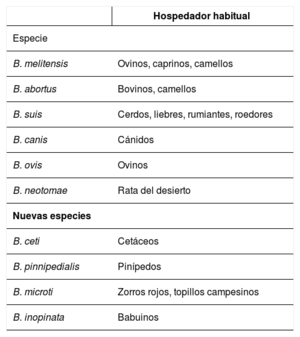
Producida por coco-bacilos Gram negativos del género Brucella, del cual existen diferentes especies con hospedadores y patogenicidad propias. B. melitensis, B. abortus y B. suis son las especies más frecuentes y B. melitensis la más patógena en seres humanos. Capaz de eludir mecanismos de la respuesta inmune, la infección por Brucella tiene tendencia a producir cuadros prolongados, recaídas y complicaciones focales.

Espectro clínico y diagnóstico

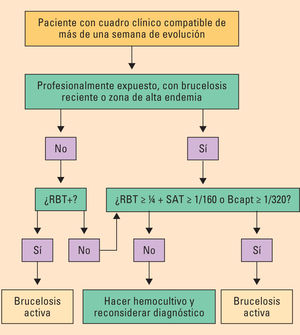
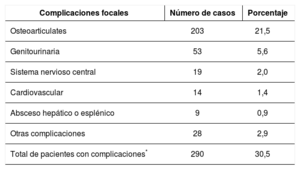
Habitualmente la brucelosis se manifiesta como un cuadro febril sin focalidad aparente, de comienzo agudo o subagudo acompañado de escalofríos, sudoración profusa, artromialgias y malestar general. Aproximadamente, un tercio de los pacientes desarrollará una complicación focal a lo largo del curso evolutivo de la enfermedad. Por lo inespecífico de su espectro clínico, siempre debe intentarse el diagnóstico microbiológico, bien mediante el aislamiento del microorganismo, para lo cual la muestra más rentable es el hemocultivo, o mediante la demostración de anticuerpos específicos a títulos significativos o seroconversión.

Tratamiento

El tratamiento más eficaz es doxiciclina 100 mg por vía oral cada 12 horas durante 6 semanas, junto a estreptomicina las primeras 2 semanas. Aunque algo menos efectiva, por su comodidad, doxiciclina junto con rifampicina 600-900 mg/día, ambas durante seis semanas, es una buena alternativa. El tratamiento de las complicaciones focales difiere según la localización y gravedad del caso.

Palabras Clave
Zoonosis
Brucelosis
Diagnóstico
Tratamiento
Complicaciones focales
Abstract
Introduction

Brucellosis is a re-emerging zoonosis that is widely distributed around the globe. It causes high morbidity and very substantial social and health losses in the countries in which it is endemic.

Aetiopathogenesis

Caused by Gram-negative coccobacilli of the Brucella genus, of which there are different species with their own hosts and pathogenicity. B. melitensis, B. abortus and B. suis are the most common species and B. melitensis is the most pathogenic in human beings. Capable of eluding immune response mechanisms, Brucella infection tends to cause prolonged symptoms, relapses and focal complications.

Clinical spectrum and diagnosis

Brucellosis routinely manifests with a fever of no apparent focus of infection, of acute or subacute onset accompanied by chills, profuse sweating, arthromyalgia and general malaise. Approximately a third of patients will develop a focal complication as the disease progresses. Because its clinical spectrum is so non-specific, microbiological diagnosis must always be attempted, either by isolating the microorganism, haemoculture is the most cost-effective method, or by demonstrating specific antibodies at significant titres or seroconversion.

Treatment

The most effective treatment is doxycycline p.o. 100 mg every 12 hours for 6 weeks, combined with streptomycin for the first 2 weeks. And for convenience, although somewhat less effective, doxycycline combined with rifampicin 600-900 mg/day, also for six weeks, is a good alternative. The treatment of focal complications varies according to their location and severity.

Keywords
Zoonosis
Brucellosis
Diagnosis
Treatment
Focal complications

Identifíquese

¿Aún no es suscriptor de la revista?

Comprar el acceso al artículo

Comprando el artículo el pdf del mismo podrá ser descargado

Teléfono para incidencias

De lunes a viernes de 9h a 18h (GMT+1) excepto los meses de julio y agosto que será de 9 a 15h

Llamadas desde España 932 415 960
Llamadas desde fuera de España +34 932 415 960
Bibliografía
[1]
201804050410346118
201804050410346119
G. Pappas, P. Papadimitriou, N. Akritidis, L. Christou, E.V. Tsianos.
The new global map of human brucelosis.
Lancet Infect Dis., (2006), 6 pp. 91-99
[2]
2018040504103461110
2018040504103461111
A.S. Dean, L. Crump, H. Greter, E. Schelling, J. Zinsstag.
Global burden of human brucelosis: a systematic review of disease frequency.
PLoS Negl Trop Dis., (2012), 6 pp. e1865
[3]
2018040504103461112
E. Rodríguez, P. Ordóñez, L.P. Sánchez.
Situación de la brucelosis humana en España Centro Nacional de Epidemiología.
Instituto de Salud Carlos III. Boletin Epidemiológico Semanal., (2012), 20 pp. 177-190
[4]
2018040504103461113
J.T. Foster, L.B. Price, S.M. Beckstrom-Sternberg, T. Pearson, W.D. Brown, D.M. Kiesling, et al.
Genotyping of Brucella species using clade specific SNPs.
BMC Microbiol., (2012), 12 pp. 110-117
[5]
K. Mühldorfer, G. Wibbelt, C.A. Szentiks, D. Fischer, H.C. Scholz, M. Zschöck, et al.
The role of ‘atypical’ Brucella in amphibians: are we facing novel emerging pathogens?.
J Appl Microbiol., (2017), 122 pp. 40-53
[6]
2018040504103461114
2018040504103461115
M.J. Corbel.
Brucelosis: an overview.
Emerg Infect Dis., (1997), 3 pp. 213-221
[7]
2018040504103461116
M. Lubani, D. Sharda, I. Helin.
Probable transmission of brucelosis from breast milk to a newborn.
Trop Geogr Med., (1988), 40 pp. 151-152
[8]
2018040504103461117
B. Ruben, J. Band, P. Wong, J. Colville.
Person-to-person transmission of Brucella melitensis.
Lancet., (1991), 337 pp. 14-15
[9]
2018040504103461118
2018040504103461119
E.J. Young.
An overview of human brucelosis.
Clin Infect Dis., (1995), 21 pp. 283-290
[10]
2018040504103461120
J.C. Wallach, L.E. Samartino, A. Efron, P.C. Baldi.
Urban outbreak of a Brucella melitensis infection in an Argentine family: clinical and diagnostic aspects.
FEMS Immunol Med Microbiol., (1994), 8 pp. 49-56
[11]
2018040504103461121
P.M. Arnow, M. Smaron, V. Ormiste.
Brucelosis in a group of travellers to Spain.
JAMA., (1984), 251 pp. 505-507
[12]
2018040504103461122
G.I. Escobar, N.R. Jacob, G. López, S.M. Ayala, A.M. Whatmore, N.E. Lucero.
Human brucelosis at a pig slaughterhouse.
Comp Immunol Microbiol Infect Dis., (2013), 36 pp. 575-580
[13]
2018040504103461123
J. Staszkiewicz, C.M. Lewis, J. Colville, M. Zervos, J. Band.
Outbreak of Brucella melitensis among microbiology laboratory workers in a community hospital.
J Clin Microbiol., (1991), 29 pp. 287-290
[14]
2018040504103461124
G. Pappas, P. Panagopoulou, L. Christou, N. Akritidis.
Brucella as a biological weapon.
Cell Mol Life Sci., (2006), 63 pp. 2229-2236
[15]
2018040504103461125
P. Ocon, J.M. Reguera, P. Morata, C. Juárez, A. Alonso, J.D. Colmenero.
Phagocytic cell function in active brucelosis.
Infect Immun., (1994), 62 pp. 910-914
[16]
E.J. Young, M. Borchert, F.L. Kretzer, D.M. Musher.
Phagocytosis and killing of Brucella by human polymorphonuclear leukocytes.
J Infect Dis., (1985), 151 pp. 82-90
[17]
L.K. Riley, D.C. Robertson.
Ingestion and intracellular survival of Brucella abortus in human and bovine polymorphonuclear leukocytes.
Infect Immun., (1984), 46 pp. 224-230
[18]
P.C. Canning, J.A. Roth, B.L. Dayoe.
Release of 5-guanosine monophosphate and adenine by Brucella abortus and their role in the intracellular survival of the bacteria.
J Infect Dis., (1986), 154 pp. 464-470
[19]
J.D. Colmenero, J.J. Porras, P. Valdivielso, J.A. Porras, E. de Ramón, M. Cause, et al.
Brucelosis: estudio prospective de 100 casos.
Med Clin (Barc)., (1986), 86 pp. 43-48
[20]
2018040504103461126
2018040504103461127
J. Ariza.
Brucelosis en el siglo XXI.
Med Clin (Barc)., (2002), 119 pp. 339-344
[21]
2018040504103461128
J.D. Colmenero, J.M. Reguera, F. Martos, D. Sánchez-De-Mora, M. Delgado, M. Causse, et al.
Complications associated with Brucella melitensis infection: a study of 530 cases.
Medicine (Baltimore)., (1996), 75 pp. 195-211
[22]
2018040504103461129
J.D. Colmenero, N.L. Muñoz-Roca, P. Bermúdez, A. Plata, A. Villalobos, J.M. Reguera.
Clinical findings, diagnostic approach, and outcome of Brucella melitensis epididymo-orchitis.
Diagn Microbiol Infect Dis., (2007), 57 pp. 367-372
[23]
2018040504103461130
H. Erdem, S. Kilic, B. Sener, C. Acikel, E. Alp, M. Karahocagil, et al.
Diagnosis of chronic brucellar meningitis and meningoencephalitis: the results of the Istanbul-2 study.
Clin Microbiol Infect., (2013), 19 pp. E80-E86
[24]
2018040504103461131
J.M. Reguera, A. Alarcón, F. Miralles, J. Pachón, C. Juárez, J.D. Colmenero.
Brucella endocarditis: clinical, diagnostic, and therapeutic approach.
Eur J Clin Microbiol Infect Dis., (2003), 22 pp. 647-650
[25]
J.D. Colmenero, M.A. Suarez-Muñoz, M.I. Queipo-Ortuño, J.M. Reguera, P. Morata.
Late reactivation of calcified granuloma in a patient with chronic suppurative brucelosis.
Eur J Clin Microbiol Infect Dis., (2002), 21 pp. 897-899
[26]
2018040504103461132
P. Yagupsky, N. Peled, J. Press, M. Abu-Rashid, O. Abramson.
Rapid detection of Brucella melitensis from blood cultures by a commercial system.
Eur J Clin Microbiol Infect Dis., (1997), 16 pp. 605-607
[27]
2018040504103461133
M. Sagi, L. Nesher, P. Yagupsky.
The bactec FX blood culture system detects brucella melitensis bacteremia in adult patients within the routine 1-week incubation period.
J Clin Microbiol., (2017), 55 pp. 942-946
[28]
2018040504103461134
M.I. Queipo-Ortuño, J.D. Colmenero, M.J. Bravo, M.A. García-Ordoñez, P. Morata.
Usefulness of a quantitative real-time PCR assay using serum samples to discriminate between inactive, serologically positive and active human brucelosis.
Clin Microbiol Infect., (2008), 14 pp. 1128-1134
[29]
P. Morata, M.I. Queipo-Ortuño, J.M. Reguera, F. Miralles, J.J. López-González, J.D. Colmenero.
Diagnostic yield of a PCR assay in focal complications of brucelosis.
J Clin Microbiol., (2001), 39 pp. 3743-3746
[30]
P. Morata, M.I. Queipo-Ortuño, J.M. Reguera, M.A. García-Ordoñez, C. Pichardo, J.D. Colmenero.
Posttreatment follow-Up of brucelosis by PCR assay.
J Clin Microbiol., (1999), 37 pp. 4163-4166
[31]
2018040504103461135
J. Ariza, T. Pellicer, R. Pallarés, A. Foz, F. Gudiol.
Specific antibody profile in human brucelosis.
Clin Infect Dis., (1992), 14 pp. 131-140
[32]
2018040504103461136
R. Díaz, A. Casanova, J. Ariza, I. Moriyón.
The Rose Bengal Test in human brucelosis: a neglected test for the diagnosis of a neglected disease.
PLoS Negl Trop Dis., (2011), 5 pp. e950
[33]
2018040504103461137
A. Orduña, A. Almaraz, A. Prado, M.P. Gutiérrez, A. García-Pascual, A. Dueñas, et al.
Evaluation of an immunocapture-agglutination test (Brucellacapt) for serodiagnosis of human brucelosis.
J Clin Microbiol., (2000), 38 pp. 4000-4005
[34]
2018040504103461138
2018040504103461139
M.R. Hasanjani Roushan, M. Mohraz, M. Hajiahmadi, A. Ramzani, A.A. Valayati.
Efficacy of gentamicin plus doxycycline versus streptomycin plus doxycycline in the treatment of brucelosis in humans.
Clin Infect Dis., (2006), 42 pp. 1075-1080
[35]
2018040504103461140
2018040504103461141
J. Solera, P. Geijo, J. Largo, M. Rodríguez-Zapata, J. Gijón, E. Martínez-Alfaro, et al.
A randomized, double-blind study to assess the optimal duration of doxycycline treatment for human brucelosis.
Clin Infect Dis., (2004), 39 pp. 1776-1782
[36]
2018040504103461142
2018040504103461143
J. Ariza, M. Bosilkovski, A. Cascio, J.D. Colmenero, M.J. Corbel, M.E. Falagas, et al.
Perspectives for the treatment of brucelosis in the 21st century: the Ioannina recommendations.
[37]
2018040504103461144
2018040504103461145
J.D. Colmenero, L.C. Fernández-Gallardo, J.A. Agúndez, J. Sedeño, J. Benítez, E. Valverde.
Possible implications of doxycycline-rifampin interaction for treatment of brucelosis.
Antimicrob Agents Chemother., (1994), 38 pp. 2798-2802