

Vol. 13. Núm. 79.
Páginas 4667-4674 (Mayo 2023)

Actualización
Glomerulonefritis agudas y rápidamente progresivas, glomerulonefritis proliferativa endocapilar y glomerulonefritis proliferativa extracapilar

Acute and rapidly progressive glomerulonephritis, endocapillary proliferative glomerulonephritis, and extracapillary proliferative glomerulonephritis

J. Mancha RamosaA. Blasco MartínezbM. Pérez FernándezaM.L. Fernández RodríguezaL.Y. Gil Giraldoc
Doi : https://10.1016/j.med.2023.05.002
Opciones
Resumen

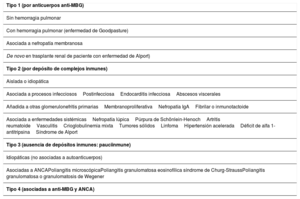
Las glomerulonefritis agudas (postinfecciosas) se presentan de forma repentina con hematuria (microscópica o macroscópica), proteinuria, disminución del filtrado glomerular y retención de sodio y agua que habitualmente producen una elevación de la presión arterial y edemas. Además, varias glomerulonefritis crónicas pueden presentarse como un síndrome nefrítico agudo y pueden ser clínicamente indistinguibles al inicio de las alteraciones agudas. Las glomerulonefritis rápidamente progresivas (GNRP) constituyen un síndrome clínico-patológico, caracterizado por un deterioro rápido de la función renal (semanas a meses), proteinuria en rango generalmente subnefrótico y la presencia de semilunas o crescientes fibrosas y celulares a nivel glomerular. Sus causas pueden ser primarias o secundarias, y su clasificación depende de hallazgos clínicos, serológicos e histológicos, dividiéndose en 3 tipos: 1 o asociada a anticuerpos antimembrana basal glomerular, 2 o asociada a complejos inmunes, 3 o pauciinmune (asociada a ANCA) y 4 (combinación de tipo 1 y 3). En relación con el diagnóstico y tratamiento deben ser precoces y suelen utilizarse inmunosupresores en dosis altas y a veces plasmaféresis, con el fin de recuperar la función renal y evitar la rápida progresión a enfermedad renal crónica avanzada o terminal. En casos de muy alta sospecha clínica, la realización de la biopsia renal no debe retrasar el inicio del tratamiento inmunosupresor.

Palabras clave
Glomerulonefritis aguda
Glomerulonefritis postinfecciosa
Glomerulonefritis con semilunas
Glomerulonefritis rápidamente progresiva
Abstract

Acute (post-infectious) glomerulonephritis presents rapidly with hematuria (microscopic or causes), proteinuria, a decrease in glomerular filtration rate, and sodium and water retention that usually cause an increase in blood pressure and edema. In addition, various types of chronic glomerulonephritis may present as acute nephrotic syndrome and can be clinically indistinguishable from the onset of acute abnormalities. Rapidly progressive glomerulonephritis (RPGN) represents a clinical-pathological syndrome characterized by a rapid decline in renal function (weeks to months); proteinuria generally in a subnephrotic range; and the presence of fibrous, cellular crescents in the glomerular area. Its causes can be primary or secondary. Its classification depends on clinical, serological, and histological findings; they are divided into 3 types: 1, associated with anti-glomerular basement membrane antibodies; 2, associated with immune complexes; 3 pauci-immune (ANCA-associated), or 4, a combination of types 1 and 3. Diagnosis and treatment must be early. High-dose immunosuppressants and, sometimes, plasmapheresis can be used for the purpose of restoring renal function and avoiding rapid progression to advanced or end-stage chronic kidney disease. In cases with very high clinical suspicion, performing a renal biopsy must not delay starting immunosuppressive therapy.

Keywords
Acute glomerulonephritis
Post-infectious glomerulonephritis
Crescentic glomerulonephritis
Rapidly progressive glomerulonephritis

Identifíquese

¿Aún no es suscriptor de la revista?
Comprar el acceso al artículo

Comprando el artículo el pdf del mismo podrá ser descargado

Teléfono para incidencias

De lunes a viernes de 9h a 18h (GMT+1) excepto los meses de julio y agosto que será de 9 a 15h
Llamadas desde España 932 415 960
Llamadas desde fuera de España +34 932 415 960
Bibliografía
[1]
W.G. Couser
202305231130024328
.
Pathogenesis and treatment of glomerulonephritis-an update.
J Bras Nefrol., (2016), 38 pp. 107-122
[2]
W.G. Couser
202305231130024329
2023052311300243210
, R.J. Johnson.
The etiology of glomerulonephritis: roles of infection and autoimmunity.
Kidney Int., (2014), 86 pp. 905-914
[3]
W.G. Couser
2023052311300243211
.
Pathogenesis of glomerulonephritis.
Kidney Int Suppl., (1993), 42 pp. S19-S26
[4]
S. Chadban
2023052311300243212
, R. Atkins.
Glomerulonephritis.
Lancet, (2005), 365 pp. 1797-1806
[5]
B. Rodríguez-Iturbe
2023052311300243213
2023052311300243214
, J.M. Musser.
The current state of poststreptococcal glomerulonephritis.
J Am Soc Nephrol., (2008), 19 pp. 1855-1864
[6]
J.R. Carapetis
2023052311300243215
, A.C. Steer, E.K. Mulholland, M. Weber.
The global burden of group A streptococcal diseases.
Lancet Infect Dis., (2005), 5 pp. 685-694
[7]
S. Roy
2023052311300243216
, F.B. Stapleton.
Changing perspectives in children hospitalized with poststreptococcal acute glomerulonephritis.
Pediatr Nephrol., (1990), 4 pp. 585-588
[8]
V. Thongboonkerd, J. Luengpailin, J. Cao, W.M. Pierce, J. Cai, J.B. Klein, et al.
Fluoride exposure attenuates expression of Streptococcus pyogenes virulence factors.
J Biol Chem., (2002), 277 pp. 16599-16605
[9]
C.C. Blyth, P.W. Robertson, A.R. Rosenberg.
Post-streptococcal glomerulonephritis in Sydney: a 16-year retrospective review.
J Paediatr Child Health., (2007), 43 pp. 446-450
[10]
R. Coppo, B. Gianoglio, M.G. Porcellini, S. Maringhini.
Frequency of renal diseases and clinical indications for renal biopsy in children (report of the Italian National Registry of Renal Biopsies in Children). Group of Renal Immunopathology of the Italian Society of Pediatric Nephrology and Group of Renal Immunopathology of the Italian Society of Nephrology.
Nephrol Dial Transplant., (1998), 13 pp. 293-297
[11]
J.E. Lewy
2023052311300243217
, L. Salinas-Madrigal, P.B. Herdson, C.L. Pirani, J. Metcoff.
Clinico-pathologic correlations in acute poststreptococcal glomerulonephritis. A correlation between renal functions, morphologic damage and clinical course of 46 children with acute poststreptococcal glomerulonephritis.
Medicine (Baltimore)., (1971), 50 pp. 453-501
[12]
B. Rodríguez-Iturbe
2023052311300243218
.
Postinfectious glomerulonephritis.
Am J Kidney Dis., (2000), 35 pp. XLVI-XLVIII
[13]
B.F. Anthony, E.L. Kaplan, L.W. Wannamaker, F.W. Briese, S.S. Chapman.
Attack rates of acute nephritis after type 49 streptococcal infection of the skin and of the respiratory tract.
J Clin Invest., (1969), 48 pp. 1697-1704
[14]
C.A. Stetson, C.H. Rammelkamp, R.M. Krause, R.J. Kohen, W.D. Perry.
Epidemic acute nephritis: studies on etiology, natural history and prevention.
Medicine (Baltimore)., (1955), 34 pp. 431-450
[15]
B. Rodríguez-Iturbe
2023052311300243219
, S. Batsford.
Pathogenesis of poststreptococcal glomerulonephritis a century after Clemens von Pirquet.
Kidney Int., (2007), 71 pp. 1094-1104
[16]
L.G. Ardiles
2023052311300243220
, G. Valderrama, P. Moya, S.A. Mezzano.
Incidence and studies on antigenic specificities of antineutrophil-cytoplasmic autoantibodies (ANCA) in poststreptococcal glomerulonephritis.
Clin Nephrol., (1997), 47 pp. 1-5
[17]
B. Rodríguez-Iturbe, V.N. Katiyar, J. Coello.
Neuraminidase activity and free sialic acid levels in the serum of patients with acute poststreptococcal glomerulonephritis.
N Engl J Med., (1981), 304 pp. 1506-1510
[18]
K. Sorger, J. Balun, F.K. Hübner, H. Köhler, H. Olbing, W. Schulz, et al.
The garland type of acute postinfectious glomerulonephritis: morphological characteristics and follow-up studies.
Clin Nephrol., (1983), 20 pp. 17-26
[19]
K. Sorger, M. Gessler, F.K. Hübner, H. Köhler, H. Olbing, W. Schulz, et al.
Follow-up studies of three subtypes of acute postinfectious glomerulonephritis ascertained by renal biopsy.
Clin Nephrol., (1987), 27 pp. 111-124
[20]
I. Sagel, G. Treser, A. Ty, N. Yoshizawa, H. Kleinberger, A.M. Yuceoglu, et al.
Occurrence and nature of glomerular lesions after group A streptococci infections in children.
Ann Intern Med., (1973), 79 pp. 492-499
[21]
S. Sanjad
2023052311300243221
, A. Tolaymat, J. Whitworth, S. Levin.
Acute glomerulonephritis in children: a review of 153 cases.
South Med J., (1977), 70 pp. 1202-1206
[22]
J.E. Lewy
2023052311300243222
, L. Salinas-Madrigal, P.B. Herdson, C.L. Pirani, J. Metcoff.
Clinico-pathologic correlations in acute poststreptococcal glomerulonephritis. A correlation between renal functions, morphologic damage and clinical course of 46 children with acute poststreptococcal glomerulonephritis.
Medicine (Baltimore)., (1971), 50 pp. 453-501
[23]
A.R. Nissenson
2023052311300243223
, L.J. Baraff, R.N. Fine, D.W. Knutson.
Poststreptococcal acute glomerulonephritis: fact and controversy.
Ann Intern Med., (1979), 91 pp. 76-86
[24]
O. Becquet, J. Pasche, H. Gatti, C. Chenel, M. Abély, P. Morville, et al.
Acute post-streptococcal glomerulonephritis in children of French Polynesia: a 3-year retrospective study.
Pediatr Nephrol., (2010), 25 pp. 275-280
[25]
D.S. Baldwin
2023052311300243224
, M.C. Gluck, R.G. Schacht, G. Gallo.
The long-term course of poststreptococcal glomerulonephritis.
Ann Intern Med., (1974), 80 pp. 342-358
[26]
E.J. Lewis, C.B. Carpenter, P.H. Schur.
Serum complement component levels in human glomerulonephritis.
Ann Intern Med., (1971), 75 pp. 555-560
[27]
J.S. Cameron, R.M. Vick, C.S. Ogg, W.M. Seymour, C. Chantler, D.R. Turner.
Plasma C3 and C4 concentrations in management of glomerulonephritis.
Br Med J., (1973), 3 pp. 668-672
[28]
G. Parra, B. Rodríguez-Iturbe, S. Batsford, A. Vogt, S. Mezzano, F. Olavarría, et al.
Antibody to streptococcal zymogen in the serum of patients with acute glomerulonephritis: a multicentric study.
Kidney Int., (1998), 54 pp. 509-517
[29]
K. Yamakami, N. Yoshizawa, K. Wakabayashi, A. Takeuchi, T. Tadakuma, M.D.P. Boyle.
The potential role for nephritis-associated plasmin receptor in acute poststreptococcal glomerulonephritis.
Methods., (2000), 21 pp. 185-197
[30]
T.M. Eison
2023052311300243225
, B.H. Ault, D.P. Jones, R.W. Chesney, R.J. Wyatt.
Post-streptococcal acute glomerulonephritis in children: clinical features and pathogenesis.
Pediatr Nephrol., (2011), 26 pp. 165-180
[31]
Niaudet
2023052311300243226
P. Postestreptococal glomerulonephritis. Uptodate 2018. Disponible en: https://www.uptodate.com/contents/poststreptococcal-glomerulonephritis?search=glomerulonefritis%20post%20estreptoc%C3%B3cica&source=search_result&selectedTitle=1∼60&usage_type=default&display_rank=1.
[32]
F. Johnston, J. Carapetis, M.S. Patel, T. Wallace, P. Spillane.
Evaluating the use of penicillin to control outbreaks of acute poststreptococcal glomerulonephritis.
Pediatr Infect Dis J., (1999), 18 pp. 327-332
[33]
F. Ferrario, O. Kourilsky, L. Morel-Maroger.
Acute endocapillary glomerulonephritis in adults: a histologic and clinical comparison between patients with and without initial acute renal failure.
Clin Nephrol., (1983), 19 pp. 17-23
[34]
S.M. Bonsib.
Glomerular basement membrane necrosis and crescent organization.
Kidney Int., (1988), 33 pp. 966-974
[35]
R.C. Atkins
2023052311300243227
, D.J. Nikolic-Paterson, Q. Song, H.Y. Lan.
Modulators of crescentic glomerulonephritis.
J Am Soc Nephrol., (1996), 7 pp. 2271-2278
[36]
W.G. Couser
2023052311300243228
.
Rapidly progressive glomerulonephritis: classification, pathogenetic mechanisms, and therapy.
Am J Kidney Dis., (1988), 11 pp. 449-464
[37]
J.B. Levy
2023052311300243229
, A.N. Turner, A.J. Rees, C.D. Pusey.
Long-term outcome of anti-glomerular basement membrane antibody disease treated with plasma exchange and immunosuppression.
Ann Intern Med., (2001), 134 pp. 1033-1042
[38]
C.O. Savage, C.D. Pusey, C. Bowman, A.J. Rees, C.M. Lockwood.
Antiglomerular basement membrane antibody mediated disease in the British Isles 1980-4.
Br Med J (Clin Res Ed)., (1986), 292 pp. 301-304
[39]
M. Walsh, P.A. Merkel, C.A. Peh, W. Szpirt, L. Guillevin, C.D. Pusey, et al.
Plasma exchange and glucocorticoid dosing in the treatment of anti-neutrophil cytoplasm antibody associated vasculitis (PEXIVAS): protocol for a randomized controlled trial.
[40]
Kidney
2023052311300243230
Disease: Improving Global Outcomes (KDIGO) Glomerulonephritis Work Group.
KDIGO Clinical Practice Guideline for Glomerulonephritis.
Kidney Inter Suppl., (2012), 2 pp. 139-274