



Vol. 14. Núm. 2.
Páginas 83-90 (Febrero 2024)

Actualización
Gastritis y gastropatías (II). Gastritis crónica atrófica y gastritis hipertrófica

Gastritis and gastropathies (II). Chronic atrophic gastritis and hypertrophic gastritis

J.L. Rueda GarcíaabA. Burgos GarcíaaM.D. Martín Arranzabc
Doi : https://10.1016/j.med.2024.02.003
Opciones
Resumen

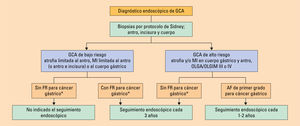
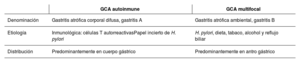
La gastritis crónica atrófica (GCA) es una patología de etiología multifactorial que produce una depleción de glándulas gástricas, afectando a la función secretora del estómago y a la absorción de, principalmente, hierro y vitamina B12. Su importancia radica en que los cambios del epitelio gástrico que condiciona pueden derivar en la aparición de cáncer gástrico. El diagnóstico de confirmación se realiza mediante la toma endoscópica de biopsias que, además, establecerán la necesidad de un seguimiento de la GCA según la presencia o no de determinadas características histopatológicas. No existe tratamiento específico para la GCA más allá del manejo de sus complicaciones.

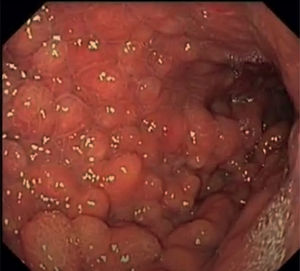
Las gastritis hipertróficas pueden darse en el seno de una infiltración secundaria del epitelio gástrico o por patologías que producen, de forma primaria, esta apariencia endoscópica de la mucosa gástrica. Destaca la enfermedad de Ménétrier, una entidad rara de la que se desconoce en gran medida su fisiopatogenia, y que también asocia un riesgo aumentado de cáncer gástrico. Se caracteriza por condicionar una gastropatía pierdeproteínas y el diagnóstico se basa en la demostración anatomopatológica de los cambios del epitelio gástrico típicos de la enfermedad. El tratamiento pasa por múltiples agentes de eficacia variable como los antisecretores y el octreótido.

Palabras clave
Gastritis
Atrofia
Hipertrofia
Cáncer
Ménétrier
Abstract

Chronic atrophic gastritis (CAG) is a disease with a multifactorial etiology that produces a depletion of gastric glands, affecting the secretory function of the stomach and the absorption, mainly, of iron and vitamin B12. Its importance lies in the fact that the changes in the gastric epithelium it causes can lead to the onset of gastric cancer. A confirmatory diagnosis is made by means of endoscopic biopsies, which will also determine the need for follow-up on CAG according to the presence or absence of certain histopathological features. There is no specific treatment for CAG beyond the management of its complications.

Hypertrophic gastritis can occur as a secondary infiltration of the gastric epithelium or due to pathologies that primarily produce this endoscopic appearance of the gastric mucosa. Of note is Ménétrier's disease, a rare disease whose pathophysiology is largely unknown that is also associated with an increased risk of stomach cancer. It is characterized as a disease that leads to a protein-losing enteropathy. The diagnosis is based on demonstrating the anatomic-pathological changes in the gastric epithelium that are typical of the disease. Treatment involves multiple agents of varying efficacy, such as antisecretory drugs and octreotide.

Keywords
Gastritis
Atrophy
Hypertrophy
Cancer
Ménétrier's disease

Identifíquese

¿Aún no es suscriptor de la revista?
Comprar el acceso al artículo

Comprando el artículo el pdf del mismo podrá ser descargado

Teléfono para incidencias

De lunes a viernes de 9h a 18h (GMT+1) excepto los meses de julio y agosto que será de 9 a 15h
Llamadas desde España 932 415 960
Llamadas desde fuera de España +34 932 415 960
Bibliografía
[1]
S. Massironi
202402200509255058
, A. Zilli, A. Elvevi, P. Invernizzi.
The changing face of chronic autoimmune atrophic gastritis: an updated comprehensive perspective.
Autoimmun Rev [Internet]., (2019), 18 pp. 215-222
[2]
M.N. Weck
202402200509255059
, H. Brenner.
Prevalence of chronic atrophic gastritis in different parts of the world.
Cancer Epidemiol Biomarkers Prev., (2006), 15 pp. 1083-1094
[3]
M.M. D’elios, M.P. Bergman, A. Azzurri, A. Amedei, M. Benagiano, J.J. De Pont, et al.
H+, K+-ATPase (proton pump) is the target autoantigen of Th1-type cytotoxic T cells in autoimmune gastritis.
Gastroenterology., (2001), 120 pp. 377-386
[4]
A. Troilo, A. Grassi, L. Petrone, F. Cianchi, M. Benagiano, C. Della Bella, et al.
Intrinsic factor recognition promotes T helper 17/T helper 1 autoimmune gastric inflammation in patients with pernicious anemia.
Oncotarget., (2019), 10 pp. 2921-2929
[5]
M.V. Lenti
2024022005092550510
, M. Rugge, E. Lahner, E. Miceli, B.H. Toh, R.M. Genta, et al.
Autoimmune gastritis.
Nat Rev Dis Prim., (2020), 6 pp. 56
[6]
P. Correa
2024022005092550511
2024022005092550512
.
Helicobacter pylori and gastric cancer: State of the art.
Cancer Epidemiol Biomarkers Prev., (1996), 5 pp. 477-481
[7]
P. Correa
2024022005092550513
, B.M. Piazuelo, K.T. Wilson.
Pathology of gastric intestinal metaplasia: Clinical implications.
Am J Gastroenterol., (2010), 105 pp. 493-498
[8]
W.L. Neumann
2024022005092550514
2024022005092550515
, E. Coss, M. Rugge, R.M. Genta.
Autoimmune atrophic gastritis-pathogenesis, pathology and management.
Nat Rev Gastroenterol Hepatol., (2013), 10 pp. 529-541
[9]
P. Correa
2024022005092550516
, B.M. Piazuelo, K.T. Wilson.
Pathology of gastric intestinal metaplasia: Clinical implications.
Am J Gastroenterol., (2010), 105 pp. 493-498
[10]
M. Chen, X.L. Liu, X.J. Zhu, S.R. Wu, N. Wang, S.B. Li, et al.
Endoscopic grading of gastric atrophy and histological gastritis staging on risk assessment for early gastric cancer: A case-control study.
J Dig Dis., (2023), 24 pp. 262-270
[11]
E. Miceli, M.V. Lenti, D. Padula, O. Luinetti, C. Vattiato, C.M. Monti, et al.
Common features of patients with autoimmune atrophic gastritis.
Clin Gastroenterol Hepatol., (2012), 10 pp. 812-814
[12]
A.D. Smith
2024022005092550517
2024022005092550518
, M.J. Warren, H. Refsum.
Vitamin B12.
Adv Food Nutr Res, (2018), 83 pp. 215-279
[13]
R.M. Russell
2024022005092550519
, S.D. Krasinski, I.M. Samloff, R.A. Jacob, S.C. Hartz, S.R. Brovender.
Folic acid malabsorption in atrophic gastritis. Possible compensation by bacterial folate synthesis.
Gastroenterology., (1986), 91 pp. 1476-1482
[14]
G. Esposito
2024022005092550520
, L. Dottori, G. Pivetta, I. Ligato, E. Dilaghi, E. Lahner.
Pernicious anemia: The hematological presentation of a multifaceted disorder caused by cobalamin deficiency.
Nutrients., (2022), 14 pp. 1672
[15]
K.G. Gwathmey
2024022005092550521
, J. Grogan.
Nutritional neuropathies.
Muscle nerve., (2020), 62 pp. 13-29
[16]
H. Kishikawa, K. Nakamura, K. Ojiro, T. Katayama, K. Arahata, S. Takarabe, et al.
Relevance of pepsinogen, gastrin, and endoscopic atrophy in the diagnosis of autoimmune gastritis.
Sci Rep [Internet]., (2022), 12 pp. 1-12
[17]
N. Uedo
2024022005092550522
, K. Yao.
Endoluminal diagnosis of early gastric cancer and its precursors: Bridging the gap between endoscopy and pathology.
Adv Exp Med Biol., (2016), 908 pp. 293-316
[18]
K. Kimura
2024022005092550523
, T. Takemoto.
An endoscopic recognition of the atrophic border and its significance in chronic gastritis.
Endoscopy., (1969), 1 pp. 87-97
[19]
M. Banks
2024022005092550524
2024022005092550525
, D. Graham, M. Jansen, T. Gotoda, S. Coda, M. Di Pietro, et al.
British Society of Gastroenterology guidelines on the diagnosis and management of patients at risk of gastric adenocarcinoma.
Gut., (2019), 68 pp. 1545-1575
[20]
M.F. Dixon
2024022005092550526
, R.M. Genta, J.H. Yardley, P. Correa, K.P. Batts, B.B. Dahms, et al.
Classification and grading of gastritis. The updated Sydney System. International Workshop on the Histopathology of Gastritis, Houston.
Am J Surg Pathol., (1994), 20 pp. 1161-1181
[21]
S. Isajevs, I. Liepniece-Karele, D. Janciauskas, G. Moisejevs, K. Funka, I. Kikuste, et al.
The effect of incisura angularis biopsy sampling on the assessment of gastritis stage.
Eur J Gastroenterol Hepatol., (2014), 26 pp. 510-513
[22]
P. Pimentel-Nunes
2024022005092550527
2024022005092550528
, D. Libânio, R. Marcos-Pinto, M. Areia, M. Leja, G. Esposito, et al.
Management of epithelial precancerous conditions and lesions in the stomach (MAPS II): European Society of Gastrointestinal Endoscopy (ESGE), European Helicobacter and Microbiota Study Group (EHMSG), European Society of Pathology (ESP), and Sociedade Portuguesa de Endoscopia Digestiva (SPED) guideline update 2019.
Endoscopy., (2019), 51 pp. 365-388
[23]
P.H. Schmidt, J.R. Lee, V. Joshi, R.J. Playford, R. Poulsom, N.A. Wright, et al.
Identification of a metaplastic cell lineage associated with human gastric adenocarcinoma.
Lab Invest., (1999), 79 pp. 639-646
[24]
C.A. González, J.M. Sanz-Anquela, O. Companioni, C. Bonet, M. Berdasco, C. López, et al.
Incomplete type of intestinal metaplasia has the highest risk to progress to gastric cancer: results of the Spanish follow-up multicenter study.
J Gastroenterol Hepatol [Internet]., (2016), 31 pp. 953-958
[25]
S. Gupta
2024022005092550529
2024022005092550530
, D. Li, H.B. El Serag, P. Davitkov, O. Altayar, S. Sultan, et al.
AGA Clinical Practice Guidelines on Management of Gastric Intestinal Metaplasia.
Gastroenterology., (2020), 158 pp. 693-702
[26]
R.A. Komorowski, J.G. Caya, J.E. Geenen.
The morphologic spectrum of large gastric folds: utility of the snare biopsy.
Gastrointest Endosc., (1986), 32 pp. 190-192
[27]
S. Jarnum, K.B. Jensen.
Plasma protein turnover (albumin, transferrin, IgG, IgM) in Ménétrier's disease (giant hypertrophic gastritis): Evidence of non-selective protein loss.
Gut., (1972), 13 pp. 128-137
[28]
Z. Berger, M.I. Lea-Plaza Puig, C. Varela, M. Becerra, M. Capetillo, J. Vargas.
IgG4 related hypertrophic gastropathy. Report of one case.
Rev Med Chil., (2019), 147 pp. 119-124
[29]
N. Toubia
2024022005092550531
2024022005092550532
, M.L. Schubert.
Menetrier's disease.
Curr treat options gastroenterol., (2008), 11 pp. 103-108
[30]
P.J. Dempsey, J.R. Goldenring, C.J. Soroka, I.M. Modlin, R.W. McClure, C.D. Lind, et al.
Possible role of transforming growth factor alpha in the pathogenesis of Ménétrier's disease: supportive evidence form humans and transgenic mice.
Gastroenterology., (1992), 103 pp. 1950-1963
[31]
E. Bayerdorffer, M.M. Ritter, R. Hatz, W. Brooks, G. Ruckdeschel, M. Stolte.
Healing of protein losing hypertrophic gastropathy by eradication of Helicobacter pylori--is Helicobacter pylori a pathogenic factor in Ménétrier's disease?.
Gut., (1994), 35 pp. 701-704
[32]
R.O. Occena, S.F. Taylor, C.C. Robinson, R.J. Sokol.
Association of Cytomegalovirus with Menetrier's Disease in Childhood.
J Pediatr Gastroenterol Nutr., (1993), 17 pp. 217-224
[33]
M. Kmiecik, A. Walczak, P. Samborski, J. Paszkowski, A. Dobrowolska, J. Karczewski, et al.
Upper gastrointestinal bleeding as an unusual manifestation of localized Ménétrier's disease with an underlying lipoma: A case report.
World J Gastrointest Endosc., (2023), 15 pp. 10-18
[34]
Y.A. Chen, H.L. Tsai, P.I. Liang, J.Y. Wang.
A rare case of Mneétrier's disease-induced gastric outlet obstruction.
Kaohsiung J Med Sci., (2023), 39 pp. 1054-1055
[35]
A.E. Almazar, J.D. Penfield, Y.A. Saito, N.J. Talley.
Survival times of patients with Menetrier's disease and risk of gastric cancer.
Clin Gastroenterol Hepatol., (2021), 19 pp. 707-712
[36]
A. Khan
2024022005092550533
, A. Chhaparia, M.B. Hammami, C. Hachem.
Role of octreotide in Ménétrier's disease: Case report and review of literature.
Cureus., (2020), 12 pp. e11515
[37]
A. Carlsen, T.B. Grimstad, L.N. Karlsen, O.J. Greve, K.B. Norheim, D. Lea.
A case of Ménétrierés disease treated with the monoclonal antibody cetuximab.
Clin J Gastroenterol., (2019), 12 pp. 562-565
[38]
K. Fukushi, K. Goda, H. Kino, M. Kondo, M. Kanazawa, K. Kashima, et al.
Curative resection with endoscopic submucosal dissection of early gastric cancer in Helicobacter pylori-negative Ménétrier's disease: A case report.
World J Gastroenterol., (2022), 28 pp. 594-601
[39]
L.G. Capelle, A.C. de Vries, J. Haringsma, F. Ter Borg, R.A. de Vries, M.J. Bruno, et al.
The staging of gastritis with the OLGA system by using intestinal metaplasia as an accurate alternative for atrophic gastritis.
Gastrointest Endosc., (2010), 71 pp. 1150-1158