
Vol. 12. Núm. 24.
Páginas 1379-1387 (Enero 2017)

Actualización
Componentes celulares y organización tisular del sistema inmune adaptativo

Adaptive immune system: cellular component and tissue organization

J. Monserrat SanzA.M. Gómez LahozL. Paule PeralA. Prieto Martín
Doi : https://10.1016/j.med.2016.12.007
Opciones
Resumen
Linfocitos B y la médula ósea

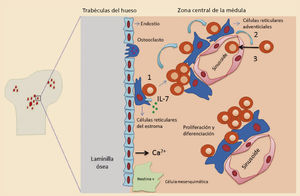
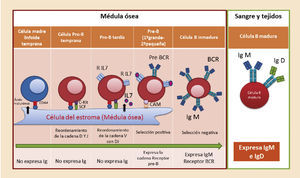
. Los linfocitos B se originan en la médula ósea, la cual proporciona el entorno celular y molecular esencial para que mediante un complejo proceso de diferenciación independiente de antígeno se forme un linfocito B inmunocompetente. Los linfocitos B sintetizarán sus receptores de antígeno, encargados de reconocer específicamente a los patógenos, mediante la recombinación somática de sus genes. Para asegurar el correcto funcionamiento de estos receptores deberán pasar por dos controles de calidad imprescindibles, demostrar que los receptores son funcionales y que no reconocen estructuras propias, proceso denominado tolerancia central.

Linfocitos T y el timo

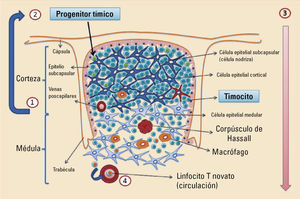
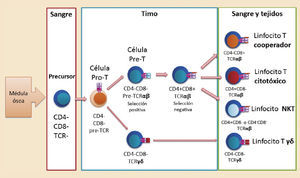
. Los linfocitos T necesitan procesos de diferenciación similares a los linfocitos B. Sin embargo, nacen en el timo a partir de un precursor pluripotencial que proviene de médula ósea. La histología tímica proporciona el entorno para realizar los procesos de tolerancia central y las señales necesarias para generar las distintas subpoblaciones de linfocitos: T-colaboradores, T-citotóxicos, NKT y Tγδ.

Órganos linfoides secundarios

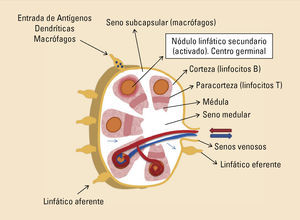
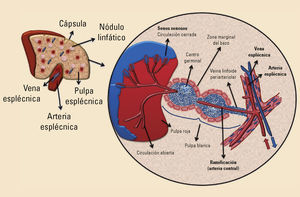
Los linfocitos maduros liberados por los órganos linfoides primarios a la circulación general se dirigirán a los órganos linfoides secundarios como ganglios linfáticos o bazo donde se producirá el reclutamiento de los antígenos y el inicio de las respuestas inmunes.

Palabras clave
Linfocitos T
Linfocitos B
Timo
Médula ósea
Órganos linfoides secundarios
Bazo
Ganglio linfático
Placas de Peyer
Abstract
B lymphocytes and bone marrow

B cells originate in the bone marrow, which provides the essential cellular and molecular environment so that through a complex process of differentiation, antigen independent, an immunocompetent B lymphocyte is formed. B lymphocytes synthesize their antigen receptors, responsible for specifically recognizing pathogens through somatic recombination of their genes. To ensure proper working of these receptors must go through two essential quality controls, demonstrate that the receptors are functional and do not recognize own structures, a process called central tolerance.

T lymphocytes and thymus

T lymphocytes need differentiation processes like B lymphocytes, however, they arise in the thymus from a pluripotent precursor that comes from bone marrow. Thymic histology provides the environment for the process of central tolerance and the necessary signals to generate the different subpopulations of T lymphocytes: T-helper, T-cytotoxic, NKT and Tγd.

Secondary lymphoid organs

Mature lymphocytes are released from primary lymphoid organs into the general circulation, and will be directed to secondary lymphoid organs such as lymph node or spleen where recruitment of antigens and the onset immune responses will occur.

Keywords
T lymphocytes
B lymphocytes
Thymus
Bone marrow
Secondary lymphoid organs
Spleen
Lymphoid node
Peyer's patches

Identifíquese

¿Aún no es suscriptor de la revista?

Comprar el acceso al artículo

Comprando el artículo el pdf del mismo podrá ser descargado

Teléfono para incidencias

De lunes a viernes de 9h a 18h (GMT+1) excepto los meses de julio y agosto que será de 9 a 15h

Llamadas desde España 932 415 960
Llamadas desde fuera de España +34 932 415 960
Bibliografía
[1]
201701080009538548
201701080009538549
F.A. Bonilla, H.C. Oettgen.
Adaptive immunity.
J Allergy Clin Immunol., (2010), 125(2) pp. S33-S40
[2]
D. Male, J. Brostoff, D. Roth, I. Roitt.
Celulas, téjidos y órganos del sistema inmunitario.
Inmunología., 8ª ed., Elsevier, pp. 17-51
[3]
2017010800095385410
2017010800095385411
J. Parkin, B. Cohen.
An overview of the immune system.
Lancet., (2001), 357
1777-89
[4]
A.K. Abbas, A.H. Lichtman, S. Pillai.
Cells and tissues of immune system.
Cellular and molecular immunology., 8th ed., Elsevier, pp. 15-37
[5]
W.E. Paul.
The immune system.
Fundamental immunology., 7ª ed., Lippincott Williams and Wilkins, pp. 571-668
[6]
2017010800095385412
T.W. LeBien, T.F. Tedder.
B lymphocytes: how they develop and function.
[7]
T.A. Milford, R.J. Su, O.L. Francis, I. Baez, S.R. Martínez, J.S. Coats, et al.
TSLP or IL-7 provide an IL-7Ralpha signal that is critical for human B lymphopoiesis.
Eur J Immunol., (2016), 46
2155-61
[8]
2017010800095385413
J.E. Labrie III, L. Borghesi, R.M. Gerstein.
Bone marrow microenvironmental changes in aged mice compromise V(D)J recombinase activity and B cell generation.
Semin Immunol., (2005), 17
347-55
[9]
2017010800095385414
A.G. Rolink, C. Schaniel, M. Busslinger, S.L. Nutt, F. Melchers.
Fidelity and infidelity in commitment to B-lymphocyte lineage development.
Immunol Rev., (2000), 175
104-11
[10]
2017010800095385415
2017010800095385416
K. Pieper, B. Grimbacher, H. Eibel.
B-cell biology and development.
J Allergy Clin Immunol., (2013), 131
959-71
[11]
2017010800095385417
2017010800095385418
G.J. Tobon, J.H. Izquierdo, C.A. Canas.
B lymphocytes: development, tolerance, and their role in autoimmunity-focus on systemic lupus erythematosus.
Autoimmune Dis., (2013), 2013 pp. 827254
[12]
2017010800095385419
S. Fillatreau.
Regulatory roles of B cells in infectious diseases.
Clin Exp Rheumatol., (2016), 34(4) pp. 1-5
[13]
2017010800095385420
G. Shahaf, S. Zisman-Rozen, D. Benhamou, D. Melamed, R. Mehr.
B cell development in the bone marrow is regulated by homeostatic feedback exerted by mature B cells.
Front Immunol., (2016), 7 pp. 77
[14]
2017010800095385421
S. Suryani, S.G. Tangye.
Therapeutic implications of advances in our understanding of transitional B-cell development in humans.
Expert Rev Clin Immunol., (2010), 6
765-75
[15]
2017010800095385422
K. Dorshkind, E. Montecino-Rodríguez.
Fetal B-cell lymphopoiesis and the emergence of B-1-cell potential.
Nat Rev Immunol., (2007), 7
213-9
[16]
2017010800095385423
2017010800095385424
M.E. Conley, A.K. Dobbs, D.M. Farmer, S. Kilic, K. Paris, S. Grigoriadou, et al.
Primary B cell immunodeficiencies: comparisons and contrasts.
Annu Rev Immunol., (2009), 27 pp. 199-227
[17]
D.A. Kaminski, C. Wei, A.F. Rosenberg, F.E. Lee, I. Sanz.
Multiparameter flow cytometry and bioanalytics for B cell profiling in systemic lupus erythematosus.
Methods Mol Biol., (2012), 900
109-34
[18]
2017010800095385425
2017010800095385426
D.A. Kaminski, C. Wei, Y. Qian, A.F. Rosenberg, I. Sanz.
Advances in human B cell phenotypic profiling.
Front Immunol., (2012), 3 pp. 302
[19]
2017010800095385427
2017010800095385428
Y. Takahama.
Journey through the thymus: stromal guides for T-cell development and selection.
Nat Rev Immunol., (2006), 6
127-35
[20]
2017010800095385429
D.A. Sultana, J.J. Bell, D.A. Zlotoff, M.E. De Obaldia, A. Bhandoola.
Eliciting the T cell fate with Notch.
Semin Immunol., (2010), 22
254-60
[21]
2017010800095385430
Y. Takahama, T. Nitta, R.A. Mat, S. Nitta, S. Murata, K. Tanaka.
Role of thymic cortex-specific self-peptides in positive selection of T cells.
Semin Immunol., (2010), 22
287-93
[22]
2017010800095385431
N.S. Fay, E.C. Larson, J.M. Jameson.
Chronic Inflammation and gammadelta T Cells.
Front Immunol., (2016), 7 pp. 210
[23]
A. Lombes, A. Durand, C. Charvet, M. Riviere, N. Bonilla, C. Auffray, et al.
Adaptive immune-like gamma/delta t lymphocytes share many common features with their alpha/beta T cell counterparts.
1449-58
[24]
2017010800095385432
S. Paul, A.K. Singh, Shilpi, G. Lal.
Phenotypic and functional plasticity of gamma-delta (gammadelta) T cells in inflammation and tolerance.
Int Rev Immunol., (2014), 33
537-58
[25]
2017010800095385433
2017010800095385434
P. Aliahmad, J. Kaye.
Commitment issues: linking positive selection signals and lineage diversification in the thymus.
Immunol Rev., (2006), 209
253-73
[26]
2017010800095385435
A. Misslitz, G. Bernhardt, R. Forster.
Trafficking on serpentines: molecular insight on how maturating T cells find their winding paths in the thymus.
Immunol Rev., (2006), 209
115-28
[27]
2017010800095385436
L. Wang, Y. Xiong, R. Bosselut.
Maintaining CD4-CD8 lineage integrity in T cells: where plasticity serves versatility.
Semin Immunol., (2011), 23
360-7
[28]
S.M. Hedrick.
Thymus lineage commitment: a single switch.
Immunity., (2008), 28
297-9
[29]
2017010800095385437
2017010800095385438
M. Coles, H. Veiga-Fernandes.
Insight into lymphoid tissue morphogenesis.
Immunol Lett., (2013), 156 pp. 46-53
[30]
W.E. Paul.
Lymphoid tissues and organs, 7th Edition ed., Fundamental Immunology,
[31]
2017010800095385439
N. Hiraoka, Y. Ino, R. Yamazaki-Itoh.
Tertiary lymphoid organs in cancer tissues.
Front Immunol., (2016), 7 pp. 244
[32]
P. Hjelmstrom.
Lymphoid neogenesis: de novo formation of lymphoid tissue in chronic inflammation through expression of homing chemokines.
J Leukoc Biol., (2001), 69
331-9
[33]
C. Pearson, H.H. Uhlig, F. Powrie.
Lymphoid microenvironments and innate lymphoid cells in the gut.
Trends Immunol., (2012), 33
289-96
[34]
2017010800095385440
K. Hoorweg, T. Cupedo.
Development of human lymph nodes and Peyer's patches.
Semin Immunol., (2008), 20
164-70
[35]
2017010800095385441
2017010800095385442
U.H. von Andrian, T.R. Mempel.
Homing and cellular traffic in lymph nodes.
Nat Rev Immunol., (2003), 3
867-78
[36]
J.M. den Haan, G. Kraal.
Innate immune functions of macrophage subpopulations in the spleen.
J Innate Immun., (2012), 4
437-45
[37]
2017010800095385443
R.E. Mebius, M.A. Nolte, G. Kraal.
Development and function of the splenic marginal zone.
Crit Rev Immunol., (2004), 24
449-64
[38]
2017010800095385444
2017010800095385445
R.E. Mebius, G. Kraal.
Structure and function of the spleen.
Nat Rev Immunol., (2005), 5
606-16
[39]
2017010800095385446
P. Garside, O. Millington, K.M. Smith.
The anatomy of mucosal immune responses.
Ann N Y Acad Sci., (2004), 1029 pp. 9-15
[40]
2017010800095385447
C. Jung, J.P. Hugot, F. Barreau.
Peyer's patches: the immune sensors of the intestine.
Int J Inflam., (2010), 2010 pp. 823710