

Vol. 12. Núm. 3.
Páginas 137-142 (Febrero 2016)

Actualización
Complicaciones gástricas de tratamientos farmacológicos

Gastric complications of drug treatments

I. Gil-AldeaaJ.R. Azanza Pereab
Doi : https://10.1016/j.med.2016.02.004
Opciones
Resumen
Introducción

Las complicaciones gástricas de los medicamentos constituyen unos de los efectos adversos más destacados y de mayor relevancia clínica, siendo los AINE los principales causantes.

Patogénesis

El daño a nivel de la mucosa gástrica se puede presentar de diferentes maneras, siendo el mecanismo fundamental la inhibición de la síntesis de prostaglandinas.

Factores de riesgo

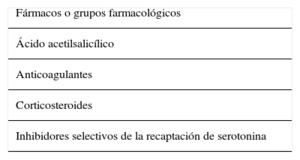
Existen diversos factores de riesgo, dependientes e independientes, que permiten estratificar a los pacientes según su riesgo y, en consecuencia, adoptar medidas preventivas.

Prevención y tratamiento

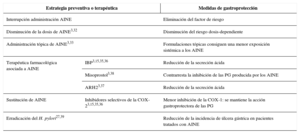
Entre estas medidas, la coadministración de AINE junto con inhibidores de la bomba de protones o la administración de inhibidores selectivos de la COX-2 han demostrado ser en estudios aleatorizados medidas efectivas. No obstante, se deben valorar otras alternativas preventivas y terapéuticas a la administración de AINE, debido sobre todo al riesgo asociado cardiovascular de este grupo farmacológico y, en especial, de los inhibidores selectivos de la COX-2.

Palabras clave
Gastroprotección
Antiinflamatorios no esteroideos
Inhibidores de la bomba de protones
Inhibidores selectivos de la COX-2
Abstract
Introduction

Gastric drug complications are one of the more adverse effects prominent and most clinically relevant, NSAIDs being the main causes.

Pathogenesis

The damage level gastric mucosa can be presented in different ways, being the fundamental mechanism inhibition of prostaglandin synthesis.

Risk factor's

There are several risk factors, dependent and independent, which allow to stratify patients according to their risk and, accordingly, take preventive measures.

Prevention and treatment

Among these measures, coadministration with NSAIDs proton-pump inhibitor or administration of COX-2 inhibitor have proven to be effective measures in randomized studies. However, you should evaluate other preventive and therapeutic administration of NSAIDs alternatives, mainly due to the risk. This associated cardiovascular drug group and, in particular, selective inhibitors COX-2.

Keywords
Gastroprotection
Nonsteroidal anti-inflammatory drugs
Proton pump inhibitors
Selective COX-2 inhibitors

Identifíquese

¿Aún no es suscriptor de la revista?

Comprar el acceso al artículo

Comprando el artículo el pdf del mismo podrá ser descargado

Teléfono para incidencias

De lunes a viernes de 9h a 18h (GMT+1) excepto los meses de julio y agosto que será de 9 a 15h

Llamadas desde España 932 415 960
Llamadas desde fuera de España +34 932 415 960
Bibliografía
[1]
P. Carrasco-Garrido, L.A. de Andrés, V.H. Barrera, G.A. de Miguel, R. Jiménez-García.
Trends of adverse drug reactions related-hospitalizations in Spain (2001-2006).
BMC Health Serv Res, (2010), 10 pp. 287
[2]
L.A. García Rodríguez, H. Jick.
Risk of upper gastrointestinal bleeding and perforation associated with individual non-steroidal anti-inflammatory drugs.
Lancet, (1994), 343 pp. 769-772
[3]
J.L. Goldstein, B. Cryer.
Gastrointestinal injury associated with NSAID use: a case study and review of risk factors and preventative strategies.
Drug Healthc Patient Saf, (2015), 7 pp. 31-41
[4]
G. Singh.
Gastrointestinal complications of prescription and over-the-counter nonsteroidal anti-inflammatory drugs: a view from the ARAMIS database. Arthritis, rheumatism, and aging medical information system.
Am J Ther, (2000), 7 pp. 115-121
[5]
L. Laine, K. Takeuchi, A. Tarnawski.
Gastric mucosal defense and cytoprotection: bench to bedside.
Gastroenterology, (2008), 135 pp. 41-60
[6]
I.M. Modlin, M. Kidd, K.D. Lye, N.A. Wright.
Gastric stem cells: an update.
Keio J Med, (2003), 52 pp. 134-137
[7]
P.H. Guth.
Current concepts in gastric microcirculatory pathophysiology.
Yale J Biol Med, (1992), 65 pp. 677-688
[8]
P. Holzer.
Role of visceral afferent neurons in mucosal inflammation and defense.
Curr Opin Pharmacol, (2007), 7 pp. 563-569
[9]
T. Stroff, S. Plate, M. Respondek, K.M. Müller, B.M. Peskar.
Protection by gastrin in the rat stomach involves afferent neurons, calcitonin gene-related peptide, and nitric oxide.
Gastroenterology, (1995), 109 pp. 89-97
[10]
M. Ham, J.D. Kaunitz.
Gastroduodenal defense.
Curr Opin Gastroenterol, (2007), 23 pp. 607-616
[11]
B.M. Peskar.
Neural aspects of prostaglandin involvement in gastric mucosal defense.
J Physiol Pharmacol, (2001), 52 pp. 555-568
[12]
L. Filaretova, T. Podvigina, T. Bagaeva, P. Bobryshev, K. Takeuchi.
Gastroprotective role of glucocorticoid hormones.
J Pharmacol Sci, (2007), 104 pp. 195-201
[13]
F. Halter, A.S. Tarnawski, A. Schmassmann, B.M. Peskar.
Cyclooxygenase 2-implications on maintenance of gastric mucosal integrity and ulcer healing: controversial issues and perspectives.
Gut, (2001), 49 pp. 443-453
[14]
T. Brzozowski, P.C. Konturek, S.J. Konturek, I. Brzozowska, T. Pawlik.
Role of prostaglandins in gastroprotection and gastric adaptation.
J Physiol Pharmacol, (2005), 56 pp. 33-55
[15]
A. Rostom, K. Muir, C. Dubé, E. Jolicoeur, M. Boucher, J. Joyce, et al.
Gastrointestinal safety of cyclooxygenase-2 inhibitors: a Cochrane Collaboration systematic review.
Clin Gastroenterol Hepatol, (2007), 5 pp. 818-828
[16]
B.L. Strom, J.A. Berlin, J.L. Kinman, P.W. Spitz, S. Hennessy, H. Feldman, et al.
Parenteral ketorolac and risk of gastrointestinal and operative site bleeding. A positmarketing surveillance study.
JAMA, (1996), 275 pp. 376-382
[17]
Singh G, Ramey DR, Morfeld D, Shi H, Hatoum HT, Fries JF. Gastrointestinal tract complications of nonsteroidal anti-inflammatory drug treatment in rheumatoid arthritis. A prospective observational cohort study. Arch Intern Med. 199622;156(14):1530-6.
[18]
F.E. Silverstein, D.Y. Graham, J.R. Senior, H.W. Davies, B.J. Struthers, R.M. Bittman, et al.
Misoprostol reduces serious gastrointestinal complications in patients with rheumatoid arthritis receiving nonsteroidal anti-inflammatory drugs. A randomized, double-blind, placebo-controlled trial.
Ann Intern Med, (1995), 123 pp. 241-249
[19]
C. Bombardier, L. Laine, A. Reicin, D. Shapiro, R. Burgos-Vargas, B. Davis, VIGOR Study Group, et al.
Comparison of upper gastrointestinal toxicity of rofecoxib and naproxen in patients with rheumatoid arthritis. VIGOR Study Group.
N Engl J Med, (2000), 343 pp. 1520-1528
[20]
J.F. Fries, C.A. Williams, D.A. Bloch, B.A. Michel.
Nonsteroidal anti-inflammatory drug-associated gastropathy: incidence and risk factor models.
Am J Med, (1991), 91 pp. 213-222
[21]
S.M. Jankovic, J. Aleksic, S. Rakovic, A. Aleksic, I. Stevanovic, N. Stefanovic-Stoimenov, et al.
Nonsteroidal antiinflammatory drugs and risk of gastrointestinal bleeding among patients on hemodialysis.
J Nephrol, (2009), 22 pp. 502-507
[22]
A. Lanas, L.A. García-Rodríguez, M.T. Arroyo, L. Bujanda, F. Gomollón, M. Forné, et al.
Investigators of the Asociación Española de Gastroenterología (AEG). Effect of antisecretory drugs and nitrates on the risk of ulcer bleeding associated with nonsteroidal anti-inflammatory drugs, antiplatelet agents, and anticoagulants.
Am J Gastroenterol, (2007), 102 pp. 507-515
[23]
L.A. García Rodríguez, S. Hernández-Díaz.
The risk of upper gastrointestinalcomplications associated with nonsteroidal anti-inflammatory drugs, glucocorticoids, acetaminophen, and combinations of these agents.
Arthritis Res, (2001), 3 pp. 98-101
[24]
F.J. De Abajo, L.A. Rodríguez, D. Montero.
Association between selective serotonin reuptake inhibitors and upper gastrointestinal bleeding: population based case-control study.
BMJ, (1999), 319 pp. 1106-1109
[25]
J.C. De Jong, P.B. van den Berg, H. Tobi, L.T. de Jong-van den Berg.
Combined use of SSRIs and NSAIDs increases the risk of gastrointestinal adverse effects.
Br J Clin Pharmacol, (2003), 55 pp. 591-595
[26]
R.I. Shorr, W.A. Ray, J.R. Daugherty, M.R. Griffin.
Concurrent use of nonsteroidal anti-inflammatory drugs and oral anticoagulants places elderly persons at high risk for hemorrhagic peptic ulcer disease.
Arch Intern Med, (1993), 153 pp. 1665-1670
[27]
J.M. Scheiman.
The use of proton pump inhibitors in treating and preventing NSAID-induced mucosal damage.
Arthritis Res Ther, (2013), 15 pp. S5
[28]
P. Wikman Jorgensen, E. López Calleja, P. Safont Gasó, M. Matarranz del Amo, R. Andrés Navarro, J. Merino Sánchez.
Antiagregación y anticoagulación, relación con la hemorragia digestiva alta.
Rev Esp Enferm Dig, (2011), 103 pp. 360-365
[29]
A. Lanas, G. García-Tell, B. Armada, A. Oteo-Alvaro.
Prescription patterns and appropriateness of NSAID therapy according to gastrointestinal risk and cardiovascular history in patients with diagnoses of osteoarthritis.
[30]
F.L. Lanza, F.K. Chan, E.M. Quigley.
Practice Parameters Committee of the American College of Gastroenterology. Guidelines for prevention of NSAID-related ulcer complications.
Am J Gastroenterol, (2009), 104 pp. 728-738
[31]
P.G. Conaghan, J. Dickson, R.L. Grant.
Guideline Development Group. Care and management of osteoarthritis in adults: summary of NICE guidance.
[32]
A. Gibofsky, S. Silberstein, C. Argoff, S. Daniels, S. Jensen, C.L. Young.
Lower-dose diclofenac submicron particle capsules provide early and sustained acute patient pain relief in a phase 3 study.
Postgrad Med, (2013), 125 pp. 130-138
[33]
T. Massey, S. Derry, R.A. Moore, H.J. McQuay.
Topical NSAIDs for acute pain in adults.
Cochrane Database Syst Rev, (2010),
[34]
C.S. Eom, C.Y. Jeon, J.W. Lim, E.G. Cho, S.M. Park, K.S. Lee.
Use of acid-suppressive drugs and risk of pneumonia: a systematic review and meta-analysis.
CMAJ, (2011), 183 pp. 310-319
[35]
F.K. Chan, A. Lanas, J. Scheiman, M.F. Berger, H. Nguyen, J.L. Goldstein.
Celecoxib versus omeprazole and diclofenac in patients with osteoarthritis and rheumatoid arthritis (CONDOR): a randomised trial.
[36]
X. Wang, H.J. Tian, H.K. Yang, P. Wanyan, Y.J. Peng.
Meta-analysis: cyclooxygenase-2 inhibitors are no better than nonselective nonsteroidal anti-inflammatory drugs with proton pump inhibitors in regard to gastrointestinal adverse events in osteoarthritis and rheumatoid arthritis.
Eur J Gastroenterol Hepatol, (2011), 23 pp. 876-880
[37]
A. Rostom, G. Wells, P. Tugwell, V. Welch, C. Dubé, J. McGowan.
The prevention of chronic NSAID induced upper gastrointestinal toxicity: a Cochrane collaboration metaanalysis of randomized controlled trials.
J Rheumatol, (2000), 27 pp. 2203-2214
[38]
A. Rostom, C. Dube, G. Wells, P. Tugwell, V. Welch, E. Jolicoeur, et al.
Prevention of NSAID-induced gastroduodenal ulcers.
Cochrane Database Syst Rev, (2002),
[39]
M. Vergara, M. Catalán, J.P. Gisbert, X. Calvet.
Meta-analysis: role of Helicobacter pylori eradication in the prevention of peptic ulcer in NSAID users.
Aliment Pharmacol Ther, (2005), 21 pp. 1411-1418
[40]
J.M. Scheiman.
Balancing risks and benefits of cyclooxygenase-2 selective nonsteroidal anti-inflammatory drugs.
Gastroenterol Clin North Am, (2009), 38 pp. 305-314