


Vol. 12. Núm. 12.
Páginas 683-692 (Mayo 2016)

Actualización
Carcinoma hepatocelular

Hepatocellular carcinoma

J. MartínezJ.L. LledóM. Aicart-RamosB. MateosA. Albillos
Doi : https://10.1016/j.med.2016.05.022
Opciones
Resumen
Epidemiología

El carcinoma hepatocelular (CHC) es uno de los tumores más importantes por su frecuencia y morbimortalidad asociada. Es la tercera causa de muerte por cáncer y se desarrolla fundamentalmente en pacientes con cirrosis hepática con grados avanzados de fibrosis.

Etiología

Las causas más frecuentes son el virus de la hepatitis C, virus de la hepatitis B y alcohol, aunque las aflatoxinas constituyen otra causa importante a nivel mundial, sobre todo en países en vías de desarrollo. Por contra, en países desarrollados, la enfermedad hepática grasa no alcohólica es una causa emergente de CHC.

Diagnóstico

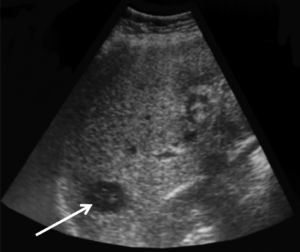
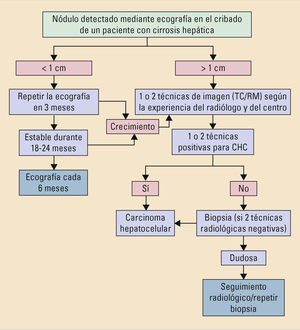
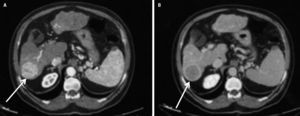
La aplicación de programas de vigilancia con ecografía en poblaciones de riesgo permite detectar el CHC en estadio precoz. El diagnóstico se establece mediante técnicas de imagen como la tomografía computarizada y la resonancia magnética, o mediante estudio anatomopatológico.

Tratamiento

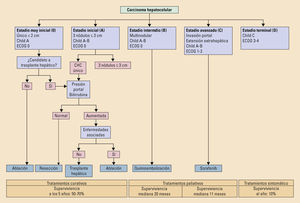
Basándose en variables clínicas y tumorales, los pacientes con CHC se clasifican en estadios que permiten orientar el tratamiento más apropiado en cada caso.

Palabras clave
Carcinoma hepatocelular
Cirrosis hepática
Clasificación BCLC
Abstract
Epidemiology

Hepatocellular carcinoma (HCC) is one of the most important tumors because of its frequency and association with a high morbidity and mortality. It is the third most common cause of cancer-related death and usually develops in patients with cirrhosis or advanced stages of fibrosis.

Etiology

Hepatitis C virus, hepatitis B virus and alcohol are the main causes of cirrhosis and HCC, although aflatoxins are another important cause worldwide, mostly in developing countries. By contrast, in developed countries non alcoholic fatty liver disease is an emerging cause of HCC.

Diagnostic

Surveillance programs with ultrasound have been developed in order to detect HCC at an early stage in at risk population. Diagnosis is established with imagine techniques such as computer tomography and magnetic resonance, or by histological exam.

Treatment

A patient classification system that takes into account clinical variables and tumor characteristics allows clinicians to apply the most appropriated treatment to each patient.

Keywords
Hepatocellular carcinoma
Liver cirrhosis
BCLC staging

Identifíquese

¿Aún no es suscriptor de la revista?

Comprar el acceso al artículo

Comprando el artículo el pdf del mismo podrá ser descargado

Teléfono para incidencias

De lunes a viernes de 9h a 18h (GMT+1) excepto los meses de julio y agosto que será de 9 a 15h

Llamadas desde España 932 415 960
Llamadas desde fuera de España +34 932 415 960
Bibliografía
[1]
F.X. Bosch, J. Ribes, M. Díaz, R. Cléries.
Primary liver cancer: worldwide incidence and trends.
Gastroenterology, (2004), 127 pp. S5-S16
[2]
A.
201606060003099513
Forner, C. Ayuso, M.I. Real, J. Sastre, R. Robles, B. Sangro, et al.
Diagnóstico y tratamiento del carcinoma hepatocelular.
Med Clin., (2009), 132 pp. 272-287
[3]
A.
201606060003099514
Forner, J.M. Llovet, J. Bruix.
Hepatocellular carcinoma.
Lancet, (2012), 379 pp. 1245-1255
[4]
H.I. Yang, M. Sherman, J. Su, P.J. Chen, Y.F. Liaw, U.H. Iloeje, et al.
Nomograms for risk of hepatocellular carcinoma in patients with chronic hepatitis B virus infection.
J ClinOncol, (2010), 28 pp. 2437-2444
[5]
J.M.
201606060003099515
Llovet, M. Ducreux.
EASL-EORTC Clinical Practice Guidelines: Management of hepatocellular carcinoma.
J Hepatol, (2012), 56 pp. 908-943
[6]
J.
201606060003099516
Bruix, M. Sherman.
AASLD Practice Guideline. Management of hepatocellular carcinoma: an update.
Hepatology, (2011), 53 pp. 1020-1022
[7]
R.F. Velázquez, M. Rodríguez, C.A. Navascués, A. Linares, R. Pérez, N.G. Sotorríos, et al.
Prospective analysis of risk factors for HCC in patients with liver cirrhosis.
Hepatology, (2003), 37 pp. 520-527
[8]
F. Degos, C. Christidis, N. Ganne-Carrie, J.P. Farmachidi, C. Degott, C. Guettier, et al.
Hepatitis C virus related cirrhosis: time to occurrence of hepatocellular carcinoma and death.
Gut., (2000), 47 pp. 131-136
[9]
A.S. Lok, L.B. Seeff, T.R. Morgan, A.M. di Bisceglie, R.K. Sterling, T.M. Curto, et al.
Incidence of hepatocellular carcinoma and associated risk factors in hepatitis C-related advanced liver disease.
Gastroenterology, (2009), 136 pp. 138-148
[10]
H.B. El-Serag, T. Tran, J.E. Everhart.
Diabetes increases the risk of chronic liver disease and hepatocellular carcinoma.
Gastroenterology, (2004), 126 pp. 460-468
[11]
R.
201606060003099517
Cabrera, R. Nelson.
Review article: the management of hepatocellular carcinoma.
Aliment Pharmacol Ther., (2009), 31 pp. 461-476
[12]
A. Sangiovanni, E. Del Ninno, P. Fasani, C. De Fazio, G. Ronchi, R. Romeo, et al.
Increased survival of cirrhotic patients with a hepatocellular carcinoma detected during surveillance.
Gastroenterology, (2004), 126 pp. 1005-1014
[13]
L. Bolondi, S. Sofia, S. Siringo, S. Gaiani, A. Casali, G. Zironi, et al.
Surveillance programme of cirrhotic patients for early diagnosis and treatment of hepatocellular carcinoma: a cost effectiveness analysis.
Gut., (2001), 48 pp. 251-259
[14]
K.
201606060003099518
Kulik, A. Chokechanachaisakul.
Evaluation and management of hepatocellular carcinoma.
Clin Liver Dis., (2015), 19 pp. 23-43
[15]
A. Singal, M.L. Volk, A. Waljee, R. Salgia, P. Higgins, M.A. Rogers, et al.
Meta-analysis: surveillance with ultrasound for early-stage HCC in patients with cirrhosis.
Aliment Pharmacol Ther, (2009), 30 pp. 37-47
[16]
A.M. Di Bisceglie, R.K. Sterling, R.T. Chung, J.E. Everhart, J.L. Dienstag, H.L. Bonkovsky, et al.
Serum alpha-fetoprotein levels in patients with advanced hepatitis C: results from the HALT-C Trial.
J Hepatol, (2005), 43 pp. 434-441
[17]
V. Santi, F. Trevisani, A. Gramenzi, A. Grignaschi, F. Mirici-Cappa, P. Del Poggio, et al.
Semiannual surveillance is superior to annual surveillance for the detection of early hepatocellular carcinoma and patient survival.
J Hepatol, (2010), 53 pp. 291-297
[18]
J.C. Trinchet, C. Chaffaut, V. Bourcier, F. Degos, J. Henrion, H. Fontaine, et al.
Ultrasonographic surveillance of hepatocellular carcinoma in cirrhosis: A randomized trial comparing 3- and 6-month periodicities.
Hepatology, (2011), 54 pp. 1987-1997
[19]
A. Forner, R. Vilana, C. Ayuso, L. Bianchi, M. Solé, J.R. Ayuso, et al.
Diagnosis of hepatic nodules 20mm or smaller in cirrhosis: Prospective validation of then on invasive diagnostic criteria for hepatocellular carcinoma.
Hepatology, (2008), 47 pp. 97-104
[20]
R. Vilana, A. Forner, L. Bianchi, A. García-Criado, J. Rimola, C.R. de Lope, et al.
Intrahepatic peripheral cholangiocarcinoma in cirrhosis patients may display a vascular pattern similar to hepatocellular carcinoma on contrast enhanced ultrasound.
Hepatology, (2010), 51 pp. 2020-2029
[21]
K.A. McGlynn, R.E. Tarone, H.B. El-Serag.
A comparison of trends in the incidence of hepatocellular carcinoma and intrahepatic cholangiocarcinoma in the United States.
Cancer Epidemiol Biomarkers Prev., (2006), 15 pp. 1198-1203
[22]
J. Bruix, M. Sherman, J.M. Llovet, M. Beaugrand, R. Lencioni, A.K. Burroughs, et al.
Clinical management of hepatocellular carcinoma. Conclusions of theBarcelona-2000 EASL conference. European Association for the Study of the Liver.
J Hepatol, (2001), 35 pp. 421-430
[23]
A.
201606060003099519
Forner, M.E. Reig, C. Rodríguez de Lope, J. Bruix.
Current strategy for staging and treatment: the BCLC update and future prospects.
Semin Liver Dis., (2010), 30 pp. 61-74
[24]
U. Cillo, A. Vitale, F. Grigoletto, F. Farinati, A. Brolese, G. Zanus, et al.
Prospective validation of the Barcelona Clinic Liver Cancer staging system.
J Hepatol, (2006), 44 pp. 723-731
[25]
M. Omata, R. Tateishi, H. Yoshida, S. Shiina.
Treatment of hepatocellular carcinoma by percutaneous tumor ablation methods: Ethanol injection therapy and radiofrequency ablation.
Gastroenterology, (2004), 127 pp. S159-S166
[26]
V. Mazzaferro, E. Regalia, R. Doci, S. Andreola, A. Pulvirenti, F. Bozzetti, et al.
Liver transplantation for the treatment of small hepatocellular carcinomas in patients with cirrhosis.
N Engl J Med., (1996), 334 pp. 693-699
[27]
J.M. Llovet, J. Bruix.
Molecular targeted therapies in hepatocellular carcinoma.
Hepatology, (2008), 48 pp. 1312-1327
[28]
A. Villanueva, J.M. Llovet.
Targeted therapies for hepatocellular carcinoma.
Gastroenterology, (2011), 140 pp. 1410-1426
[29]
S. Shiina, T. Teratani, S. Obi, S. Sato, R. Tateishi, Fujishima, et al.
A randomized controlled trial of radiofrequency ablation with ethanol injection for small hepatocellular carcinoma.
Gastroenterology, (2005), 129 pp. 122-130
[30]
J.M. Llovet, J. Bruix.
Systematic review of randomized trials for unresectable hepatocellular carcinoma: Chemoembolization improves survival.
Hepatology, (2003), 37 pp. 429-442
[31]
C. Camma, F. Schepis, A. Orlando, M. Albanese, L. Shahied, F. Trevisani, et al.
Transarterial chemoembolization for unresectable hepatocellular carcinoma: meta-analysis of randomized controlled trials.
Radiology, (2002), 224 pp. 47-54
[32]
C.M. Lo, H. Ngan, W.K. Tso, C.L. Liu, C.M. Lam, R.T. Poom, et al.
Randomized controlled trial of transarterial lipiodol chemoembolization for unresectable hepatocellular carcinoma.
Hepatology, (2002), 35 pp. 1164-1171
[33]
R. Salem, R.J. Lewandowski, L. Kulik, E. Wang, A. Riaz, R.K. Ryu, et al.
Radioembolization results in longer time-to-progression and reduced toxicity compared with chemoembolization in patients with hepatocellular carcinoma.
Gastroenterology, (2011), 140 pp. 497-507
[34]
J.M.
2016060600030995110
Llovet, S. Ricci, V. Mazzaferro, P. Hilgard, E. Gane, J.F. Blanc, et al.
Sorafenib in advanced hepatocellular carcinoma.
N Engl J Med., (2008), 359 pp. 378-390
[35]
A.L. Cheng, Y.K. Kang, Z. Chen, C.J. Tsao, S. Qin, J.S. Kim, et al.
Efficacy and safety of sorafenib in patients in the Asia-Pacific region with advanced hepatocellular carcinoma: a phase III randomized, double-blind, placebo-controlled trial.
Lancet Oncol, (2009), 10 pp. 25-34