

Vol. 14. Núm. 56.
Páginas 3409-3419 (Mayo 2026)

Actualización
Virus del papiloma humano: verrugas genitales, displasia anal y cáncer anal

Human papillomavirus: genital warts, anal dysplasia, and anal cancer

A.G. García-Ruiz de MoralesM. Rosas Cancio-SuárezR. Navarro-SolerM. Suárez-RoblesM.D. Corbacho-LoarteD. Gayoso-CanteroC.M. CanoJ. Díaz-ÁlvarezS. Moreno
Doi : https://10.1016/j.med.2026.06.001
Opciones
Resumen

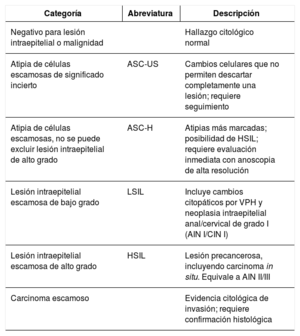
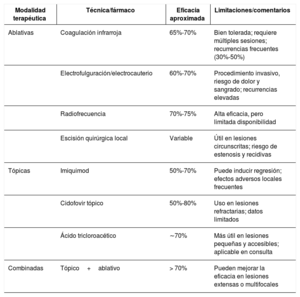
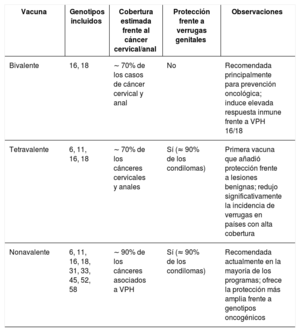
El virus del papiloma humano (VPH) es la infección de transmisión sexual (ITS) más frecuente, y la causa principal de verrugas genitales, lesiones intraepiteliales de alto grado y cáncer anal. El diagnóstico se basa en la citología (sistema Bethesda), la detección molecular de genotipos de alto riesgo y la anoscopia de alta resolución que permite identificar y tratar lesiones precancerosas en poblaciones de riesgo. El tratamiento de las verrugas genitales incluye agentes tópicos y procedimientos destructivos locales, mientras que las lesiones intraepiteliales de alto grado requieren técnicas ablativas o escisionales para prevenir la progresión a cáncer. El cáncer anal se aborda mediante estrategias combinadas de cirugía, radioterapia y quimioterapia según el estadio. La vacunación frente a genotipos oncogénicos ha demostrado una alta eficacia en la reducción de verrugas y lesiones preneoplásicas, consolidándose como la medida preventiva más efectiva.

Palabras clave
Virus del papiloma humano (VPH)
Verrugas genitales
Cáncer anal
Displasia anal
Vacunación
Abstract

Human papillomavirus (HPV) is the most common sexually transmitted infection (STI) and the leading cause of genital warts, high-grade intraepithelial lesions, and anal cancer. Diagnosis is based on cytology (Bethesda system), molecular detection of high-risk genotypes, and high-resolution anoscopy, which allows for identifying and treating precancerous lesions in at-risk populations. The treatment of genital warts includes topical agents and local destructive procedures, while high-grade intraepithelial lesions require ablative or excisional techniques to prevent progression to cancer. Anal cancer is managed using combined strategies that involve surgery, radiation therapy, or chemotherapy, depending on the stage. Vaccination against oncogenic genotypes has demonstrated high efficacy in reducing warts and preneoplastic lesions and has been established as the most effective preventive measure.

Keywords
Human papillomavirus (HPV)
Genital warts
Anal cancer
Anal dysplasia
Vaccination

Identifíquese

¿Aún no es suscriptor de la revista?

Comprar el acceso al artículo

Comprando el artículo el pdf del mismo podrá ser descargado

Teléfono para incidencias

De lunes a viernes de 9h a 18h (GMT+1) excepto los meses de julio y agosto que será de 9 a 15h

Llamadas desde España 932 415 960
Llamadas desde fuera de España +34 932 415 960
Bibliografía
[1]
L.E. Markowitz
202606240410599918
202606240410599919
, E.R. Unger.
Human papillomavirus vaccination.
New Engl J Med., (2023), 388 pp. 1790-1798
[2]
R.E. Plotzker
2026062404105999110
2026062404105999111
, A. Vaidya, U. Pokharel, E.A. Stier.
Sexually transmitted human papillomavirus: Update in epidemiology, prevention, and management.
Infect Dis Clin North Am., (2023), 37 pp. 289-310
[3]
J.N.E. Jensen
2026062404105999112
2026062404105999113
, G.L. Becker, J.B. Jackson, M.B. Rysavy.
Human papillomavirus and associated cancers: A review.
Viruses., (2024), 16 pp. 680
[4]
H. Trottier
2026062404105999114
2026062404105999115
, E.L. Franco.
The epidemiology of genital human papillomavirus infection.
Vaccine., (2006), 24Suppl1 pp. S1-S15
[5]
W. Hanft
2026062404105999116
2026062404105999117
, H.S. Karita, N. Khorsandi, P. Vohra, R. Plotzker.
Sexually transmitted human papillomavirus and related sequelae.
Clin Microbiol Rev., (2025), 38 pp. e0008523
[6]
J. Wolf
2026062404105999118
2026062404105999119
, L.F. Kist, S.B. Pereira, M.A. Quessada, H. Petek, A. Pille, et al.
Human papillomavirus infection: Epidemiology, biology, host interactions, cancer development, prevention, and therapeutics.
Rev Med Virol., (2024), 34 pp. e2537
[7]
V. Bouvard
2026062404105999120
, R. Baan, K. Straif, Y. Grosse, B. Secretan, F. El Ghissassi, et al.
A review of human carcinogens--Part B: biological agents.
Lancet Oncol., (2009), 10 pp. 321-322
[8]
E.M. Kojic
2026062404105999121
2026062404105999122
, L. Conley, T. Bush, S. Cu-Uvin, E.R. Unger, K. Henry, et al.
Prevalence and incidence of anal and cervical High-Risk Human Papillomavirus (HPV) types covered by current HPV vaccines among HIV-infected women in the SUN Study.
J Infect Dis., (2018), 217 pp. 1544-1552
[9]
L. Alemany
2026062404105999123
2026062404105999124
, M. Saunier, I. Alvarado-Cabrero, B. Quirõs, J. Salmeron, H.R. Shin, et al.
Human papillomavirus DNA prevalence and type distribution in anal carcinomas worldwide.
Int J Cancer., (2015), 136 pp. 98-107
[10]
E.A. Van Dyne
2026062404105999125
2026062404105999126
, S.J. Henley, M. Saraiya, C.C. Thomas, L.E. Markowitz, V.B. Benard.
Trends in human papillomavirus–associated cancers — united states, 1999-2015.
MMWR Morb Mortal Wkly Rep., (2019), 67 pp. 918-924
[11]
NIH
2026062404105999127
2026062404105999128
. National Cancer Institute n.d. https://seer.cancer.gov/statfacts/.
[12]
E. Marra
2026062404105999129
2026062404105999130
, A. Kovaleva, S.M. Bruisten, W. Vermeulen, A. Boyd, M.F. Schim Van Der Loeff.
Incidence and clearance of anal high-risk human papillomavirus infections and their determinants over 5 years among human immunodeficiency virus–negative men who have sex with men.
Clinical Infectious Diseases., (2019), 68 pp. 1556-1565
[13]
G.M. Clifford
2026062404105999131
2026062404105999132
, D. Georges, M.S. Shiels, E.A. Engels, A. Albuquerque, I.M. Poynten, et al.
A meta-analysis of anal cancer incidence by risk group: Toward a unified anal cancer risk scale.
Int J Cancer., (2020), 148 pp. 38
[14]
J.M. Palefsky
2026062404105999133
2026062404105999134
, J.Y. Lee, N. Jay, S.E. Goldstone, T.M. Darragh, H.A. Dunlevy, et al.
Treatment of anal high-grade squamous intraepithelial lesions to prevent anal cancer.
New Engl J Med., (2022), 386 pp. 2273-2282
[15]
M.T. Faber
2026062404105999135
2026062404105999136
, K. Frederiksen, J.M. Palefsky, S.K. Kjaer.
Risk of anal cancer following benign anal disease and anal cancer precursor lesions: A Danish Nationwide Cohort Study.
Cancer Epidemiol Biomarkers Prev., (2020), 29 pp. 185-192
[16]
W.C. Mathews
2026062404105999137
2026062404105999138
, W. Agmas, E.R. Cachay, B.C. Cosman, C. Jackson.
Natural history of anal dysplasia in an HIV-infected clinical care cohort: Estimates using multi-state markov modeling.
PLoS One, (2014), 9 pp. e104116
[17]
G.C. Lee
2026062404105999139
2026062404105999140
, H. Kunitake, H. Milch, L.R. Savitt, C.E. Stafford, L.G. Bordeianou, et al.
What is the risk of anal carcinoma in patients with anal intraepithelial neoplasia III?.
Dis Colon Rectum., (2018), 61 pp. 1350-1356
[18]
E.A. Stier
2026062404105999141
2026062404105999142
, M.A. Clarke, A.A. Deshmukh, N. Wentzensen, Y. Liu, I.M. Poynten, et al.
International Anal Neoplasia Society's consensus guidelines for anal cancer screening.
Int J Cancer., (2024), 154 pp. 1694-1702
[19]
R.W. Temple
2026062404105999143
2026062404105999144
, J.C.L. Larker, J.M. Brus.
Genital warts: Rapid evidence review.
Am Fam Physician., (2025), 111 pp. 156-162
[20]
V.W. Jongen
2026062404105999145
2026062404105999146
, O. Richel, E. Marra, M.L. Siegenbeek van Heukelom, A. van Eeden, H.J.C. de Vries, et al.
Anal squamous intraepithelial lesions (SILs) in human immunodeficiency virus-positive men who have sex with men: Incidence and risk factors of SIL and of progression and clearance of low-grade SILs.
J Infect Dis., (2020), 222 pp. 62-73
[21]
M. Steben
2026062404105999147
2026062404105999148
, S.M. Garland.
Genital warts.
Best Pract Res Clin Obstet Gynaecol., (2014), 28 pp. 1063-1073
[22]
K.A. Workowski
2026062404105999149
2026062404105999150
, L.H. Bachmann, P.A. Chan, C.M. Johnston, C.A. Muzny, I. Park, et al.
Sexually transmitted infections treatment guidelines, 2021.
MMWR Recommendations and Reports., (2021), 70 pp. 1
[23]
A. Gudur
2026062404105999151
2026062404105999152
, D. Shanmuganandamurthy, Z. Szep, J. Lucas Poggio.
An update on the current role of high resolution anoscopy in patients with anal dysplasia.
Anticancer Res., (2019), 39 pp. 17-23
[24]
L.F. Barroso
2026062404105999153
2026062404105999154
, E.A. Stier, R. Hillman, J. Palefsky.
Anal cancer screening and prevention: Summary of evidence reviewed for the 2021 Centers for Disease Control and Prevention Sexually transmitted infection guidelines.
Clinical Infectious Diseases, (2022), 74 pp. S179-S192
[25]
A.B. Benson
2026062404105999155
2026062404105999156
, A.P. Venook, M.M. Al-Hawary, N. Azad, Y.J. Chen, K.K. Ciombor, et al.
Anal carcinoma, Version 2.2023.
JNCCN., (2023), 21 pp. 653-677
[26]
T.B. Pedersen
2026062404105999157
2026062404105999158
, F.R. Pachler, J. Rosenberg, K. Andresen.
Interventions for anal canal intraepithelial neoplasia.
Cochrane Database Syst Rev, (2025), 8
[27]
J. Burgos
2026062404105999159
2026062404105999160
, A. Curran, J. Garcia, D. Campany, V. Descalzo, P. Suanzes, et al.
Effectiveness of electrocautery, topical cidofovir and topical sinecatechins for the treatment of anal high-grade squamous intraepithelial lesions in persons with HIV: an open-label, randomized controlled trial.
Clin Infect Dis., (2025),
[28]
E.P.F. Chow
2026062404105999161
, A. Carter, T. Vickers, C.K. Fairley, A. McNulty, R.J. Guy, et al.
Effect on genital warts in Australian female and heterosexual male individuals after introduction of the national human papillomavirus gender-neutral vaccination programme: an analysis of national sentinel surveillance data from 2004-18.
Lancet Infect Dis., (2021), 21 pp. 1747-1756
[29]
M.K. Ellingson
2026062404105999162
2026062404105999163
, H. Sheikha, K. Nyhan, C.R. Oliveira, L.M. Niccolai.
Human papillomavirus vaccine effectiveness by age at vaccination: A systematic review.
Hum Vaccin Immunother., (2023), 19