
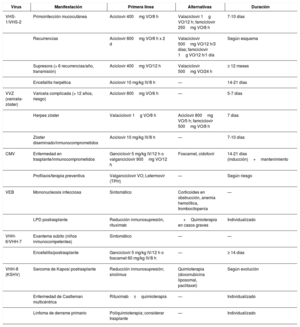

Las infecciones por virus del herpes humano (VHH) representan una causa importante de morbilidad global, especialmente en pacientes inmunocomprometidos. El tratamiento depende del virus implicado y de la manifestación clínica. Aciclovir, valaciclovir y famciclovir constituyen la base terapéutica frente al virus herpes simple (VHS-1, VHS-2) y al virus de la varicela zóster, reservándose el aciclovir intravenoso para cuadros graves o diseminados. Las infecciones por citomegalovirus se tratan principalmente con ganciclovir o valganciclovir, quedando foscarnet y cidofovir para cepas resistentes;. En el trasplante, se recomiendan estrategias profilácticas o preventivas con valganciclovir y letermovir. El virus de Epstein-Barr suele cursar de forma autolimitada, aunque complicaciones como la enfermedad linfoproliferativa postrasplante requieren una reducción de inmunosupresión y tratamiento con rituximab. Los VHH-6 y VHH-7 generalmente causan cuadros leves, pero pueden provocar encefalitis grave en pacientes trasplantados, con tratamiento basado en ganciclovir o foscarnet. El VHH-8 se asocia al sarcoma de Kaposi (herpesvirus asociado al sarcoma de Kaposi —KSHV—), la enfermedad de Castleman multicéntrica y el linfoma de derrame primario que requieren inmunomodulación, quimioterapia o rituximab, aunque el papel de los antivirales sigue siendo limitado. En conjunto, el abordaje terapéutico se basa en el virus causal, el estado inmunitario del huésped y la gravedad clínica, con antivirales, inmunomoduladores y terapias dirigidas como pilares principales.
Human herpesvirus (HHV) infections are a major cause of global morbidity, especially in immunocompromised patients. Treatment depends on the virus involved and the clinical presentation. Acyclovir, valacyclovir, and famciclovir form the therapeutic foundation for herpes simplex virus (HSV-1, HSV-2) and varicella-zoster virus, with intravenous acyclovir reserved for severe or disseminated cases. Cytomegalovirus infections are primarily treated with ganciclovir or valganciclovir, with foscarnet and cidofovir for resistant strains. In transplantation, prophylactic or preventive strategies with valganciclovir and letermovir are recommended. Epstein-Barr virus usually has a self-limiting course, although complications such as post-transplant lymphoproliferative disease require a reduction in immunosuppression and treatment with rituximab. Human herpesviruses (HHV) 6 and 7 generally cause mild symptoms, but can cause severe encephalitis in transplanted patients; treatment is based on ganciclovir or foscarnet. Human herpesvirus 8 (HHV-8, KSHV) is associated with Kaposi's sarcoma, multicentric Castleman disease, and primary effusion lymphoma which require immunomodulation, chemotherapy, or rituximab, although the role of antivirals remains limited. Overall, the therapeutic approach is based on the causative virus, the host's immune status, and clinical severity. The mainstays of treatment are antivirals, immunomodulators, and targeted therapies.
Identifíquese
¿Aún no es suscriptor de la revista?

Comprar el acceso al artículo
Comprando el artículo el pdf del mismo podrá ser descargado
Teléfono para incidencias
De lunes a viernes de 9h a 18h (GMT+1) excepto los meses de julio y agosto que será de 9 a 15h
