

Vol. 14. Núm. 59.
Páginas 3669-3674 (Junio 2026)

Protocolos de práctica asistencial
Protocolo diagnóstico y terapéutico de las parasitosis con afectación hepática y/o biliar

Diagnostic and treatment protocol for parasitosis that affect the liver and/or biliary tract

L. Suárez-HormigaC. Betancort-PlataC. Carranza-RodríguezC. Lavilla-SalgadoN. Jaén-SánchezJ.L. Pérez-Arellano
Doi : https://10.1016/j.med.2026.06.033
Opciones
Resumen

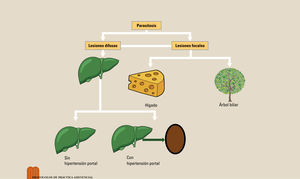
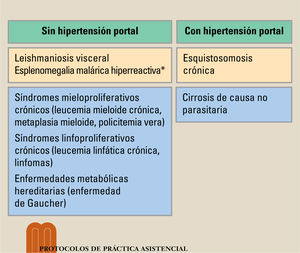
El hígado y las vías biliares, clave en el metabolismo y eliminación de toxinas, pueden ser afectados por diversas parasitosis, generando desde cuadros asintomáticos hasta enfermedades graves. Su rica vascularización favorece la diseminación sistémica de los parásitos y su conexión con el bazo puede provocar esplenomegalia por hipertensión portal (HTP). Las lesiones se clasifican en difusas (como hepatomegalia o citólisis) y focales (abscesos o quistes), causadas por invasión directa, obstrucción, respuesta inmune o depleción celular. Entre las parasitosis difusas sin HTP destacan la malaria y la leishmaniosis visceral, mientras que la esquistosomiasis se asocia típicamente a HTP. Echinococcus granulosus y Entamoeba histolytica producen lesiones hepáticas focales. Varios parásitos pueden afectar el sistema biliar, provocando colangitis o colecistitis. En concreto, algunos trematodos como Fasciola spp., Clonorchis spp. y Opisthorchis spp. pueden dar lugar a una colangitis crónica y evolucionar a cirrosis. El diagnóstico se basa en la detección de huevos en heces, la serología, la reacción en cadena de la polimerasa y los estudios de imagen. El tratamiento incluye antiparasitarios y cirugía o endoscopia.

Palabras clave
Lesiones hepáticas difusas
Lesiones hepáticas focales
Colecistitis
Colangitis
Abstract

The liver and biliary tract, which play a key role in metabolism and toxin elimination, can be affected by various parasitic infections. They can generate anything from asymptomatic conditions to severe diseases. Their rich vascularization facilitates systemic dissemination of the parasites and their connection to the spleen can lead to splenomegaly due to portal hypertension. Lesions are classified as diffuse (such as hepatomegaly or cytolysis) and focal (abscesses or cysts) and they are caused by direct invasion, obstruction, immune response, or cellular depletion. Among diffuse parasitic infections without portal hypertension, malaria and visceral leishmaniasis stand out, while schistosomiasis is typically associated with portal hypertension. Echinococcus granulosus and Entamoeba histolytica cause focal liver lesions. Several parasites can affect the biliary system, causing cholangitis or cholecystitis. Specifically, some trematodes such as Fasciola spp., Clonorchis spp., and Opisthorchis spp. can give rise to chronic cholangitis and progress to cirrhosis. The diagnosis is based on the detection of eggs in feces, serology, polymerase chain reaction, and imaging studies. Treatment includes antiparasitic drugs and surgery or endoscopy.

Keywords
Diffuse liver lesions
Focal liver lesions
Cholecystitis
Cholangitis

Identifíquese

¿Aún no es suscriptor de la revista?

Comprar el acceso al artículo

Comprando el artículo el pdf del mismo podrá ser descargado

Teléfono para incidencias

De lunes a viernes de 9h a 18h (GMT+1) excepto los meses de julio y agosto que será de 9 a 15h

Llamadas desde España 932 415 960
Llamadas desde fuera de España +34 932 415 960
Bibliografía
[1]
S. Ekpanyapong
202607080411251768
202607080411251769
, K.R. Reddy.
Fungal and parasitic infections of the liver.
Gastroenterol Clin North Am., (2020), 49 pp. 379-410
[2]
K.H. Herbinger
2026070804112517610
, I. Hanus, T.W. Felbinger, C. Weber, M. Beissner, F. von Sonnenburg, et al.
Elevated values of clinically relevant transferases induced by imported infectious diseases: A controlled cross-sectional study of 14,559 diseased german travelers returning from the tropics and subtropics.
Am J Trop Med Hyg., (2016), 95 pp. 481-487
[3]
E.E. Elmakki
2026070804112517611
2026070804112517612
.
Hyper-reactive malarial splenomegaly syndrome (HMSS).
Cureus., (2012), 4 pp. e72
[4]
N. Badwaik
2026070804112517613
2026070804112517614
, P. Gharde, R.K. Shinde, H. Tayade, P.S. Navandhar, M. Patil.
Hydatid cyst or echinococcosis: A comprehensive review of transmission, clinical manifestations, diagnosis, and multidisciplinary treatment.
Cureus., (2024), 16 pp. e63713
[5]
A. Govindasamy
2026070804112517615
2026070804112517616
, P.R. Bhattarai, J. John.
Liver cystic echinococcosis: a parasitic review.
Ther Adv Infect Dis., (2023), 10
[6]
M. Agholi
2026070804112517617
, H.R. Heidarian, M. Moghadami, G.R. Hatam.
First detection of acalculous cholecystitis associated with Sarcocystis infection in a patient with AIDS.
Acta Parasitol., (2014), 59 pp. 310-315
[7]
H. Araki
2026070804112517618
, S. Shimizu, K. Hayashi, T. Yamada, A. Kusakabe, H. Kanie, et al.
Acute acalculous cholecystitis caused by Giardia lamblia.
Intern Med., (2017), 56 pp. 1657-1662
[8]
S.S. Rana
2026070804112517619
2026070804112517620
, D.K. Bhasin, M. Nanda, K. Singh.
Parasitic infestations of the biliary tract.
Curr Gastroenterol Rep., (2007), 9 pp. 156-164
[9]
Y. Li
2026070804112517621
, W. Yixi, Q. Dengzeng, R. Yibi, K. Liu.
Biliary taeniasis: Case series and literature review.
Am J Trop Med Hyg., (2024), 110 pp. 868-873
[10]
J.C. Yombi
2026070804112517622
, C.M. Meuris, A.M. Van Gompel, M. Ben Younes, B.C. Vandercam.
Acalculous cholecystitis in a patient with Plasmodium falciparum infection: a case report and literature review.
J Travel Med., (2006), 13 pp. 178-180
[11]
G. Raptou
2026070804112517623
, I. Pliakos, P. Hytiroglou, S. Papavramidis, G. Karkavelas.
Severe eosinophilic cholangitis with parenchymal destruction of the left hepatic lobe due to hydatid disease.
Pathol Int., (2009), 59 pp. 395-398
[12]
D. Harrington
2026070804112517624
2026070804112517625
, P.H.L. Lamberton, A. McGregor.
Human liver flukes.
Lancet Gastroenterol Hepatol., (2017), 2 pp. 680-689
[13]
J.Y. Chai
2026070804112517626
2026070804112517627
, B.K. Jung.
General overview of the current status of human foodborne trematodiasis.
Parasitology., (2022), 149 pp. 1262-1285