

Vol. 14. Núm. 54.
Páginas 3325-3331 (Mayo 2026)

Protocolos de práctica asistencial
Protocolo de manejo de la infección por Clostridioides difficile

Protocol for the management of Clostridioides difficile infection

M.D. Corbacho-LoarteabA.G. García-Ruiz de MoralesabM. Rosas Cancio-SuárezabM. Suárez-RoblesabJ. Díaz-ÁlvarezabC.M. CanoabR. Navarro-SolerabD. Gayoso-CanteroabS. Morenoab
Doi : https://10.1016/j.med.2026.04.024
Opciones
Resumen

La infección por Clostridioides difficile (ICD) es la principal causa de diarrea asociada a la asistencia sanitaria en países desarrollados, con una incidencia significativa y alto riesgo de recurrencia. En España, la incidencia oscila entre 2 y 4 casos por 10000 estancias, y se han incrementado los casos comunitarios. Su espectro clínico varía desde diarrea leve hasta colitis fulminante, con una recurrencia del 20%-25% tras el primer episodio.

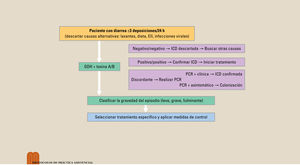
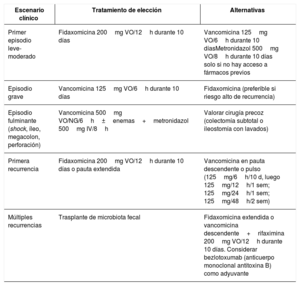
El diagnóstico se realiza mediante la evaluación clínica y la confirmación microbiológica, utilizando enzimoinmunoanálisis (EIA) y reacción en cadena de la polimerasa (PCR). El tratamiento incluye la suspensión de antibióticos innecesarios, el manejo hidroelectrolítico y el uso de fidaxomicina como tratamiento de elección, mientras que la vancomicina se emplea en casos graves. En situaciones de recurrencia múltiple, el trasplante de microbiota fecal es altamente efectivo.

Las medidas preventivas destacan el aislamiento, el lavado de manos y la limpieza con desinfectantes esporicidas y la optimización de los antibióticos ha reducido la incidencia de la ICD. El seguimiento clínico es crucial tras 48-72 horas desde el inicio del tratamiento, y se aconseja la educación a pacientes sobre higiene y riesgo de recurrencia.

Palabras clave
Clostridioides difficile
Colitis pseudomembranosa
Recurrencia
Trasplante de microbiota fecal
Abstract

Clostridioides difficile infection (CDI) is the leading cause of healthcare-associated diarrhea in developed countries, with a significant incidence and high risk of recurrence. In Spain, the incidence ranges from 2 to 4 cases per 10,000 hospital stays and community-acquired cases have increased. Its clinical spectrum ranges from mild diarrhea to fulminant colitis, with a recurrence rate of 20%–25% after the first episode.

The diagnosis is made through clinical evaluation and microbiological confirmation via enzyme-linked immunosorbent assay (ELISA) and polymerase chain reaction (PCR). Treatment includes the discontinuation of unnecessary antibiotics, fluid and electrolyte management, and the use of fidaxomicin as the treatment of choice, while vancomycin is used in severe cases. In cases of multiple recurrences, fecal microbiota transplantation is highly effective.

Preventive measures include isolation, handwashing, and cleaning with sporicidal disinfectants; optimization of antibiotic use has reduced the incidence of CDI. Clinical follow-up is crucial in the 48–72hours after the start of treatment and patient education on hygiene and the risk of recurrence is recommended.

Keywords
Clostridium difficile
Pseudomembranous colitis
Recurrence
Fecal microbiota transplantation

Identifíquese

¿Aún no es suscriptor de la revista?
Comprar el acceso al artículo

Comprando el artículo el pdf del mismo podrá ser descargado

Teléfono para incidencias

De lunes a viernes de 9h a 18h (GMT+1) excepto los meses de julio y agosto que será de 9 a 15h
Llamadas desde España 932 415 960
Llamadas desde fuera de España +34 932 415 960
Bibliografía
[1]
S.B. Debast
202605140410538248
, M.P. Bauer, E.J. Kuijper.
European Society of Clinical Microbiology and Infectious Diseases: update of the treatment guidance document for Clostridium difficile infection.
Clin Microbiol Infect., (2014), 20Suppl2 pp. S1-S26
[2]
L.C. McDonald, D.N. Gerding, S. Johnson, J.S. Bakken, K.C. Carroll, S.E. Coffin, et al.
Clinical practice guidelines for Clostridium difficile infection in adults and children: 2017 Update by the IDSA and SHEA.
Clin Infect Dis., (2018), 66 pp. 987-994
[3]
M.J.T. Crobach
202605140410538249
, T. Planche, C. Eckert, F. Barbut, E.M. Terveer, O.M. Dekkers, et al.
European Society of Clinical Microbiology and Infectious Diseases: update of the diagnostic guidance document for Clostridium difficile infection.
Clin Microbiol Infect., (2016), 22Suppl4 pp. S63-S81
[4]
R. Li, L. Lu, Y. Lin, M. Wang, X. Liu.
Efficacy and safety of metronidazole monotherapy versus vancomycin monotherapy or combination therapy in patients with Clostridium difficile Infection: A systematic review and meta-analysis.
PLoS One., (2015), 10 pp. e0137252
[5]
C.N. Chakra, A. McGeer, A.C. Labbé, A.E. Simor, W.L. Gold, M.P. Muller, et al.
Factors associated with complications of Clostridium difficile infection in a multicenter prospective cohort.
Clin Infect Dis., (2015), 61 pp. 1781-1788
[6]
M.H. Wilcox, D.N. Gerding, I.R. Poxton, C. Kelly, R. Nathan, T. Birch, et al.
Bezlotoxumab for prevention of recurrent Clostridium difficile infection.
N Engl J Med., (2017), 376 pp. 305-317
[7]
J. Suez, N. Zmora, E. Segal, E. Elinav.
The pros, cons, and many unknowns of probiotics.
Nat Med., (2019), 25 pp. 716-729
[8]
S. Di Bella
2026051404105382410
, G. Sanson, J. Monticelli, V. Zerbato, L. Principe, M. Giuffrè, et al.
Clostridioides difficile infection: history, epidemiology, risk factors, prevention, clinical manifestations, treatment, and future options.
Clin Microbiol Rev., (2024), 37
[9]
J.R. Fletcher, C.M. Pike, R.J. Parsons, A.J. Rivera, M.H. Foley, M.R. McLaren, et al.
Clostridioides difficile exploits toxin-mediated inflammation to alter the host nutritional landscape.
Nat Commun., (2021), 12 pp. 6244
[10]
J.E. Buddle, R.P. Fagan.
Pathogenicity and virulence of Clostridioides difficile.
Virulence., (2023), 14 pp. 2156659
[11]
F.C. Lessa, Y. Mu, W.M. Bamberg, Z.G. Beldavs, G.K. Dumyati, J.R. Dunn, et al.
Burden of Clostridium difficile infection in the United States.
N Engl J Med., (2015), 372 pp. 825-834
[12]
European Centre for Disease Prevention and Control (ECDC). Healthcare-associated point prevalence survey of infections and antimicrobial use in acute care hospitals 2022-2023. Disponible en: https://www.ecdc.europa.eu.
[13]
A. Liubakka, B.P. Vaughn.
Clostridium difficile infection and fecal microbiota transplant.
AACN Adv Crit Care., (2016), 27 pp. 324-337
[14]
Y.S. Kim, Y.S. Lee.
Recurrent Clostridium difficile infection: risk factors, treatment, and prevention.
Gut Liver., (2018), 12 pp. 1-10
[15]
J.J. Dawkins, J.R. Allegretti, T.E. Gibson, E. McClure, M. Delaney, L. Bry, et al.
Gut metabolites predict Clostridioides difficile recurrence.
Microbiome., (2022), 10 pp. 87
[16]
S. Khanna, M. Assi, C. Lee, D. Yoho, T. Louie, W. Knapple, et al.
Efficacy and safety of RBX2660 in PUNCH CD3, a phase III, randomized, double-blind, placebo-controlled trial with a bayesian primary analysis for the prevention of recurrent Clostridioides difficile infection.
Drugs., (2022), 82 pp. 1527-1538
[17]
P. Feuerstadt, T.J. Louie, B. Lashner, E.E.L. Wang, L. Diao, J.A. Bryant, et al.
SER-109, an oral microbiome therapy for recurrent Clostridioides difficile Infection.
N Engl J Med., (2022), 386 pp. 220-229
[18]
H. Raeisi, P. Spigaglia, A. Sadeghi, F. Barbanti, G. Tillotson, H. Safarpour, et al.
Risk factors and outcomes of Clostridioides difficile infection in patients with colorectal cancer: critical perspective in management.
Gut Pathog., (2025), 17 pp. 44
[19]
K. Rao
2026051404105382411
, P.N. Malani.
Diagnosis and treatment of Clostridioides (Clostridium) difficile infection in adults in 2020.
JAMA., (2020), 323 pp. 1403-1404
[20]
M. Quan, X. Zhang, Q. Fang.
Fighting against Clostridioides difficile infection: Current medications.
Int J Antimicrob Agents., (2024), 64 pp. 107198
[21]
M. Cranis, A. Elamin, B. Hatch-Vallier, C.D. Collins, A.N. Malani.
Impact of infectious diseases consultation for hospitalized patients with Clostridioides difficile infection.
Infect Control Hosp Epidemiol., (2024), 45 pp. 770-773
[22]
P. Spigaglia.
Clostridioides difficile infection (CDI) during the COVID-19 pandemic.
[23]
B.H. Mullish, L. Martinez-Gili, E. Chekmeneva, G.D.S. Correia, M.R. Lewis, V. Horneffer-Van Der Sluis, et al.
Assessing the clinical value of faecal bile acid profiling to predict recurrence in primary Clostridioides difficile infection.
Aliment Pharmacol Ther., (2022), 56 pp. 1556-1569
[24]
A.C. Miller, A.T. Arakkal, D.K. Sewell, A.M. Segre, J. Tholany, P.M. Polgreen.
CDC MInD-Healthcare Group. Comparison of different antibiotics and the risk for community-associated Clostridioides difficile infection: a case-control study.
Open Forum Infect Dis., (2023), 10 pp. ofad413
[25]
J. Cobo
2026051404105382412
, E. Merino, C. Martínez, A. Cózar-Llistó, E. Shaw, T. Marrodán, et al.
Nosocomial Infection Study Group. Prediction of recurrent Clostridium difficile infection at the bedside: the GEIH-CDI score.
Int J Antimicrob Agents., (2018), 51 pp. 393-398
[26]
S. Johnson.
Recurrent Clostridium difficile infection: risk factors, treatments, and outcomes.
J Infect., (2009), 58 pp. 403-410
[27]
K.M. Mullane, D.J. Winston, A. Nooka, M.I. Morris, P. Stiff, M.J. Dugan, et al.
A randomized, placebo-controlled trial of fidaxomicin for prophylaxis of Clostridium difficile-associated diarrhea in adults undergoing hematopoietic stem cell transplantation.
Clin Infect Dis., (2019), 68 pp. 196-203
[28]
F.A. Zar, S.R. Bakkanagari, Moorthi KMLST, M.B. Davis.
A comparison of vancomycin and metronidazole for the treatment of Clostridium difficile-associated diarrhea, stratified by disease severity.
Clin Infect Dis., (2007), 45 pp. 302-307
[29]
K.Z. Vardakas, K.A. Polyzos, K. Patouni, P.I. Rafailidis, G. Samonis, M.E. Falagas.
Treatment failure and recurrence of Clostridium difficile infection with vancomycin or metronidazole: a systematic review.
Int J Antimicrob Agents., (2012), 40 pp. 1-8
[30]
S. Çetin, M. Uğur.
Clostridioides difficile infections and factors associated with recurrence.
Infect Dis Clin Microbiol., (2024), 6 pp. 268-275
[31]
A.E. Maraolo, M. Mazzitelli, E. Zappulo, R. Scotto, G. Granata, R. Andini, et al.
Oral vancomycin prophylaxis for primary and secondary prevention of Clostridioides difficile infection in patients treated with systemic antibiotic therapy: a systematic review, meta-analysis and trial sequential analysis.
Antibiotics (Basel)., (2022), 11 pp. 183
[32]
M.N. Quraishi, M. Widlak, N. Bhala, D. Moore, M. Price, N. Sharma, et al.
Systematic review with meta-analysis: the efficacy of faecal microbiota transplantation for the treatment of recurrent and refractory Clostridium difficile infection.
Aliment Pharmacol Ther., (2017), 46 pp. 479-493
[33]
R. Escudero-Sánchez, M. Ruíz-Ruizgómez, J. Fernández-Fradejas, S. García Fernández, M. Olmedo Samperio, A. Cano Yuste, et al.
Real-world experience with bezlotoxumab for prevention of recurrence of Clostridioides difficile infection.
J Clin Med., (2020), 10 pp. 2
[34]
C.R. Polage, C.E. Gyorke, M.A. Kennedy, J.L. Leslie, D.L. Chin, S. Wang, et al.
Overdiagnosis of Clostridium difficile infection in the molecular test era.
JAMA Intern Med, (2015), 175 pp. 1792-1801
[35]
C.P. Kelly.
Can we identify patients at high risk of recurrent Clostridium difficile infection?.
Clin Microbiol Infect., (2012), 18Suppl6 pp. 21-27
[36]
S. Khanna, D.S. Pardi.
Clostridium difficile infection: new insights into management.
Mayo Clin Proc., (2012), 87 pp. 1106-1117
[37]
J. Pépin, L. Valiquette, M.E. Alary, P. Villemure, A. Pelletier, K. Forget, et al.
Clostridium difficile-associated diarrhea in a region of Quebec from 1991 to 2003: a changing pattern of disease severity.
CMAJ., (2004), 171 pp. 466-472
[38]
J. Suez, N. Zmora, E. Segal, E. Elinav.
The pros, cons, and many unknowns of probiotics.
Nat Med., (2019), 25 pp. 716-729
[39]
S. Johnson, V. Lavergne, A.M. Skinner, A.J. Gonzales-Luna, K.W. Garey, C.P. Kelly, et al.
Clinical practice guideline by the Infectious Diseases Society of America (IDSA) and Society for Healthcare Epidemiology of America (SHEA): 2021 focused update guidelines on management of Clostridioides difficile infection in adults.
Clin Infect Dis., (2021), 73 pp. e1029-e1044
[40]
S. Kamel, M.D. Corbacho-Loarte, R. Escudero-Sánchez, A. Halperin, S. Llorente, S.M. Quevedo, et al.
Impact of an intervention program on Clostridioides difficile infections: comparison of 2 hospital cohorts.
Open Forum Infect Dis., (2024), 11 pp. ofae390
[41]
M.P. Bauer, E.J. Kuijper, J.T. van Dissel.
European Society of Clinical Microbiology and Infectious Diseases. European Society of Clinical Microbiology and Infectious Diseases (ESCMID): treatment guidance document for Clostridium difficile infection.
Clin Microbiol Infect., (2009), 15 pp. 1067-1079
[42]
L. Daneri, A. Urbano, R. Escudero-Sánchez, A.V. Halperin, A. Moreno-Blanco, M.D. Corbacho, et al.
Lyophilised fecal microbiota transfer in capsules for recurrent Clostridioides difficile infection.
Int J Antimicrob Agents., (2025), 66 pp. 107561
[43]
E. Bouza, J.M. Aguado, L. Alcalá, B. Almirante, P. Alonso-Fernández, M. Borges, et al.
Recommendations for the diagnosis and treatment of Clostridioides difficile infection: an official clinical practice guideline of the Spanish Society of Chemotherapy (SEQ), Spanish Society of Internal Medicine (SEMI) and the working group of Postoperative Infection of the Spanish Society of Anesthesia and Reanimation (SEDAR).
Rev Esp Quimioter., (2020), 33 pp. 151-175