

Vol. 14. Núm. 62.
Páginas 3826-3834 (Septiembre 2026)

Actualización
Deterioro cognitivo y demencia: hacia la detección precoz. Biomarcadores en líquido y pruebas neuropsicológicas digitales. Nuevos tratamientos modificadores de la enfermedad e intervenciones digitales

Cognitive impairment and dementia: toward early detection. Biomarkers in body fluids and digital neuropsychological tests. New disease-modifying treatments and digital interventions

I. Nieto FernándezD.F. Febres PanezE. Espinosa GimenoA. Alises García-MoratoJ. Castillejo NúñezC. Rodríguez Román
Doi : https://10.1016/j.med.2026.09.002
Opciones
Resumen

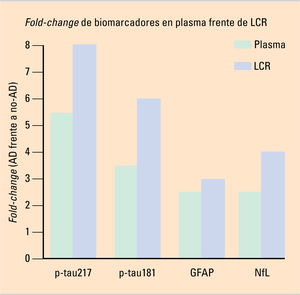
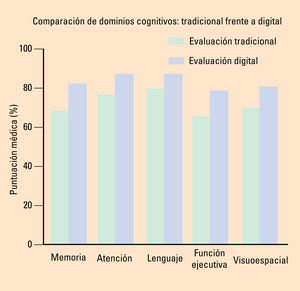
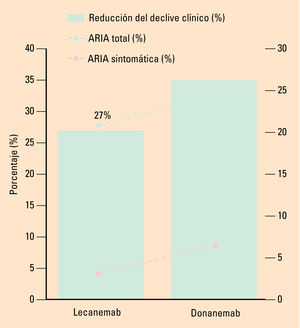
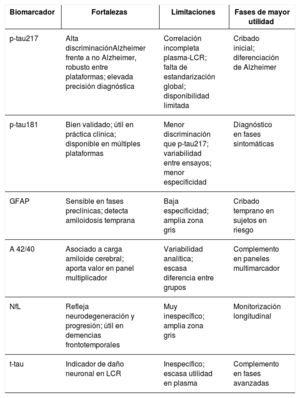
El deterioro cognitivo y la demencia son síndromes neurológicos frecuentes en el envejecimiento, con un impacto creciente en la práctica clínica. Esta actualización revisa los principales avances en la detección y el abordaje del deterioro cognitivo, con especial atención a los biomarcadores y a las herramientas de evaluación cognitiva. Se describen los fundamentos biológicos de las demencias más prevalentes y el papel de los biomarcadores plasmáticos, destacando la tau fosforilada, especialmente p-tau217, junto con GFAP, Aβ42/40 y neurofilamento ligero, como apoyo al diagnóstico y la caracterización etiológica. Asimismo, se analizan las pruebas neuropsicológicas digitales, como el Digital Clock and Recall y el Digital Clock Drawing Test que permiten una evaluación objetiva y estandarizada de distintos dominios cognitivos. Se abordan también los tratamientos modificadores de la enfermedad de Alzheimer actualmente disponibles y las principales intervenciones digitales empleadas en el deterioro cognitivo leve y la demencia.

Palabras clave
Deterioro cognitivo
Enfermedad de Alzheimer
Biomarcadores plasmáticos
Evaluación cognitiva digital
Terapias modificadoras de la enfermedad
Abstract

Cognitive impairment and dementia are common neurological syndromes associated with aging with a growing impact on clinical practice. This update reviews the main advances in the detection and management of cognitive impairment with a special focus on biomarkers and cognitive assessment tools. It describes the biological basis of the most prevalent forms of dementia and the role of plasma biomarkers, highlighting phosphorylated tau (particularly p-tau217) along with GFAP, Aβ42/40, and light neurofilament as aids in diagnosis and etiological characterization. It also analyzes digital neuropsychological tests, such as the Digital Clock and Recall and the Digital Clock Drawing Test, which allow for an objective and standardized assessment of various cognitive domains. The article also discusses currently available disease-modifying treatments for Alzheimer's disease and the main digital interventions used in mild cognitive impairment and dementia.

Keywords
Cognitive impairment
Alzheimer's disease
Plasma biomarkers
Digital cognitive assessment
Disease-modifying therapies

Identifíquese

¿Aún no es suscriptor de la revista?
Comprar el acceso al artículo

Comprando el artículo el pdf del mismo podrá ser descargado

Teléfono para incidencias

De lunes a viernes de 9h a 18h (GMT+1) excepto los meses de julio y agosto que será de 9 a 15h
Llamadas desde España 932 415 960
Llamadas desde fuera de España +34 932 415 960
Bibliografía
[1]
U. Lucca
202610010411230518
, M. Tettamanti, P. Tiraboschi, G. Logroscino, C. Landi, L. Sacco, et al.
Incidence of dementia in the oldest-old and its relationship with age: the Monzino 80-plus population-based study.
Alzheimers Dement., (2020), 16 pp. 472-481
[2]
T.J. Montine
202610010411230519
, M.M. Corrada, C. Kawas, S. Bukhari, L.R. White, L. Tian, et al.
The 90+ Study. Association of cognition and dementia with neuropathologic changes of Alzheimer disease and other conditions in the oldest-old.
Neurology., (2022), 99 pp. e1067-e1078
[3]
G. Logroscino
2026100104112305110
, M. Piccininni, C. Graff, O. Hardiman, A.C. Ludolph, F. Moreno, et al.
FRONTIERS Group. Incidence of syndromes associated with frontotemporal lobar degeneration in 9 European countries.
JAMA Neurol, (2023), 80 pp. 279-286
[4]
L. Chouliaras
2026100104112305111
, A. Thomas, M. Malpetti, P. Donaghy, J. Kane, E. Mak, et al.
Differential levels of plasma biomarkers of neurodegeneration in Lewy body dementia, Alzheimer's disease, frontotemporal dementia and progressive supranuclear palsy.
J Neurol Neurosurg Psychiatry., (2022), 93 pp. 651-658
[5]
M. Wu
2026100104112305112
2026100104112305113
, J. Feng, R. Sun, S. Zhang, Y. Zhang, F. Yang, et al.
Validity and usability for digital cognitive assessment tools to screen for mild cognitive impairment: a randomized crossover trial.
J Neuroeng Rehabil., (2025), 22 pp. 132
[6]
H. Ding
2026100104112305114
, C. Lyu, C. Karjadi, P. Sunderaraman, C.B. Young, E.C. Mormino, et al.
Association of the digital clock drawing test with amyloid and tau PET biomarkers in low age risk adults.
Sci Rep., (2025), 15 pp. 11104
[7]
J.D. Doecke
2026100104112305115
2026100104112305116
, G. Bellomo, L. Vermunt, D. Alcolea, S. Halbgebauer, S. in ‘t Veld, et al.
Diagnostic performance of plasma Aβ42/40 ratio, p-tau181, GFAP, and NfL along the continuum of Alzheimer's disease and non-AD dementias: an international multi-center study.
Alzheimers Dement (N Y)., (2025), 21 pp. e14573
[8]
C.H. van Dyck
2026100104112305117
2026100104112305118
, C.J. Swanson, P. Aisen, R.J. Bateman, C. Chen, M. Gee, et al.
Lecanemab in early Alzheimer's disease.
N Engl J Med., (2023), 388 pp. 9-21
[9]
Q. Hu
2026100104112305119
, X. Zhou, Z. Xiao, Q. Zhao, D. Ding, J. Zhang.
White matter injury, plasma Alzheimer's disease, and neurodegenerative biomarkers on cognitive decline in community-dwelling older adults: a 10-year longitudinal study.
Alzheimers Dement., (2025), 21 pp. e14594
[10]
N.J. Ashton
2026100104112305120
, A. Keshavan, W.S. Brum, U. Andreasson, B. Arslan, M. Droescher, et al.
The Alzheimer's Association Global Biomarker Standardization Consortium (GBSC) plasma phospho-tau Round Robin study.
Alzheimers Dement., (2025), 21 pp. e14508
[11]
L. Yu
2026100104112305121
, L. Du, T. Wang, L.L. Barnes, J.L. Dage, K.A. Russ, et al.
Neuropathologic correlates of distinct plasma biomarker profiles in community-living older adults.
Brain., (2025), 148 pp. 3340-3349
[12]
C.R. Vanderlip
2026100104112305122
2026100104112305123
, C.E.L. Stark.
Integrating plasma p-tau217 and digital cognitive assessments for early detection in Alzheimer's disease.
Alzheimers Dement., (2025), 21 pp. e70355
[13]
M. Ogos
2026100104112305124
, D. Stary, M. Bajda.
Recent advances in the search for effective anti-Alzheimer's drugs.
Int J Mol Sci., (2024), 26 pp. 157
[14]
J.R. Sims
2026100104112305125
2026100104112305126
, J.A. Zimmer, C.D. Evans, M. Lu, P. Ardayfio, J. Sparks, et al.
Donanemab in early symptomatic Alzheimer disease: the TRAILBLAZER-ALZ 2 randomized clinical trial.
JAMA., (2023), 330 pp. 512-527
[15]
J.L. Cummings
2026100104112305127
2026100104112305128
, Y. Zhou, G. Lee, K. Zhong, J. Fonseca, A.M. Leisgang-Osse, et al.
Alzheimer's disease drug development pipeline: 2025.
Alzheimers Dement (N Y)., (2025), 11 pp. e70098
[16]
U.S. Food and Drug
2026100104112305129
Administration.
Leqembi (lecanemab-irmb) injection: prescribing information.
FDA, (2023 Jul 6),
[17]
Q. Wang
2026100104112305130
, S. Chen, J. Wang, H. Shang, X. Chen.
Advancements in pharmacological treatment of Alzheimer's disease: the advent of disease-modifying therapies (DMTs).
Brain Sci., (2024), 14 pp. 990
[18]
X. Lin
2026100104112305131
2026100104112305132
, G. Xu, M. Zhao, Y. Jiang.
Efficacy of different digital interventions in patients with mild cognitive impairment or dementia: a systematic review and network meta-analysis.
Int J Nurs Stud., (2025), 169 pp. 105129
[19]
H.S. Jeong
2026100104112305133
2026100104112305134
, Y.W. Lee, T.G. Rhee, S.R. Shim.
Efficacy of digital therapeutic applications for cognitive training among older adults with mild cognitive impairment or dementia: a systematic review and network meta-analysis of randomized controlled trials.
Psychiatry Res., (2025), 348 pp. 116426
[20]
Q. Yang
2026100104112305135
2026100104112305136
, L. Zhang, F. Chang, H. Yang, B. Chen, Z. Liu.
Virtual reality interventions for older adults with mild cognitive impairment: systematic review and meta-analysis of randomized controlled trials.
J Med Internet Res., (2025), 27 pp. e59195
[21]
M.G. Maggio
2026100104112305137
, R. Maione, M. Cotelli, P. Bonasera, F. Corallo, G. Pistorino, et al.
Cognitive rehabilitation using virtual reality in subjective cognitive decline and mild cognitive impairment: a systematic review.
Front Psychol., (2025), 16 pp. 1641693
[22]
T. Papaioannou
2026100104112305138
, A. Voinescu, K. Petrini, D. Stanton Fraser.
Efficacy and moderators of virtual reality for cognitive training in people with dementia and mild cognitive impairment: a systematic review and meta-analysis.
J Alzheimers Dis., (2022), 88 pp. 1341-1370
[23]
M.B. Kale
2026100104112305139
2026100104112305140
, N. Wankhede, R. Pawar, S. Ballal, R. Kumawat, M. Goswami, et al.
AI-driven innovations in Alzheimer's disease: integrating early diagnosis, personalized treatment, and prognostic modelling.
Ageing Res Rev., (2024), 101 pp. 102497
[24]
R. Li
2026100104112305141
, X. Wang, K. Lawler, S. Garg, Q. Bai, J. Alty.
Applications of artificial intelligence to aid early detection of dementia: a scoping review on current capabilities and future directions.
J Biomed Inform., (2022), 127 pp. 104030
[25]
M. Al-Rajab
2026100104112305142
, J. Lu, S. Amawi, N. Elmehalawy, B. Babillie, Y. Alasmi, et al.
A smart secure virtual reality immersive application for Alzheimer's and dementia patients.
Sci Rep., (2025), 15 pp. 30584